

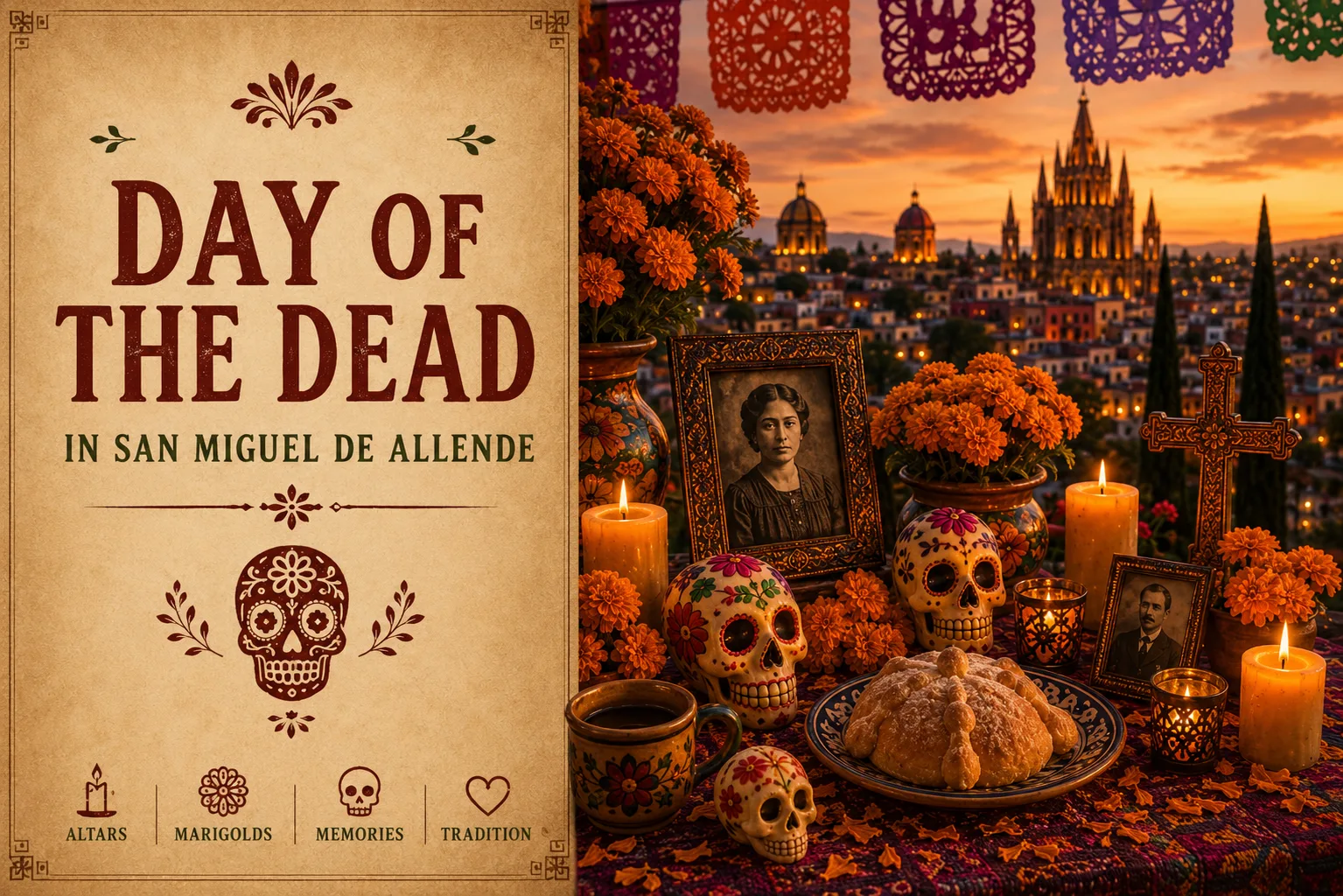
You're likely in one of two places right now. You're either planning a first visit and trying to separate the meaningful parts of Day of the Dead in San Miguel de Allende from the usual tourist shorthand, or you're considering a home here and want to know what the city feels like during its most important cultural celebration.
Both questions matter, because this isn't a festival you understand by booking a rooftop dinner and watching a parade go by. It unfolds across streets, plazas, doorways, and cemeteries. It changes tone from one day to the next. It also reveals something essential about San Miguel itself. This city knows how to hold beauty, ritual, community life, and public celebration all at once.
For a visitor, that means better planning and better choices. For a future resident, it offers a clear window into neighborhood character, walkability, noise, social rhythms, and the kind of civic life you'd be joining.
Table of Contents
- An Invitation from the Spirits
- Understanding Día de los Muertos in San Miguel
- A Three-Day Calendar of Events and Traditions
- Where to Experience the Magic A Neighborhood Guide
- Visitor Etiquette and Practical Tips
- Luxury Stays Dining and Curated Experiences
- The Resident Experience Living with the Celebration
An Invitation from the Spirits
The first surprise for many newcomers is emotional, not logistical. The name sounds solemn, but the lived experience in San Miguel de Allende isn't heavy in the way outsiders often expect. At night, candlelight softens stone facades, music carries across plazas, and families move through the streets in groups that include grandparents, children, and everyone in between.
In San Miguel, Day of the Dead is celebrated as reunion. Families clean and decorate graves, pray together, and stay close to one another. In the cemeteries, people don't arrive as isolated mourners. They arrive as households. According to a detailed local travel account, multigenerational families line up to clean, water, decorate, and pray at graves, often bringing wheelchairs and strollers so everyone can take part, while evening plazas fill with free shows, mariachi, dancing, concerts, movies, and food carts serving tacos, tamales, and gorditas (local celebration details in San Miguel).
That combination explains why the holiday leaves such a strong impression on people considering life here. It's public, but not performative. It's festive, but not detached from meaning. Children dressed up for candy can be part of the same evening that brings families to a cemetery gate with flowers and candles.
Day of the dead in San Miguel de Allende isn't built around spectacle alone. The spectacle rests on family memory.
For the discerning visitor, the best approach is to arrive with curiosity and enough structure to avoid treating the city as one large stage set. For the prospective resident, pay attention to how neighborhoods behave after sunset, how easily people walk, where processions gather, and where local life feels most rooted. Those details tell you as much about San Miguel as any property showing will.
Understanding Día de los Muertos in San Miguel
At dusk in San Miguel, a first-time visitor may see marigolds, candlelight, and painted faces and assume the city is staging a beautiful festival. A future resident notices something else. Which streets quiet down for family gatherings, which plazas fill with public altars, and which neighborhoods keep their local character even as the crowds arrive.
Why the atmosphere feels different
Día de los Muertos in San Miguel follows a sacred sequence, not a generic event calendar. The observance unfolds from October 31 through November 2, with each day carrying a different emotional weight inside homes, churches, cemeteries, schools, and public spaces.
That structure matters on the ground. Visitors who schedule every night the same way usually miss the shift from anticipation to remembrance to communal celebration. Residents understand the rhythm instinctively, and it shapes how the city moves after dark.
The deeper point is continuity. This is not a festival created for tourism, even though tourism now surrounds it. It is a long-held Mexican tradition expressed through local family practice, Catholic observance, indigenous memory, and neighborhood participation. For buyers considering San Miguel seriously, that distinction says a great deal about the city. Culture here is lived, not installed for a weekend.
For a broader sense of how these annual rhythms shape local life, the guide to festivals in San Miguel de Allende gives useful year-round context.
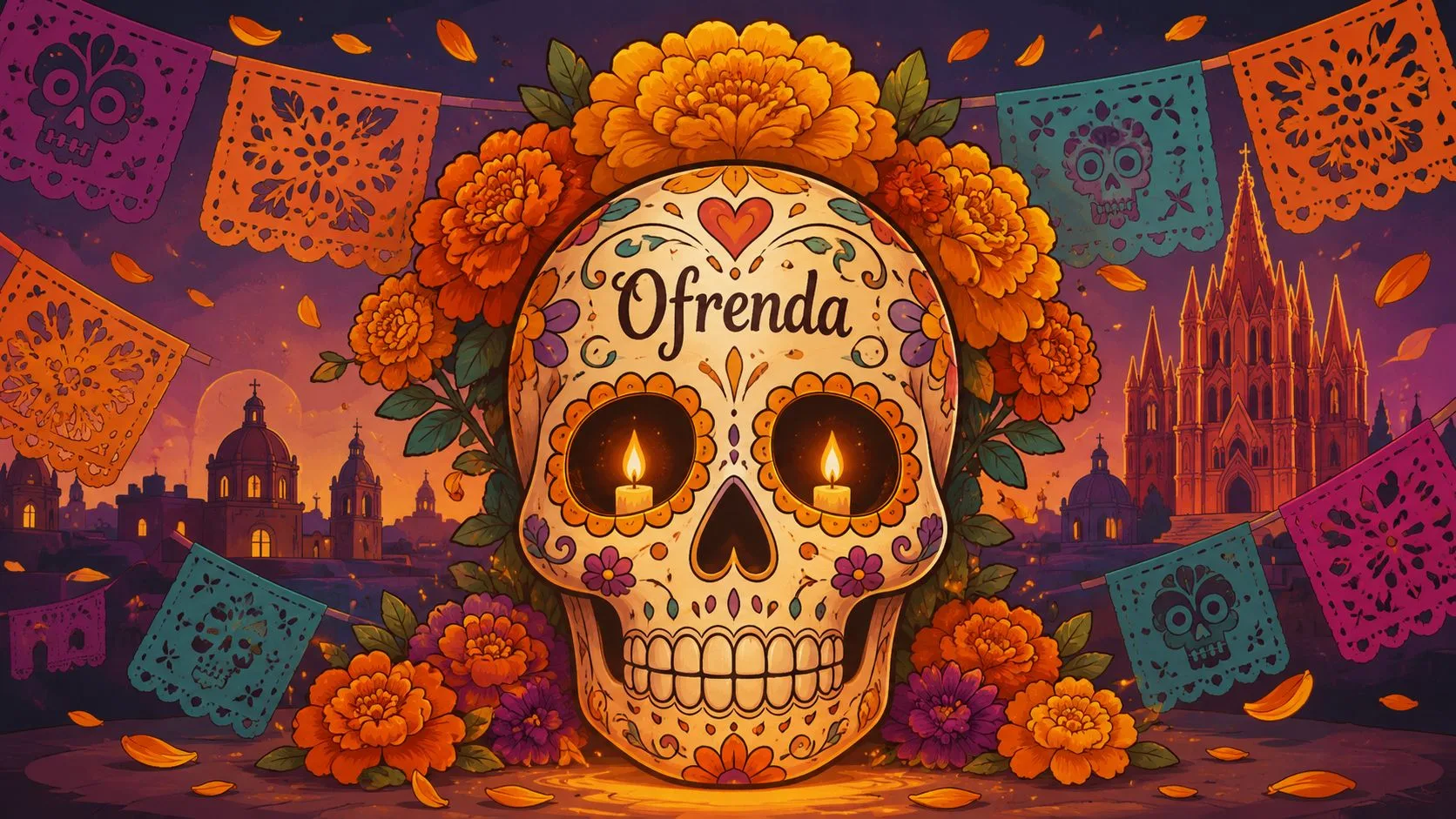
How to read an ofrenda
The ofrenda is the clearest expression of the holiday's meaning. It is not party décor. It is a temporary place of welcome for the dead, built with intention and usually with a specific person or family line in mind.
Read the altar closely:
- Photographs identify who is being remembered.
- Favorite foods and drinks show care, familiarity, and hospitality.
- Candles mark presence and guide the way.
- Marigolds and other flowers create color, scent, and ritual focus.
- Personal objects often reveal more than any label could.
Understanding San Miguel is clarified by examining its altars. An altar in a boutique hotel, a private courtyard, or a neighborhood plaza may look equally beautiful, but they do not all serve the same purpose. Some are devotional. Some are educational. Some are civic presentations. Knowing the difference helps a visitor respond with respect, and it helps a prospective homeowner see which parts of the city still operate from local custom rather than pure performance.
Practical rule: Pause before photographing an ofrenda, and take a moment to understand who is being honored and whether the setting feels public or personal.
A short visual primer helps if you want a quick orientation before walking the city:
Where Halloween ends and San Miguel begins
San Miguel can hold both Halloween and Día de los Muertos at once, especially in the more international parts of town. Children may be in costume, restaurants may host themed dinners, and the streets can feel playful. The deeper current remains remembrance.
That is why skulls, candles, and Catrina makeup here carry a different charge than they do in a typical costume setting. They point to mortality, memory, family lineage, and social ritual. For visitors, the trade-off is simple. Enjoy the public energy, but do not treat every altar, cemetery, or procession as entertainment. For residents, especially those choosing between Centro, Guadiana, San Antonio, or Atascadero, this period reveals how each neighborhood balances tourism, tradition, walkability, and daily life.
San Miguel rewards people who read the celebration with care.
A Three-Day Calendar of Events and Traditions
Arrive on the wrong day, or even at the wrong hour, and you can misread San Miguel's Day of the Dead completely. I tell clients the same thing every year. This celebration has a sequence, and the sequence matters if you want a meaningful visit or if you are using the holiday to judge how a neighborhood lives under pressure.
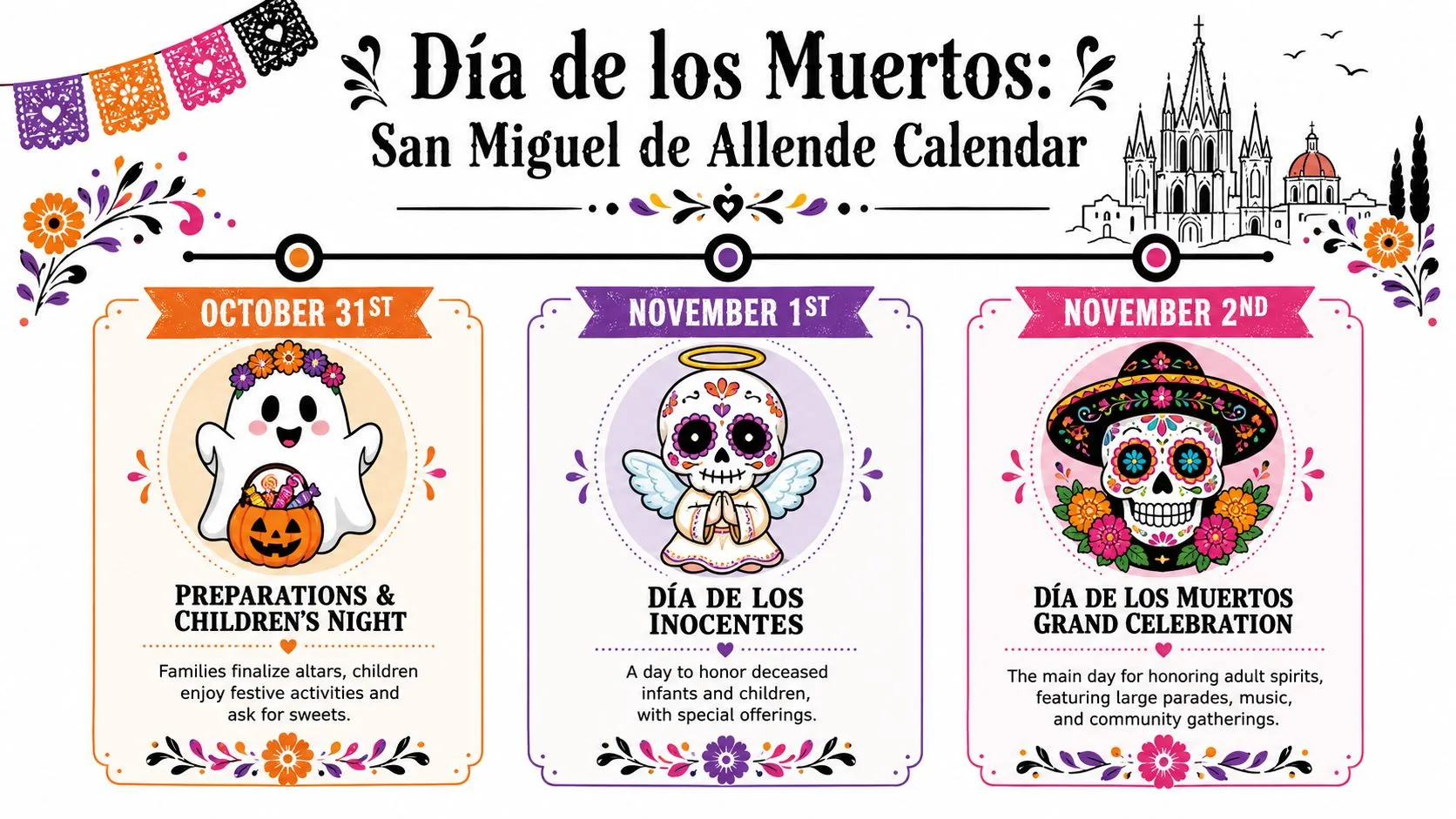
A useful distinction comes from a guide that addresses a common visitor mistake. It separates the quieter observances tied to children on November 1 from the more public, music-filled atmosphere that builds on November 2, a shift many travelers miss when planning their stay (guide to the holiday's timing and tone).
October 31 and arrival energy
October 31 is a setup day, but not a minor one. The city begins to gather visual force. Altars are being finished, marigolds appear in greater volume, and the streets start to fill with families, children, and returning visitors who know the rhythm of the week.
Use this day to get oriented. Walk Centro before dusk. Pass through side streets rather than only the main square. If you want a calmer first look, route part of your afternoon through the paths around Benito Juárez Park in San Miguel de Allende, then head back toward the center as the city grows busier.
The trade-off is simple. October 31 rewards observation more than scheduling. People who pack the evening with reservations and timed stops usually spend it in traffic, in crowds, or checking their phones instead of noticing what is taking shape around them.
A practical approach for October 31:
- Arrive before late afternoon so hotel check-in or luggage does not interfere with evening street activity.
- Stay on foot once you are central because road closures and congestion build quickly.
- Scout key routes in daylight if you plan to attend events after dark.
- Keep dinner plans flexible since the city's pace starts to change by the hour.
November 1 and the quieter register
November 1 carries a gentler emotional tone. Families honor children and young souls, and the city often feels more reflective than festive, even when public spaces remain active and visually rich.
This is usually the better day for visitors who want to see details instead of spectacle. Public altars can be appreciated more slowly. Cemetery visits call for restraint, patience, and enough maturity to understand that your experience is secondary to the family ritual in front of you. For prospective residents, this day also reveals a lot about neighborhood character. Areas with stronger local family networks tend to feel more inward and less performative.
| Date | Focus | Key Activities and Locations |
|---|---|---|
| October 31 | Preparation and arrival | Final altar work, family gatherings, early evening walks through Centro and decorated streets |
| November 1 | Children and innocents | Offerings, cemetery visits, quieter public observances, reflective viewing in plazas and residential areas |
| November 2 | Adult spirits and all departed | Heavier cemetery activity, music, roaming bands, fuller street celebration and larger public gatherings |
November 1 suits travelers who prefer texture over noise. It also suits buyers who want to study how a street behaves when tradition, foot traffic, and daily life meet.
November 2 and the fullest expression
November 2 brings the broadest public expression of the holiday. Cemeteries are active, music carries farther, and the city feels more communal, audible, and outward-facing. If November 1 asks for a quieter presence, November 2 asks for stamina, good timing, and realistic expectations.
Go out knowing that some spaces will be crowded and lively. A cemetery may include flowers, prayer, conversation, laughter, and musicians in close proximity. That mix can surprise first-time visitors, but in San Miguel it often reflects participation rather than disrespect.
What works well on November 2:
- Pick one main experience such as a cemetery visit, a public altar circuit, or time in the plazas, then allow the rest of the day to unfold naturally.
- Wear proper walking shoes because cobblestones, standing time, and route changes add up fast.
- Eat early or late to avoid the tightest restaurant bottlenecks.
- Build in extra transit time if you are staying outside Centro or considering neighborhoods as a home base.
What usually fails on November 2:
- Driving into the historic center near peak hours
- Expecting quiet contemplation in every cemetery setting
- Booking tightly timed dinner reservations around public activity
- Trying to cover all major zones in one evening
Visitors get a better experience by choosing a lane. Residents do too. If you want the city at its most public and theatrical, November 2 delivers it. If you are evaluating San Miguel as a place to live, pay attention to how different blocks absorb that intensity. The holiday is beautiful, but it is also revealing.
Where to Experience the Magic A Neighborhood Guide
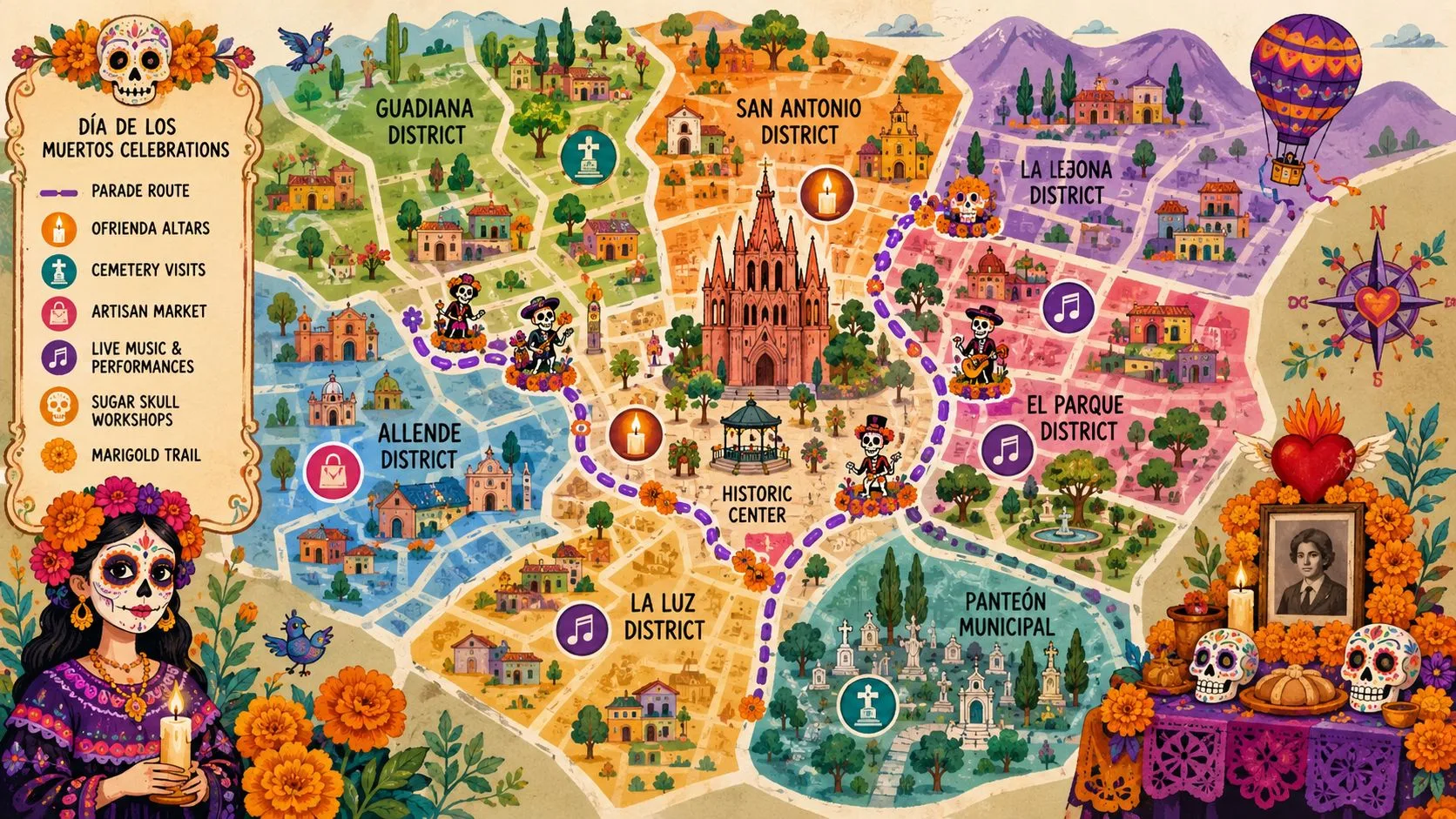
By late afternoon, the choice becomes clear. Stay in the center and accept noise, crowds, and spectacle at your doorstep, or step a few blocks outward and feel the holiday settle into courtyards, side streets, and neighborhood routines. That distinction matters to a visitor planning one memorable evening, and it matters even more to a buyer deciding where San Miguel fits their life.
Centro and El Jardín
Centro gives you the most public, polished, and photogenic version of day of the dead in San Miguel de Allende. Around El Jardín, the holiday plays out in full view through large ofrendas, costumed walkers, passing music, and the steady current of local families, weekend visitors, and international residents. If someone has one evening in town and wants the clearest sense of the city's festival energy, this is the obvious starting point.
The trade-off is straightforward. Centro is exhilarating for a few hours and demanding for a full day. For travelers, that usually means choosing a short list of priorities and staying flexible. For prospective residents, it raises a more personal question. Do you want immediate access to the city's most animated public life, or do you want the option to step into it and then retreat home to quiet?
The parade activity and catrina presence tend to concentrate here, especially along the streets feeding into the historic core. During the holiday, Centro shows San Miguel at its most social and performative. It is the right choice for people who enjoy being in the middle of things, and a poor fit for anyone who values calm over proximity.
San Antonio and Guadiana
San Antonio and Guadiana reveal a different side of the celebration. The scale softens. You notice decorated entries, candles in windows, small altars, and neighbors moving at a familiar pace rather than a festival pace. For many clients I advise, these are the neighborhoods that answer the core question behind a holiday visit. What does San Miguel feel like once the public event becomes everyday life?
That answer is often favorable here. Visitors can walk these streets without committing to the intensity of Centro. Renters get a practical middle ground, close enough to join the main activity and far enough to sleep well. Buyers can judge something more useful than charm alone. They can observe how a neighborhood behaves under pressure, how much street activity carries into the evening, and whether the atmosphere feels communal or intrusive.
Guadiana has another advantage. It offers breathing room near the center. Time in Benito Juárez Park, a favorite green retreat near Guadiana resets the pace before dinner or after a crowded evening in town.
Cemetery visits and nearby residential zones
Cemetery visits call for restraint and good judgment. The experience can be moving, beautiful, and public at the same time, but it is still anchored in family remembrance. Visitors who do well here keep some distance, watch before photographing anything, and follow the tone set by the people who have come to honor their dead.
The surrounding residential zones deserve attention too, especially for anyone assessing walkability and location value. During Día de los Muertos, those blocks tell the truth. You learn which streets stay active late, where pedestrian flow thickens, and how close "close to Centro" feels once processions, music, and evening foot traffic are in motion.
A handsome house can look perfect on a quiet weekday. Festival days give you the better test.
Visitor Etiquette and Practical Tips
Good logistics improve the holiday. Good manners determine whether you experience it with depth or skim across the surface.
How to move through the city well
Walking is usually the smartest decision. During major festival periods, street closures, pedestrian density, and informal slowdowns make cars more burden than advantage in the historic core.
Wear shoes that handle cobblestones without complaint. Bring layers because San Miguel evenings can cool off quickly, especially once you stop moving. Keep your bag compact and your schedule light. The city is much easier to enjoy when you're not hauling purchases, camera gear, and a rigid reservation calendar through packed streets.
A practical checklist helps:
- Choose one central zone per outing instead of bouncing between neighborhoods.
- Build in extra transit time even for short distances.
- Carry cash for smaller purchases because food carts and quick street stops are part of the experience.
- Keep your phone charged if you're meeting others after dark in crowded areas.
For travelers who want a broader read on comfort and common-sense precautions, this local guide on whether San Miguel de Allende is safe is worth reviewing before arrival.
How to be welcome instead of merely present
Photography is where etiquette usually breaks down. Public altars in plazas are one thing. Private ofrendas, family gravesites, and emotionally charged moments are another.
Ask before photographing people in intimate settings. If the answer isn't clear, don't take the photo. You'll remember the moment without collecting it. The same rule applies to private doorways and residential altars. Admire them, but don't treat someone's threshold as a set piece.
A few standards separate thoughtful visitors from careless ones:
- Lower your voice in cemeteries, especially on quieter visits.
- Don't touch altar elements unless explicitly invited.
- Avoid blocking narrow streets for posed photos during procession hours.
- Respect children's participation without turning them into costumes for your camera roll.
Local standard: Curiosity is welcome. Intrusion isn't.
The city is generous during these days. Return that generosity by moving with humility.
Luxury Stays Dining and Curated Experiences
For travelers with high standards, Day of the Dead in San Miguel de Allende is less about finding “luxury” in the abstract and more about choosing the right location, pace, and access strategy.
Where premium location matters
The strongest luxury stays during this period tend to do one of two things well. They either place you close enough to walk into the heart of the celebration without relying on a car, or they provide enough calm and service infrastructure that returning from the crowds feels restorative instead of inconvenient.
Properties around Centro offer immediacy. You can step into the evening, watch the city gather, and return on foot. The trade-off is noise, density, and less separation from the festivities. Hotels slightly outside the tightest core can feel more composed, but only if they still allow practical access.
For travelers comparing premium options, a closer look at the Rosewood San Miguel de Allende is useful because it illustrates the appeal of a polished base near the center without requiring total immersion at every hour.
Dining choices that work during festival days
During these dates, dinner strategy matters as much as restaurant quality.
The best approach is to decide what role the meal plays in your evening:
- Anchor dinner before the main activity if you want certainty and calm.
- Choose a late, flexible meal if you plan to follow the city's rhythm first.
- Use rooftops selectively because they offer atmosphere, but they can also distance you from what's happening at street level.
What works well is a restaurant with a reliable kitchen, strong service, and an address that doesn't require complicated transport once roads fill. What works less well is chasing the most talked-about table across town during peak procession time.
A discerning visitor usually does better with one polished reservation and one intentionally casual night. The casual night matters because food carts, tamales, tacos, and street snacks are part of the social fabric of the celebration, not an inferior substitute for a formal meal.
When a private experience is worth arranging
Private guidance can be worthwhile during this holiday, but only if it adds context, not insulation. A good local guide helps you understand timing, etiquette, neighborhood routes, and the distinction between what should be observed discreetly and what can be enjoyed more openly.
The same goes for workshops or curated cultural access. An altar-making experience, a thoughtful neighborhood walk, or a locally informed cemetery visit can deepen the trip. A forced “VIP” version that shields you from the city usually diminishes it.
The strongest luxury choice here is discernment. Comfort should support immersion, not replace it.
The Resident Experience Living with the Celebration
The difference between visiting and living in San Miguel becomes visible during this holiday. A visitor asks where to go. A resident asks how the neighborhood feels when the city is fully itself.
What ownership feels like during festival week
Residents don't experience Day of the Dead as a backdrop. They live inside the preparation. Local groups of teens cutting and assembling brightly colored tissue flowers to decorate ofrendas, cemeteries, and doorways are part of what reinforces the holiday's role in San Miguel's cultural identity and makes it a special time to be a resident, as described in this community account of San Miguel's Day of the Dead preparations.
That detail matters if you're thinking about property ownership. During festival days, you're not just evaluating architecture. You're evaluating how close you want to be to processions, plaza activity, church bells, music, and foot traffic. Some owners want to open the front door and step directly into it. Others want a short walk home to something quieter.

Neighborhood fit matters more than romantic ideas
Festival week is one of the best times to test your assumptions about where you'd want to live.
If you're drawn to Centro, ask yourself whether you enjoy activity as part of daily life or only as a temporary pleasure. If you prefer Guadiana, San Antonio, Ojo de Agua, or a more removed residential setting, consider whether you'd still feel connected enough to the city's ceremonial life. There's no universal answer. There's only fit.
For buyers, this period reveals practical truths quickly:
- Walkability matters more than people expect.
- Street exposure can feel charming or tiring, depending on the block.
- Community participation is easier when neighbors know one another.
- Distance from the center changes the holiday from immersive to optional.
Owning in San Miguel is never only about the house. It's about your relationship to the city's rituals, noise, beauty, and public life. Day of the Dead makes that visible in a way no brochure can.
If you're considering a move, a second home, or a lifestyle investment in San Miguel de Allende, Inside San Miguel offers informed guidance grounded in how the city is lived. For buyers who want more than listings, and who care about neighborhood character as much as architecture, it's a strong place to begin.