

You're probably in one of two places right now. Either you've visited San Miguel de Allende once and can't stop thinking about it, or you haven't visited yet but you're staring at listings, reading forums, and wondering whether this city could work for your retirement.
That's the right question. Not “Can I buy a house there?” You probably can. The key question is whether the lifestyle fits you when the honeymoon wears off. Retirement homes in San Miguel de Allende aren't just about architecture, terraces, or whether the kitchen has Talavera tile. They're about how you want to live on a Tuesday morning, who you want around you, how much walking you're willing to do, and what kind of support you may need later.
San Miguel rewards clarity. If you choose the right neighborhood and the right property type, retirement here can feel rich, social, and manageable. If you choose badly, you'll spend your time fighting hills, noise, stairs, or a home that looked romantic online but doesn't suit your body or your routine. That's what this guide is for.
Table of Contents
- Why Retire in San Miguel de Allende
- Finding Your Perfect Colonia Neighborhood Profiles for Retirees
- Property Types and Typical Price Bands
- Healthcare and Wellness for a Secure Retirement
- The Legal and Financial Path to Ownership
- Partnering with a Boutique Realtor for Success
- Your Essential Moving and Residency Checklist
- Common Questions and Your Next Steps
Why Retire in San Miguel de Allende
A lot of retirees start with the same fantasy. Morning coffee in a courtyard. Bells from a nearby church. A short walk to lunch, a gallery opening later, maybe dinner with friends who also decided they wanted more life and less obligation.
San Miguel de Allende can deliver that. But the deeper reason people stay isn't the postcard beauty. It's the rhythm. The city gives retirees something many places don't. Daily life feels active without feeling frantic.
San Miguel de Allende had a population of 174,615 in the 2020 census, which is part of why it works so well for retirement. It's big enough to support services, dining, culture, and an international community, but still small enough to feel personal and socially navigable, as shown in Data México's profile of San Miguel de Allende. That balance matters when you're building a new life, not just changing your address.
What retirement looks like here
Some retirees want stimulation. Others want calm. San Miguel handles both, if you choose carefully.
You can live in the historic core and walk to cafés, language classes, concerts, and dinner. Or you can live in a quieter colonia and come into town when you want energy, then go home to silence. That flexibility is a major strength of retirement homes in San Miguel de Allende. You don't have to buy one version of retirement.
Practical rule: If your retirement depends on walking to most of your life, choose location before charm.
There's also a strong social advantage here. Newcomers can build community faster in San Miguel than in many resort towns or suburban retirement markets because there's an established mix of local life, international residents, arts activity, and shared routines. You don't have to manufacture a social life from scratch.
Why retirees keep narrowing in on San Miguel
People often compare San Miguel with beach towns and larger Mexican cities. My view is simple. If you want a place where retirement feels cultural, walkable, visually beautiful, and socially alive, San Miguel is hard to beat. If your top priority is flat terrain, anonymous modernity, or driving everywhere, it may not be your place.
Before you buy, get realistic about your monthly lifestyle costs, not just home price. A useful starting point is this guide to San Miguel de Allende cost of living. It helps frame the day-to-day side of retirement, which is where good decisions are made.
Finding Your Perfect Colonia Neighborhood Profiles for Retirees
In San Miguel, neighborhood choice is lifestyle choice. I've seen buyers fall in love with a house and then realize they picked the wrong daily life. Don't do that. Pick the rhythm first, then the property.
This visual comparison is a helpful starting point.
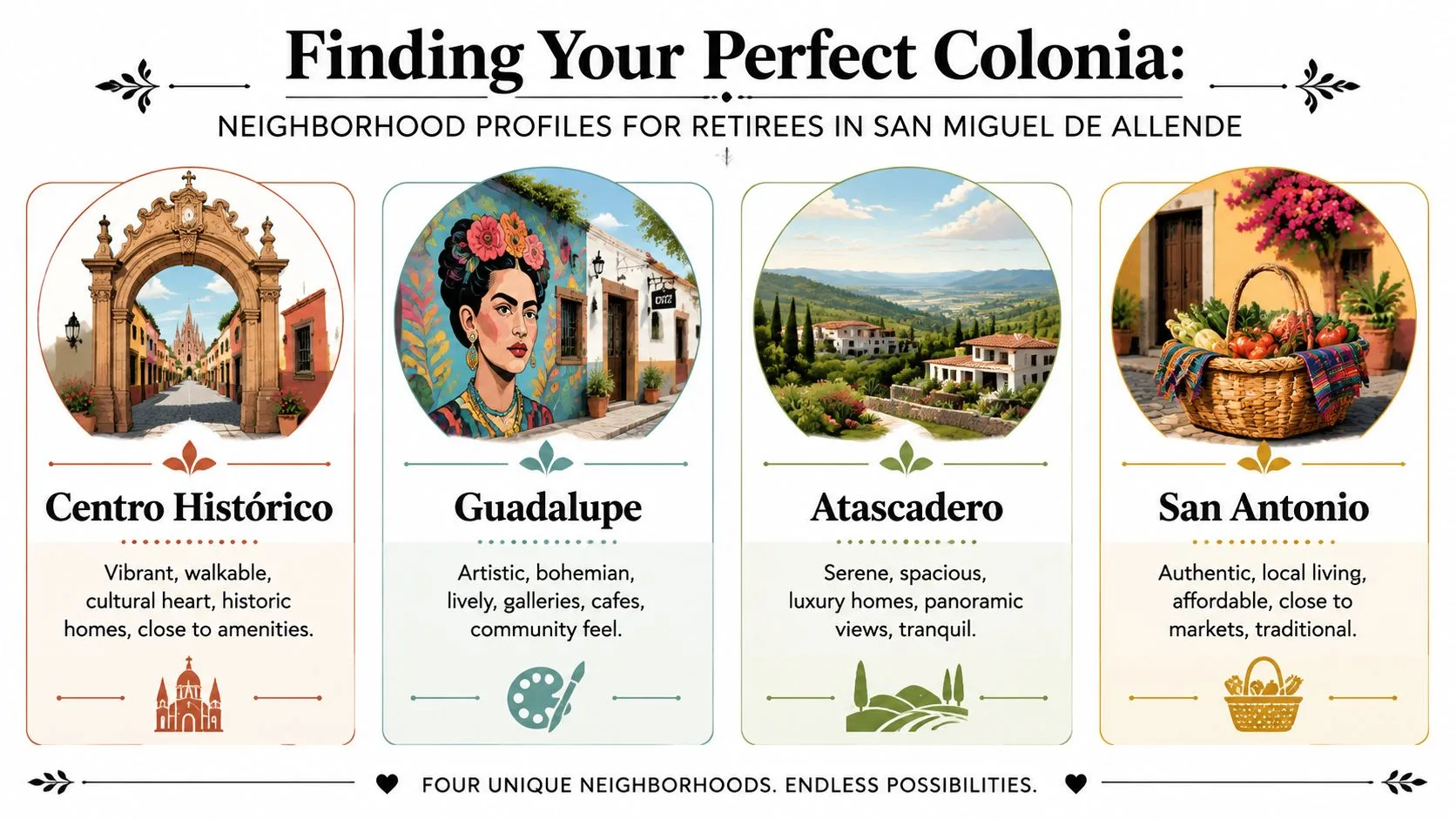
Centro Histórico
Centro is for retirees who want to be in the middle of things. If you want to step outside and feel the city immediately, this is the obvious choice. Historic homes, roof terraces, courtyards, restaurants, churches, galleries, and constant visual beauty. It's intoxicating.
It's also not for everyone. Streets can be noisy. Sidewalks can be uneven. Many homes have stairs, split levels, and charming design features that stop being charming when your knees disagree. Buyers who choose Centro well usually accept those tradeoffs because they value walkability and cultural access above quiet and ease.
Best fit for:
- Walkers: You want to do most errands on foot.
- Culture lovers: You care about galleries, restaurants, events, and architecture.
- Part-time drivers: You'd rather not depend on a car daily.
San Antonio
San Antonio feels more lived-in. It has a practical, neighborhood texture that many retirees prefer after they've spent a few weeks in Centro. You still get access to cafés, markets, and community, but the atmosphere is less performative and often more relaxed.
This area works especially well for retirees who want a balance of local life and expat familiarity. You'll find homes ranging from older, simple properties to updated casitas and newer builds. For many foreign buyers, San Antonio is the sweet spot because it doesn't ask you to choose between convenience and authenticity.
To get a better visual feel for the city, this video offers useful context before you start touring neighborhoods.
Guadiana
Guadiana is where many serious retirees end up after they've seen enough of the town to know what lasts. It tends to appeal to buyers who want calm streets, greenery, and proximity to town without being in the center of the performance.
Homes here often attract buyers who care about comfort over drama. Less noise. More settled feeling. Strong appeal for full-time living. If you want to host friends, keep a garden, and still get into town without making it a project, Guadiana deserves a close look.
Ojo de Agua and Balcones
These areas are for people who value views and space. The payoff can be spectacular. You can get light, terraces, air, and a stronger sense of retreat. For some retirees, that's the dream.
But be honest about terrain. Hills are real. A house with a gorgeous view can become a house that limits your freedom if you stop enjoying stairs, inclines, or driving. I like Ojo de Agua and Balcones most for buyers who still want visual drama but also know they'll use a car or driver more often.
Some retirees buy a view and accidentally sell their independence.
Gated communities for easier living
If you want less unpredictability, look at gated communities such as Vista Antigua or Ventanas. These often appeal to retirees who want controlled access, more standardized maintenance, and homes built around modern expectations rather than historic quirks.
That doesn't mean they're automatically better. They're better for a certain kind of retirement.
| Area | Daily feel | Typical appeal | Main caution |
|---|---|---|---|
| Centro | Energetic, walkable, beautiful | Historic charm and urban life | Noise, stairs, uneven streets |
| San Antonio | Mixed, neighborly, practical | Balanced lifestyle and community feel | Not every block feels the same |
| Guadiana | Quiet, residential, polished | Comfortable full-time living | Fewer dramatic views |
| Ojo de Agua / Balcones | Scenic, elevated, private | Space and outlook | Hills and driving dependence |
| Gated communities | Controlled, orderly, easier logistics | Security and simpler upkeep | Can feel less organic |
If you're choosing among retirement homes in San Miguel de Allende, ask yourself three blunt questions:
- How much do I want to walk every day?
- Do I want energy outside my door, or do I want to visit energy and then leave it?
- Will this location still work if my mobility changes?
Those three answers will usually narrow your search faster than any price filter.
Property Types and Typical Price Bands
A retiree can spend the same amount on two homes and end up with two very different lives. One home gives you easy mornings, simple upkeep, and freedom to leave for a week without worry. The other ties you to stairs, repairs, staff coordination, and rooms you stop using after the novelty wears off.
Start with function, not romance. Your best option depends on how you plan to live in San Miguel every day, and on how simple you want ownership to be as a foreign buyer handling inspections, closing, insurance, and ongoing maintenance from abroad.
Start with the right property type
Historic homes near Centro attract buyers for obvious reasons. They are beautiful, distinctive, and full of character. They also tend to ask more from you. Expect stairs, older systems, interior courtyards, uneven floors, and maintenance that looks charming in photos but feels less charming when you are coordinating plumbers in Spanish.
Single-level casitas usually make more sense for retirees who want comfort without excess. They are easier to maintain, easier to furnish, and easier to adapt later if mobility changes. If you want a practical starting point, review examples of casitas in San Miguel de Allende. This is often the smartest fit for buyers who want style, privacy, and a manageable footprint.
Condos work well for part-time residents and for retirees who want a lock-and-leave setup. Monthly fees matter here, so review them carefully. Ask exactly what they cover, how reserves are funded, whether elevators are reliable, and how guest access and rentals are handled. Foreign buyers often focus on purchase price and ignore carrying costs. That is a mistake.
Larger houses in view neighborhoods or gated communities suit a narrower group than many buyers assume. They fit retirees who host often, want outdoor living, expect long family visits, or value privacy enough to accept more driving and more upkeep. If that is not you, do not buy extra house just because it feels impressive on a showing.
Typical price bands and what usually drives them
Price in San Miguel is not just about size. Lifestyle fit, walkability, condition, views, parking, land, HOA structure, and renovation risk all move the number.
Here is the practical way to frame it:
- Casitas and smaller condos: Often the most accessible entry point for retirees who want independent living with lower upkeep.
- Well-located single-level homes: Usually command a premium because they are easier to live in now and easier to resell later.
- Historic colonial homes: Can range widely. The spread usually reflects location, restoration quality, outdoor space, and how much future work the property will require.
- Larger view homes and gated properties: Often cost more because of lot size, newer construction, parking, amenities, and privacy.
- Managed senior living and assisted living: Budget for monthly operating cost, not just real estate value.
For care-oriented housing, monthly costs rise fast once meals, supervision, transportation, and hands-on support are added. A survey by Insider Monkey on retirement communities in Mexico showed a wide monthly range between independent and assisted living options. That gap matters. If you know support services may be part of your future, build that into your budget now instead of treating it as a distant problem.
Buy for daily ease first. Charm is a bonus, not a plan.
My recommendation by retiree profile
I give clients a simple filter.
Choose a single-level casita or compact home if you want full-time living with manageable responsibilities.
Choose a condo if you plan to travel, split time between countries, or want simpler ownership logistics.
Choose a larger standalone home only if you will fully use the space and are comfortable managing the upkeep, directly or through a trusted property manager.
Choose senior living or assisted living if support, meals, oversight, or future care planning already belongs in the decision.
Foreign buyers should also remember this. The easiest home to own is often the easiest home to buy well. Smaller, clearer properties with clean paperwork, straightforward utilities, and fewer renovation unknowns usually create fewer surprises during due diligence and closing. That matters just as much as the terrace view.
Healthcare and Wellness for a Secure Retirement
You find a beautiful home on a quiet cobblestone street. Then you realize the nearest routine care, pharmacy, and reliable ride are less convenient than you want for real daily life. That is how retirees end up with a house they admire and a lifestyle that wears them down.
Put healthcare and wellness near the top of your buying criteria. In San Miguel, the right retirement home is not just attractive and well located. It supports the way you will live in year one, year five, and year ten.
Build your care plan before you choose the property
Start with your weekly routine, not the listing photos.
Ask yourself four direct questions:
- What medical care do you use now on a regular basis?
- Which services do you want in San Miguel, and which are you comfortable handling in another city if needed?
- Will this home still work if stairs, long walks, or uneven surfaces become harder later?
- How much time and effort are you willing to spend getting to appointments, therapy, pharmacies, and fitness activities?
Those answers should shape the neighborhood and property type you target. A retired couple who walks everywhere has different needs from a solo buyer who wants quick access to support, transportation, and familiar services. A buyer managing a chronic condition should be stricter. Choose convenience over romance.
San Miguel appeals to retirees for more than architecture and weather. It also gives foreign buyers a realistic path to age in place because care options, wellness services, and support networks are already part of daily life here. If you are still comparing destinations, this overview of the best places to retire in Mexico helps put San Miguel in context.
What aging in place actually looks like
Aging in place starts with a home that forgives change.
For active retirees, that may mean a walkable location, a manageable floor plan, and easy access to groceries, classes, and routine care. For solo retirees, community often matters more than square footage. A lock-and-leave condo or a smaller home near friends and services usually beats a larger property that feels isolated. For buyers with existing health concerns, a practical setup wins every time. Single-level living, simple entry, good light, dependable help, and room for a caregiver if needed are smart choices.
Wellness belongs in this decision too. San Miguel makes retirement easier when your normal week includes movement, social contact, fresh food, and manageable stress. That points many buyers toward neighborhoods where they can walk for coffee, get to a class, meet friends without a car, and handle errands without turning every outing into a project.
Here is my advice. If a house makes daily care harder, keep looking. The right retirement home should reduce friction, support your independence, and still make sense on an ordinary Tuesday.
The Legal and Financial Path to Ownership
Foreign buyers usually worry about the wrong thing. They worry that buying in Mexico is vague or risky by default. In San Miguel, the issue is simpler. The process works when you use the right professionals and respect the order of operations.
And there's one important point many buyers don't realize until late in the search. San Miguel de Allende is not in the coastal restricted zone, so foreign buyers can generally hold direct title rather than using the bank trust structure associated with restricted areas. That makes ownership here more straightforward than many people expect.
The purchase sequence that matters
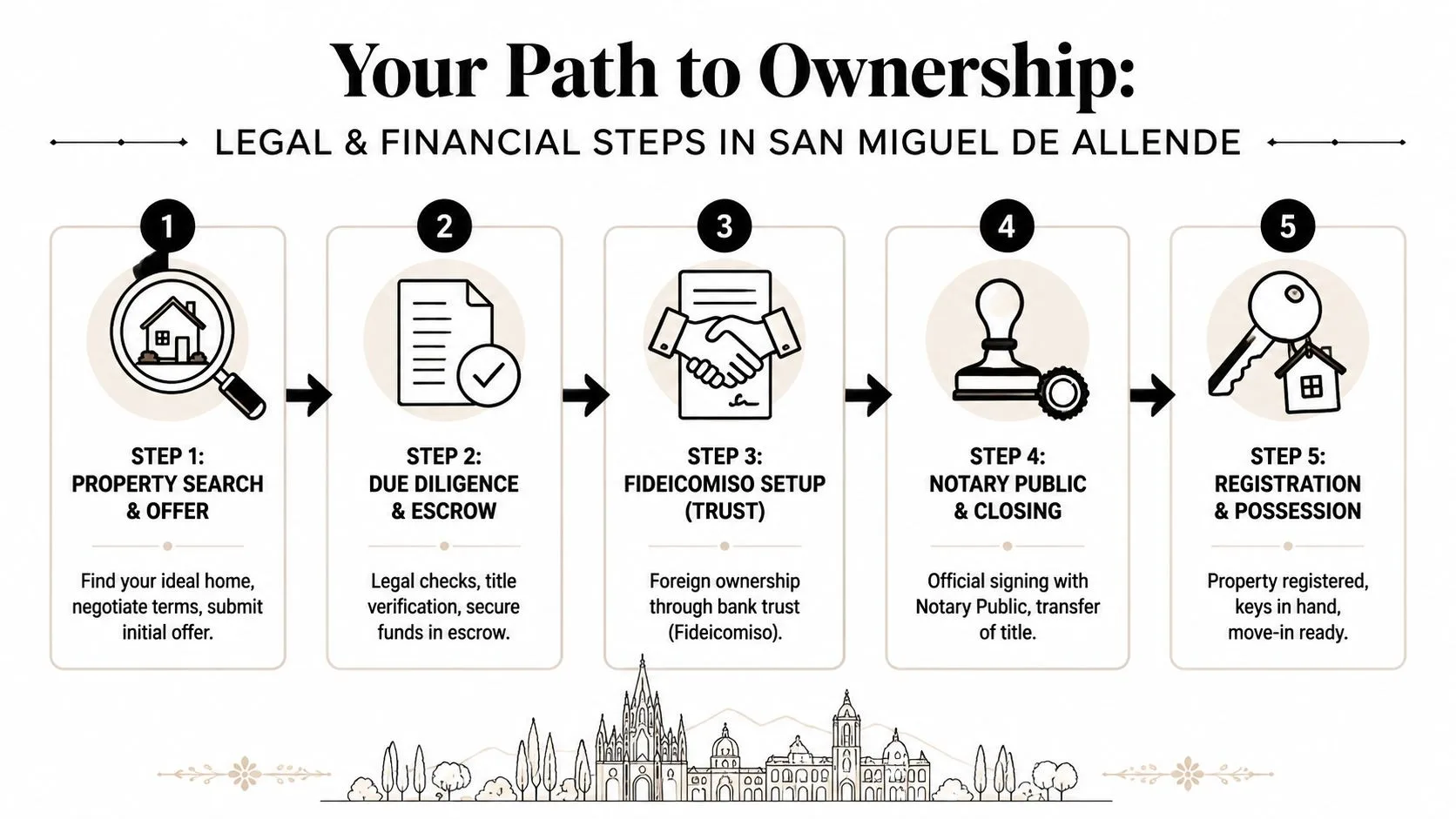
The clean version of the path looks like this:
Search with criteria that match your retirement plan
Don't start with listings. Start with mobility, location, noise tolerance, maintenance appetite, and whether this is a full-time or part-time home.Make an offer with terms that are clear
Price matters, but so do closing timelines, inclusions, and conditions attached to the sale.Run due diligence properly
Title review, liens, permits, homeowner association documents if relevant, and property status all require serious attention.Use escrow and documented funds flow
Buyers need clarity on where money is going, under what conditions, and when it's released.Close through the notario público
The notario is a central legal figure in Mexican real estate transactions. This is not the same role as a U.S. notary who witnesses signatures.Register title and take possession
Don't confuse signed papers with fully completed ownership administration.
Working rule: If a seller or intermediary wants to rush due diligence, slow the deal down.
Where foreign buyers get into trouble
The common mistakes aren't dramatic. They're ordinary.
- Falling for aesthetics first: Buyers commit emotionally before checking whether the property works legally and physically.
- Ignoring future usability: They buy stairs, slopes, and layout problems they'll resent later.
- Using vague verbal assurances: If it matters, it belongs in writing.
- Assuming every agent understands foreign-buyer process: Some do. Some don't.
One caution about the infographic above. It references a fideicomiso step because that's common in many foreign-buyer Mexico explanations, but in San Miguel that trust structure generally isn't the standard route because the city isn't in the restricted zone. That's exactly why local guidance matters. Generic “buying in Mexico” advice often mixes rules from beach markets into inland transactions.
Partnering with a Boutique Realtor for Success
A retiree buying in San Miguel doesn't need more listings. You need sharper judgment. That's why I favor boutique representation over high-volume, impersonal brokerage culture.
A generalist can open doors. A serious local advisor helps you avoid buying the wrong life.

Why local nuance matters more than listing volume
San Miguel isn't a market you understand from square footage and photos alone. One block can feel ideal, the next less so. A house can look magical online and be wrong because the street is too loud, the grade is too steep, the water pressure is inconsistent, or the daily walk you imagined isn't realistic.
That's especially true with retirement homes in San Miguel de Allende. The right advisor should be asking questions many buyers forget to ask themselves:
- Will you live here year-round or seasonally?
- How much maintenance do you want to manage personally?
- Will family visit often enough to justify guest space?
- Do you need one-level living now, or later?
What to expect from a real advisor
A good boutique realtor acts more like a coordinator than a salesperson. They should help narrow neighborhoods, flag physical and lifestyle mismatches, and stay useful after the showing ends.
That can include:
- Curated search: Fewer options, better matched.
- Due diligence coordination: Working alongside legal and closing professionals.
- Vendor network: Inspectors, contractors, designers, movers, and service providers.
- Cross-border clarity: Explaining process in terms that make sense to foreign buyers.
One example is Inside San Miguel, which curates homes across key neighborhoods and supports international buyers with lifestyle-based search and transaction coordination. That's the model I'd recommend in this market. Not because it sounds polished, but because retirees need context and follow-through more than sales pressure.
Your Essential Moving and Residency Checklist
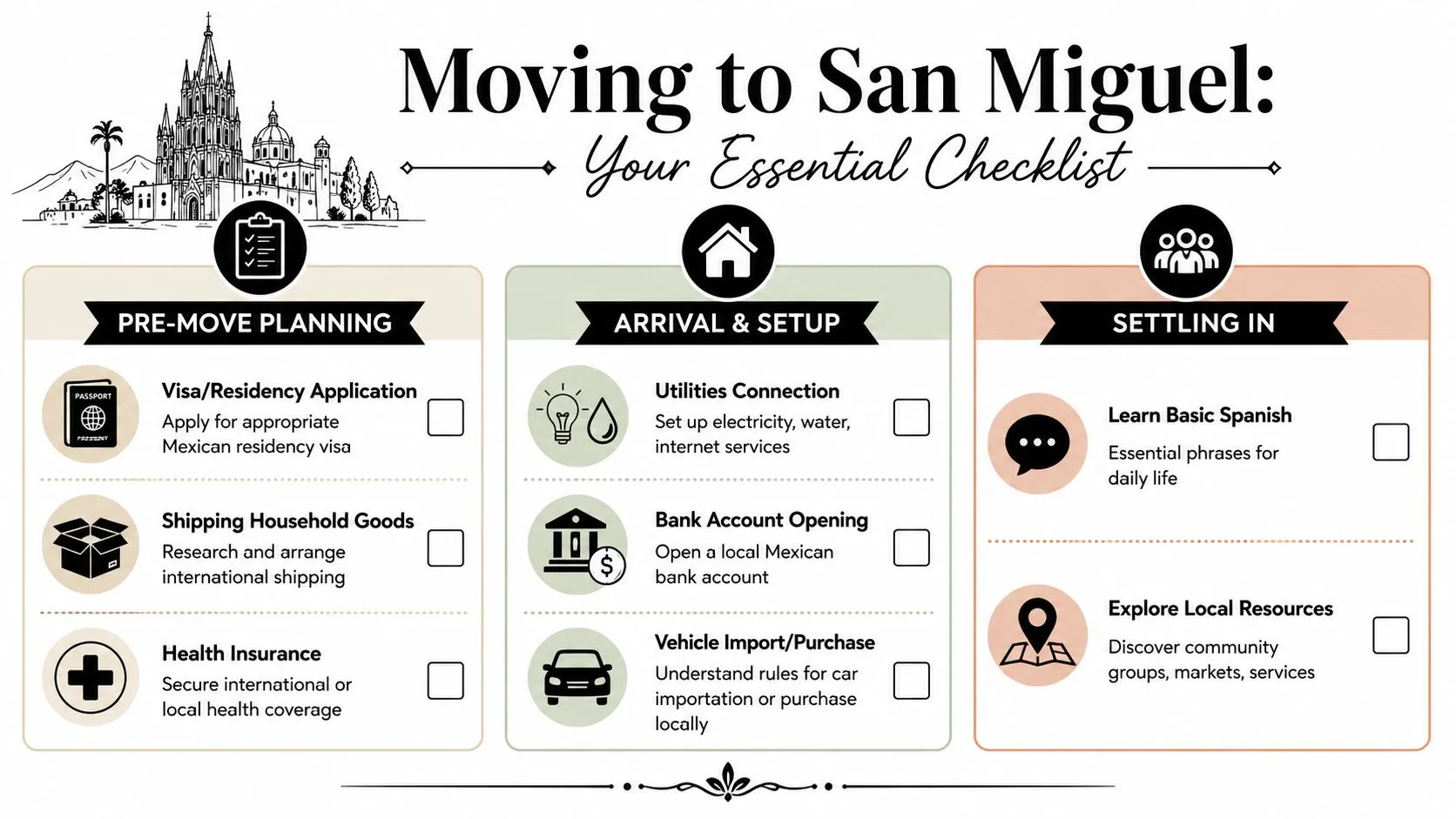
Buying the home is only half the job. The move itself is where stress spikes, especially for retirees trying to handle logistics across borders. The easiest way to stay sane is to make decisions in the right order.
Before you move
Start with the decisions that affect everything else.
- Residency first: Know whether you're entering as a visitor while exploring, or moving with a formal residency path in mind. If you're considering long-term status, review this overview of permanent residency in Mexico.
- Keep or replace furniture: In San Miguel, many retirees discover that shipping everything they own isn't worth the effort. Bring what matters emotionally or functionally. Replace the rest locally over time.
- Sort your documents: Passports, birth and marriage certificates if relevant, financial records, medical summaries, prescriptions, pet paperwork, and digital backups. This sounds basic until you need one item urgently.
- Plan your healthcare handoff: Get copies of current records and make a clear medication list before leaving home.
Bring less than you think you need. Bring better records than you think you need.
After you arrive
The first weeks are about utility, not perfection. Don't try to recreate your previous life in ten days.
Focus on the basics:
- Set up utilities: Electricity, water, internet, and gas if relevant.
- Open local accounts where useful: A Mexican bank account can simplify recurring local payments.
- Create your home support list: Cleaner, handyman, gardener, driver, pet care, pharmacy, and trusted taxi contacts.
- Learn functional Spanish: Not perfect Spanish. Functional Spanish. Enough to handle daily life with confidence and respect.
- Map your service radius: Grocery options, cafés, doctors, pharmacies, and emergency contacts should become familiar quickly.
For retirees, I also recommend a soft landing approach. Rent first if you're uncertain. Or, if you've already bought, spend your first months learning the city through routine instead of trying to solve every setup detail at once. San Miguel gets easier when you stop treating it like a project and start living in it.
Common Questions and Your Next Steps
Is San Miguel de Allende safe for retirees? In practical day-to-day terms, many retirees live here comfortably and build stable routines. But “safe” depends on your habits, your neighborhood choice, your mobility, and whether you're realistic about how you live. Walk the area at different times. Ask about noise, lighting, traffic, and access. Choose a location that fits your actual routine, not your fantasy version of yourself.
Do you need fluent Spanish? No. You can live comfortably with limited Spanish, especially as a foreign retiree in well-known neighborhoods. But you should still learn enough to manage daily interactions, show respect, and reduce dependence. Life gets better fast when you can ask basic questions, understand simple replies, and solve small problems yourself.
That's the bigger truth about retirement homes in San Miguel de Allende. The right home isn't just attractive. It makes your life easier, more social, and more resilient. The right neighborhood supports your energy level. The right property type respects your future, not just your present. The right buying process protects your money and your peace of mind.
If you're ready to explore retirement homes in San Miguel de Allende with a lifestyle-first approach, start with Inside San Miguel. You'll find curated properties, neighborhood-specific guidance, and practical help for foreign buyers who want a home that fits the way they plan to live.