

You're probably looking at Centro San Miguel the way most serious buyers do. Half of your mind is on the romance of it. Morning bells, stone streets, a house wrapped around a courtyard, sunset from a rooftop with the Parroquia in view. The other half is asking better questions. Can I live here full time. What will upkeep cost. What happens when a beautiful colonial house needs rewiring, drainage work, or structural reinforcement inside a protected historic zone.
That second set of questions is where most glossy guides fail.
Owning in Centro isn't just about taste. It's about judgment. The right purchase can give you an extraordinary lifestyle in one of Mexico's best-known heritage cities. The wrong one can turn into a slow, expensive lesson in access constraints, permit friction, utility complexity, and maintenance that never quite ends. Buyers who do well here usually understand that the headline price is only the beginning.
This guide is written from that practical point of view. It treats Centro as a place to own, maintain, and use, not just admire. If you're still narrowing your search, it helps to start with a grounded overview of Centro in San Miguel de Allende before you commit to a specific street or property type.
Table of Contents
- Your Guide to Owning a Piece of History in San Miguel
- The Enduring Allure of Centro Histórico
- Navigating Centro's Most Desirable Streets and Landmarks
- The Centro Lifestyle Amenities and Daily Culture
- Understanding Centro Real Estate Properties and Prices
- The International Buyer's Guide to Purchasing in Centro
- Embracing Life in Centro Tips for New Residents
Your Guide to Owning a Piece of History in San Miguel
A buyer falls in love with Centro in stages. First with the façade. Then with the light in the courtyard. Then with the idea of living inside a place that already had a life long before the listing photographer arrived. That emotional pull is real, and it's part of why Centro keeps attracting global attention.
But ownership here only works when affection is paired with discipline.
The house that feels magical during a one-hour tour may have no practical parking, difficult service access, aging electrical runs, and a roof terrace that needs more structural review than most buyers expect. Another house, less theatrical on first impression, may be the better asset because it already solves the old-city problems that matter every day. Easy circulation. Sensible mechanical integration. Good natural light. Manageable stairs. Staff access. Storage. Delivery practicality.
What sophisticated buyers get right
They don't buy Centro San Miguel as if they were buying a suburban luxury home. They buy it as a historic urban asset.
That means looking at:
- How the house works daily. Not just how it photographs.
- What can be modernized cleanly. Bathrooms and kitchens matter, but infrastructure matters more.
- How much friction the location creates. Noise, crowds, vehicle access, and pedestrian intensity all vary block by block.
- Whether the property already contains scarce features. Courtyards, terraces, and discreet parking change both lifestyle and resale.
Practical rule: In Centro, convenience hidden behind authenticity is usually worth more than obvious cosmetic beauty.
The most successful purchases tend to feel almost understated at first. They reveal their value after a buyer notices how well the property handles the practicalities of life in a tightly preserved historic core.
The Enduring Allure of Centro Histórico
Centro holds value because it isn't interchangeable. Plenty of markets offer luxury homes. Very few offer a walkable colonial core with global recognition, a dense urban identity, and daily life organized around a historic center that still functions as the city's emotional and commercial anchor.
San Miguel de Allende's significance is tied to its heritage profile, and El Centro remains the symbolic heart of the city, with the historic core retaining lifestyle appeal and price resilience more effectively than peripheral areas, as noted in this overview of San Miguel de Allende and its central district. That matters because buyers in prime heritage cities aren't just purchasing square footage. They're buying into continuity.
Why heritage status matters in real estate terms
UNESCO recognition creates prestige, but for owners it also does something more important. It reinforces the long-term identity of the district. Streetscape, scale, architectural rhythm, and the visual coherence of the center don't drift as easily as they do in ordinary urban neighborhoods.
That creates several practical effects:
- The area remains legible. Buyers know what Centro is, and what it is not.
- The center stays culturally relevant. Activity keeps returning to the historic heart.
- Authenticity becomes a real market filter. Not every renovation improves value. Some dilute it.
A polished colonial home in Centro can command attention because the neighborhood itself does so much of the work. The setting is already established. The architecture already signals scarcity. The walkability already supports a lifestyle that newer districts can imitate but not reproduce.
The attraction is emotional, but the value is structural
Buyers often talk about beauty first. They should. Centro is beautiful. The stone, cantera, wood doors, interior courtyards, rooflines, and church silhouettes all contribute to a place that feels unusually complete.
But beauty alone isn't what gives Centro San Miguel staying power.
Heritage real estate performs best when charm is backed by a district people continue to use, not just visit.
That's the distinction here. El Centro isn't a decorative quarter detached from city life. It remains the place where movement, landmarks, commerce, and civic identity converge. The plaza, the alleys, the church frontage, and the surrounding streets still organize how people experience San Miguel.
What this means for a buyer
The purchase decision becomes less about chasing novelty and more about selecting the right form of permanence. A house in Centro isn't valuable because it is old. It's valuable when age, location, and usable design align.
If you buy well, you're not just acquiring a charming residence. You're acquiring a stake in a protected urban fabric that can't be reproduced on the edge of town.
Navigating Centro's Most Desirable Streets and Landmarks
The biggest mistake buyers make in Centro is treating it as one uniform neighborhood. It isn't. A five-minute walk can change your experience completely. One block feels ceremonious and public. The next feels tucked away and residential. Another is elegant at noon and noisy late into the evening.
Micro-location starts to matter more than broad labels.
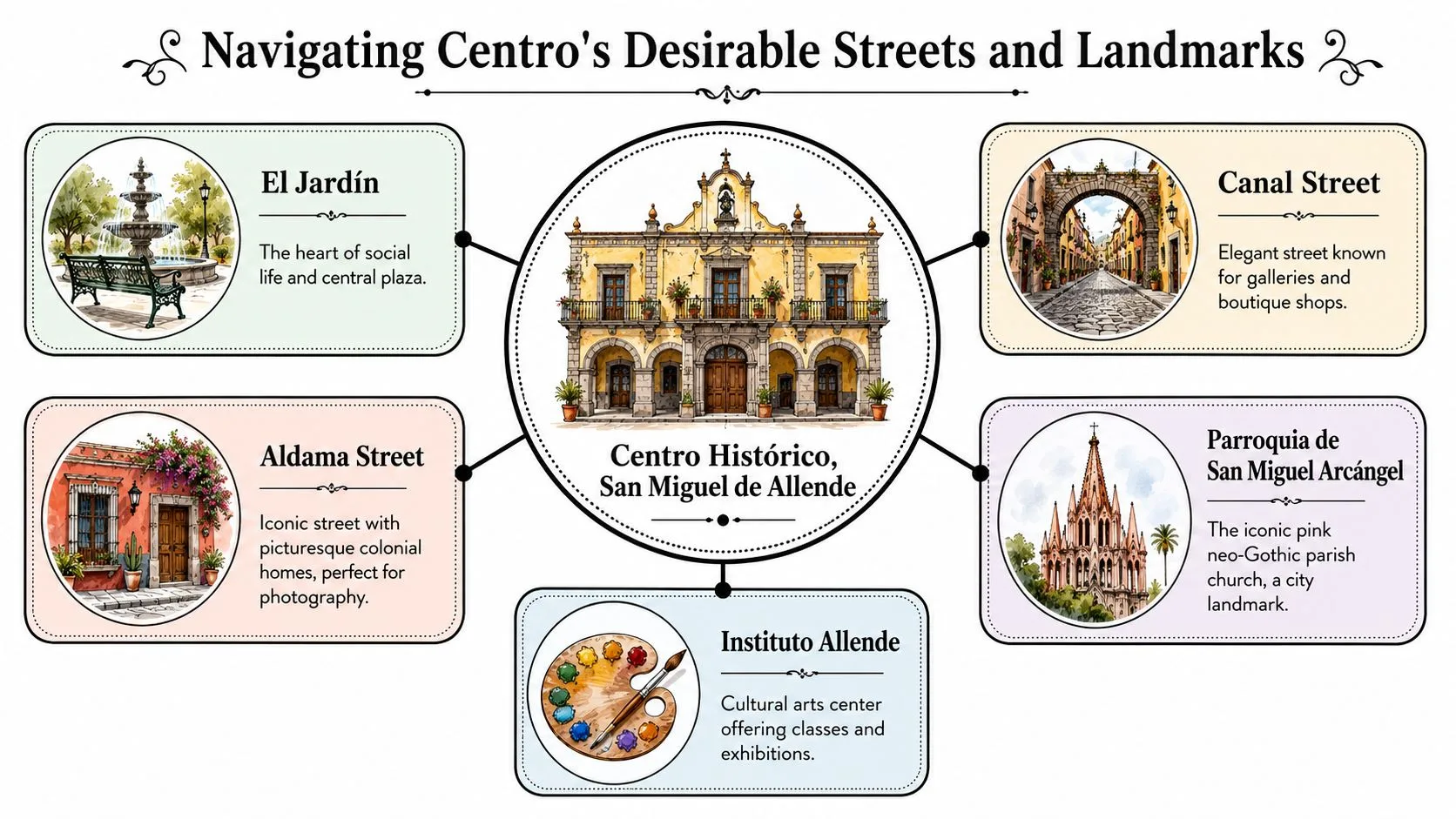
Start with the landmarks, then judge the streets around them
Most buyers orient themselves around the obvious anchors. That's useful, but only if you go one step further and ask how close is too close.
- El Jardín and the Parroquia area. This is the civic and visual center. It offers immediacy, prestige, and easy access to restaurants and events. It also brings constant activity, more pedestrian traffic, and less privacy.
- Canal and adjacent gallery streets. These addresses often feel polished and social, with strong visual appeal and easy access to boutiques and dining.
- Aldama and similarly photogenic streets. These tend to attract buyers who want the classic postcard version of San Miguel, with architecture doing much of the emotional work.
- Edges near cultural institutions. Areas around Bellas Artes or Instituto Allende often appeal to buyers who want a cultural rhythm without being on top of the busiest plaza corridors.
For a green break from the densest core, many buyers also consider how close they are to Benito Juárez Park in San Miguel, especially if they plan to live in town for extended periods rather than use the home only for short visits.
A quick visual reference helps if you're still building your map of the district:
How to choose your micro-location
The right street depends on how you plan to use the property.
If you want a lock-and-leave residence with immediate access to dining and social life, being closer to the core may be worth the trade-offs. If you want longer stays, work-from-home comfort, or easy hosting, a quieter street just outside the most intense foot traffic often performs better in practice.
Use this filter when walking properties:
| Preference | Usually works better | Watch for |
|---|---|---|
| Frequent entertaining | Streets near major landmarks and rooftops | Noise bleed and service access |
| Full-time living | Quieter side streets with less through-traffic | Steep grades, parking difficulty |
| Art and culture focus | Near galleries, schools, and cultural venues | Event-related congestion |
| Maximum icon value | Near the Parroquia or postcard streets | Privacy and delivery friction |
A beautiful street isn't always a comfortable address. In Centro, the buyer who walks the block in the morning, afternoon, and evening usually makes the better decision.
What works and what doesn't
What works is buying a street that matches your real routine. What doesn't is buying for fantasy usage. A buyer who thinks they want to be in the center of everything often discovers they really wanted to be able to reach everything within a short walk, then retreat.
That distinction is expensive if you get it wrong.
The Centro Lifestyle Amenities and Daily Culture
Living in Centro feels effortless when you experience it as a visitor. It becomes more layered when you live there. The appeal is obvious. You can build a day around walking. Coffee, bread, a market stop, lunch with friends, a gallery opening, dinner on a rooftop. Very little requires a car, and that's part of the reason the district remains so desirable.
The practical side is less discussed. In Centro, convenience is often pedestrian convenience, not operational convenience. It's easy to walk to dinner. It may be less easy to coordinate a furniture delivery, a contractor arrival, or regular parking if your house doesn't solve those issues internally.
What daily life feels like when it works
The best homes in Centro support a rhythm that feels compact and elegant.
A well-located property lets you:
- Handle ordinary errands on foot without turning the day into logistics.
- Host comfortably because guests can arrive and leave without confusion.
- Use outdoor space often because a courtyard or terrace extends the house.
- Stay engaged with the city without feeling trapped inside the tourist version of it.
That last point matters. Centro is not only for visitors. It is also a lived neighborhood with local routines, service workers, long-term residents, schools, shops, and nonprofit activity woven into the city's social fabric.
The real cost of the lifestyle
The ownership question isn't just purchase price. The historic center is a UNESCO World Heritage core zone of 43 hectares, and that protected condition affects remodeling, access, and long-term upkeep, as described in the San Miguel de Allende historical overview. Buyers should read that less as a romantic label and more as an operating condition.
The result is a different cost structure from newer neighborhoods. Not necessarily worse. Just more specific.
Here are the recurring pressure points owners underestimate:
- Access and parking. If the home doesn't include workable parking, you feel that absence repeatedly.
- Maintenance tempo. Historic materials and older assemblies need more attentive care.
- Renovation friction. Protected settings can slow changes that would be straightforward elsewhere.
- Service coordination. Deliveries, garbage handling, trades, and move-ins often need planning.
The premium in Centro isn't only what you pay to buy in. It's what you keep paying to preserve ease.
A more honest view of community
Luxury demand is real, but so is the social complexity around it. Discussions about Centro often dwell on architecture and restaurants while ignoring pressure on affordability and year-round local life. That's a mistake. Buyers who plan to stay should understand that they're entering a neighborhood with both prestige and strain.
Local signals also show ongoing community support efforts, including fundraising tied to education for more than 100 underprivileged children in San Miguel de Allende, which underscores that social inequity remains visible in the city's civic life, as reflected in this local community fundraising post.
For thoughtful owners, that changes the tone of ownership. Centro isn't just a backdrop for a private lifestyle. It's a living district where your renovation choices, rental strategy, staffing relationships, and day-to-day presence all have some effect on the block around you.
Understanding Centro Real Estate Properties and Prices
Buyers usually arrive in Centro thinking in broad categories. Small home. Colonial house. Trophy property. That's a reasonable starting point, but Centro pricing rarely tracks simple size logic. The more accurate way to evaluate inventory is by function, scarcity, and how efficiently the house solves historic-core constraints.
In this submarket, value shifts away from raw land and toward building efficiency. Properties with internal courtyards, rooftop terraces, or discreet parking tend to command stronger attention because they solve the everyday limitations of density and expansion in the historic district, as reflected in this Centro property example emphasizing rooftop use and garage access.
The three property profiles buyers encounter most
A casita is usually the most compact expression of Centro ownership. It may offer charm, excellent location, and lower carrying complexity, but it can also sacrifice storage, parking, staff flow, and entertaining space. For part-time use, that trade can work well. For long stays, a casita needs to be unusually well planned.
A classic casa colonial is what many buyers think they want. Courtyard. Thick walls. Multiple levels. Roof terrace. Architectural detail. This category is broad, and quality varies dramatically. Some houses preserve authenticity while functioning beautifully. Others are romantic but cumbersome, with awkward stairs, fragmented layouts, and deferred infrastructure hidden behind pretty finishes.
A casona or larger estate-style residence can be extraordinary, but only if the buyer wants the operating burden. These homes can support staff, events, and multigenerational visits. They can also require a different level of maintenance discipline and project management.
What actually drives price in Centro
Forget generic luxury markers for a moment. In Centro San Miguel, these features often matter more than an additional bedroom:
- A courtyard that improves circulation, not just visual charm
- A rooftop terrace with usable access
- Discreet garage or off-street parking
- A layout that allows mechanical modernization without fighting the architecture
- Privacy from the street despite central location
- Light quality inside older masonry construction
A buyer who overpays for finishes can recover. A buyer who overpays for a flawed layout usually cannot.
Buyer's test: Ask whether the house is merely beautiful, or whether it has already solved the hard urban problems that Centro creates.
Typical Centro Property Profiles 2026 Estimates
The table below is qualitative by design. Precise price ranges were requested in the planning brief, but no verified pricing data for this specific table appears in the approved fact set, so the most responsible approach is to frame the market comparatively rather than invent numbers.
| Property Type | Typical Size | Key Features | Price Range (USD) |
|---|---|---|---|
| Casita | Compact | Walkable address, limited outdoor area, often no parking | Entry level for Centro relative to larger colonial homes |
| Casa colonial | Medium to large | Courtyard, terrace potential, stronger entertaining value | Broad middle to upper tier depending on renovation quality and location |
| Renovated luxury house | Medium to large | Modern systems, strong finish quality, premium roof or view features | Upper tier within Centro |
| Casona or estate | Large | Multiple living zones, larger courtyards, guest capacity, staff support | Trophy tier with highly property-specific pricing |
If you want to compare central homes against inventory across the city, it helps to review a broader selection of homes for sale in San Miguel de Allende before deciding how much premium you're willing to pay for a Centro address.
Renovation capital should go to the hidden problems first
Cosmetic upgrades are seductive because they photograph well and feel immediate. In Centro, they're often the wrong first move. Better spending usually goes into circulation, structure, roof performance, drainage logic, electrical modernization, and mechanical integration.
That's because the market tends to reward preserved authenticity plus modern functionality, not merely fresh finishes. A house with old-city charm and competent systems is far easier to enjoy, maintain, and resell than one with designer tile covering unresolved infrastructure.
The International Buyer's Guide to Purchasing in Centro
Foreign buyers often assume the main challenge in San Miguel is legal eligibility. It usually isn't. The more important challenge is doing thorough due diligence on a historic property where paperwork, physical condition, and practical use must all line up.
San Miguel's interior location also matters. The common coastal trust discussion often confuses buyers who are new to Mexico. In San Miguel, the conversation is typically less about restricted-zone ownership mechanics and more about title clarity, permits, property condition, utility reality, and whether the house can support the life you intend to have in it.
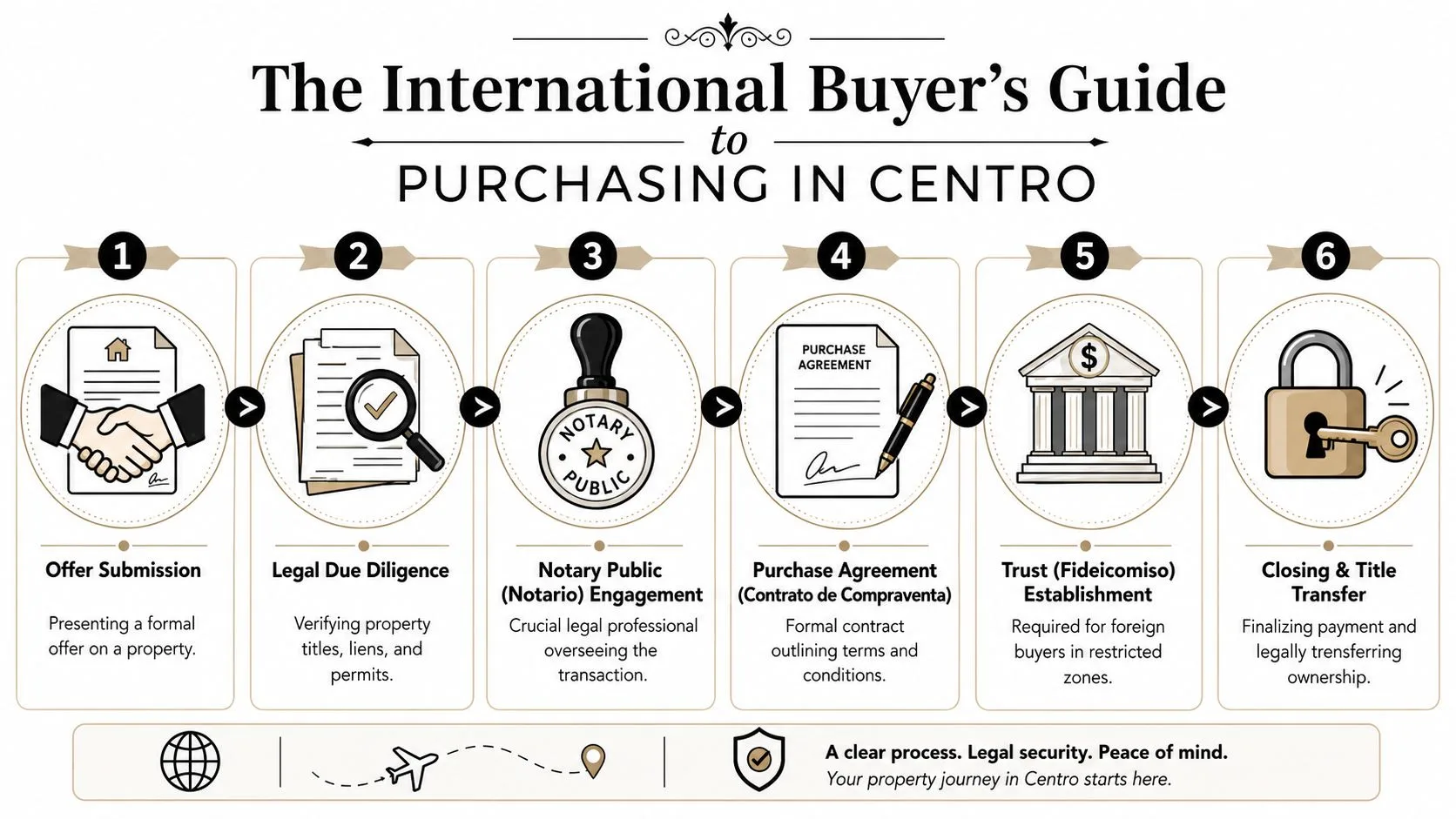
The sequence that protects buyers best
The smoothest transactions usually follow a disciplined order.
Define the use case before making offers
Decide whether this is a primary residence, seasonal home, rental-oriented asset, or long-hold family property. That choice affects what defects are acceptable and which are disqualifying.Write the offer around verifiable conditions
In Centro, assumptions create expensive problems. The offer stage should leave room to confirm title, boundaries, permits, utilities, and any unresolved obligations attached to the property.Engage legal review early
A notario is critical in Mexican transactions, but buyers still benefit from independent legal review focused on their interests. The more historic and altered the property, the more important that review becomes.Inspect the house as a system, not a showroom
Rooflines, moisture pathways, retaining conditions, electrical logic, plumbing runs, drainage, and service access deserve close review. Historic homes hide issues well.
For buyers comparing build-versus-buy decisions, a review of land opportunities in San Miguel de Allende can be useful, even if most Centro purchasers ultimately prefer existing homes because entitlement and heritage constraints add complexity.
Centro due diligence is more than title work
The highest-risk mistake is thinking legal review alone is enough. In Centro, physical due diligence often changes the economics of the deal more than negotiation does.
A key example is utility modernization. Historic properties often require careful coordination of buried services and conduit routing. In analogous municipal utility standards, joint-use trenches require adequate separation from other utilities, and specified conduit is electrical-grade PVC Schedule 40, as outlined in the construction handbook reference for utility and conduit standards. For buyers, the practical meaning is simple. Service upgrades are not generic contractor work.
What to verify before you get comfortable
Use a buyer file that answers these questions clearly:
- Who owns the property, and is title documentation consistent
- Whether liens, unpaid obligations, or unresolved inheritance issues exist
- What renovations were done, and whether they align with local requirements
- How utilities currently enter and move through the property
- Whether neighboring walls, shared conditions, or access routes create hidden dependency
- If the layout allows future work without reopening completed finishes
If a seller can't explain how the house was modernized, assume you may need to discover that at your own expense.
The buyers who feel confident at closing
They aren't the buyers who rushed. They're the ones who resolved uncertainty before wiring final funds. In Centro, that usually means accepting a slower, more document-heavy process in exchange for a cleaner long-term ownership experience.
That trade is almost always worth making.
Embracing Life in Centro Tips for New Residents
After closing, the quality of ownership depends on how quickly you adapt to Centro's operating logic. Buyers who settle in well don't try to force suburban expectations onto a historic core. They build systems around the neighborhood as it works.
San Miguel de Allende had a documented population of 174,615 in the 2020 census, with a substantial urban economy and housing market supporting the city's downtown vitality, according to Data México's profile of the municipality. That broader scale is useful to remember. Centro may feel intimate, but it functions inside a real city with constant movement, service demand, and year-round housing pressure.
Set up the practical side first
The first month should be operational, not decorative.
Focus on:
- Utilities and service contacts. Know who handles electricity, water-related issues, internet coordination, and emergency callouts for your specific property.
- Property management expectations. Even owner-occupied homes benefit from a reliable local manager or caretaker who can meet vendors, supervise access, and monitor issues when you travel.
- Deliveries and access routines. Large deliveries, trades, and move-ins go more smoothly when timed carefully and managed by someone who knows the street conditions.
- Parking strategy. If the house has a garage, learn its practical limits early. If it doesn't, solve the routine before it becomes a recurring irritation.
Hire for historic property experience, not just general competence
A good contractor in a newer subdivision isn't automatically the right contractor in Centro. The same goes for architects, designers, waterproofing crews, and electricians. Older masonry, shared walls, roof terraces, hidden service paths, and heritage expectations require a different standard of judgment.
Build your local bench around people who understand:
- Colonial-era construction behavior
- Moisture management in older walls
- Staged renovation in occupied homes
- How to preserve character while improving function
Owners often save money by spending more carefully, not by choosing the cheapest bid.
New residents do best when they treat the house like a living asset that needs stewardship, not a finished product that only needs furnishing.
Live the neighborhood with some humility
The strongest Centro owners learn the cadence of their block. They greet neighbors. They respect noise patterns. They understand when street activity is part of local life and when their own use of the property creates avoidable disruption.
That approach pays off in practical ways. Better vendor relationships. Better neighborhood goodwill. Fewer small frictions becoming larger ones.
The reward is substantial. When Centro ownership works, it's hard to match anywhere else. You get daily beauty, genuine walkability, cultural density, and a home that participates in the identity of San Miguel instead of sitting outside it.
That's its true appeal. Not just owning a beautiful house, but owning one you can truly enjoy.
If you're evaluating Centro San Miguel seriously and want experienced, on-the-ground guidance, Inside San Miguel helps buyers discern the difference between a beautiful listing and a sound acquisition. From identifying the right neighborhood fit to coordinating due diligence on colonial and luxury homes, the team supports international buyers who want clarity before they commit.