
You're probably in one of two situations right now. You've either found a parcel in Mexico that feels right and you don't want to lose it, or you've started researching and realized that most advice online talks almost entirely about beach property, bank trusts, and broad warnings that don't help you judge one actual lot.
That gap matters. Buying land in Mexico can be straightforward, but only when you focus on the right risk. For many inland purchases, the main problem isn't whether a foreigner is allowed to buy. It's whether the land is private, transferable, buildable, and cleanly documented.
That's why experienced buyers approach land in Mexico as a legal and development problem first, and a lifestyle purchase second. The lifestyle can be excellent. The upside can be real. But the parcel has to survive scrutiny before it deserves enthusiasm.
Table of Contents
- Your Dream of Owning Land in Mexico
- Understanding The Three Types of Land in Mexico
- The Legal Framework for Foreign Land Buyers
- Your Due Diligence Checklist Before Making an Offer
- The Full Cost of Acquiring and Owning Land
- Spotlight on San Miguel de Allende A Premier Inland Market
- Your Path to Secure Land Ownership in Mexico
Your Dream of Owning Land in Mexico
Owning land in Mexico appeals to a specific kind of buyer. You want control. You may want to build a house that fits your life instead of adapting to someone else's floor plan. You may want privacy, views, gardens, a guest casita, equestrian use, or a long-hold position in a place where you'd spend time.
Mexico gives you a wide spectrum of possibilities because it is physically vast and geographically varied. According to Britannica's overview of Mexico, the country covers about 1,964,375 square kilometers in total area, has about 1,943,945 square kilometers of land, and is commonly described through nine major physiographic regions. For a land buyer, that scale isn't trivia. It explains why one parcel sits on a flat, serviceable plateau near established roads while another sits in terrain that looks romantic in photos and becomes expensive the moment an engineer visits the site.
The attraction is real. So is the complexity.
Practical rule: Buy the parcel that works on paper before you buy the parcel that works in your imagination.
A smart first land purchase in Mexico usually comes down to a few hard questions:
- What legal regime applies: Is it private land, ejido-related land, or land with another status that changes transferability?
- What can you do with it: Residential build, agricultural use, subdivision, hold for future construction, or nothing without approvals?
- What will the site demand physically: Access roads, retaining work, drainage planning, utility extension, water strategy?
Most bad outcomes start when buyers rush past those questions because the view is good, the seller sounds confident, or the asking price looks unusually attractive. Land rewards discipline. It punishes assumptions.
Understanding The Three Types of Land in Mexico
Land tenure is where many foreign buyers make their first serious mistake. They treat every parcel as if it were a vacant lot with a deed. In Mexico, that assumption can be costly.
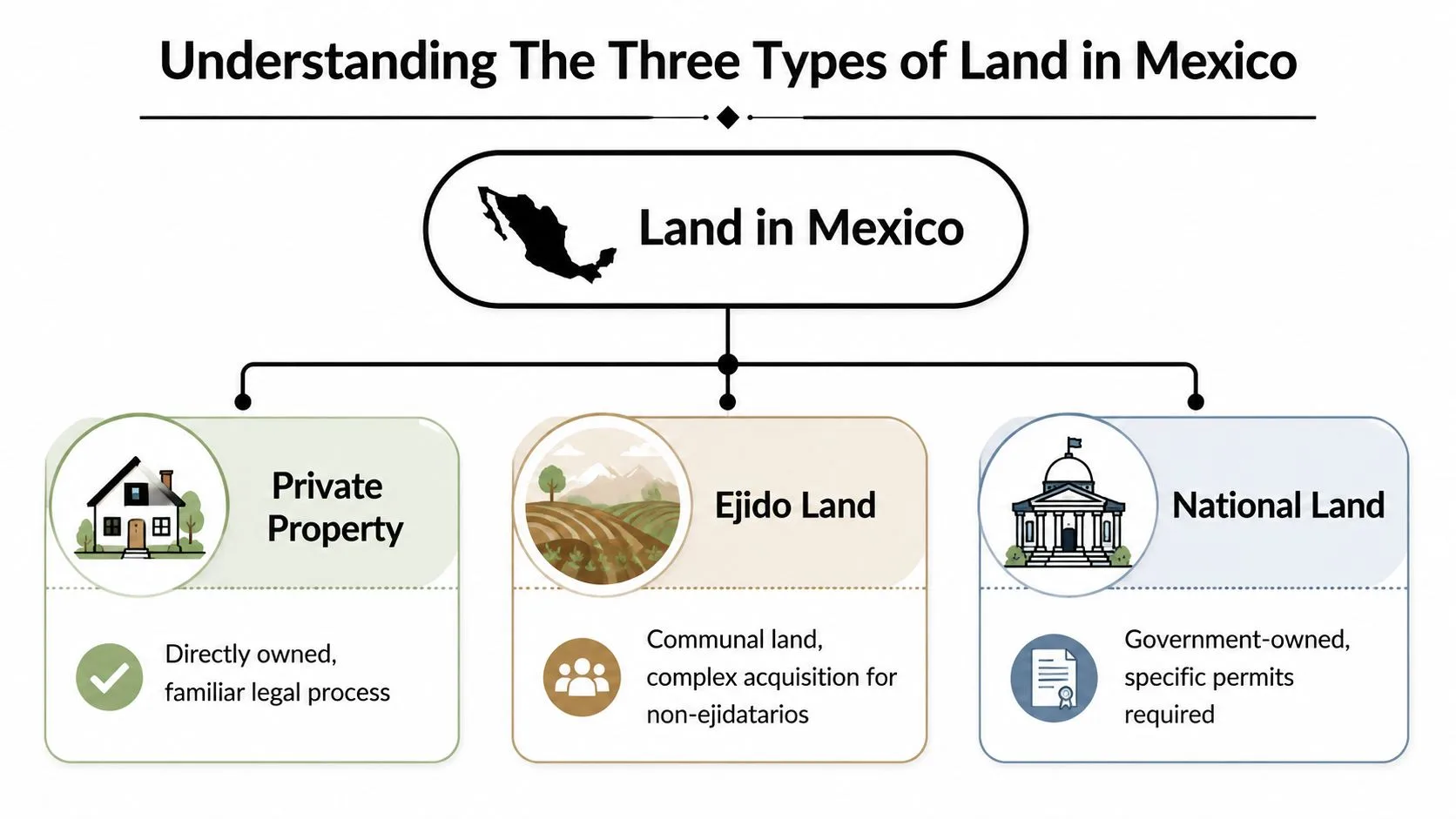
Private property
Private property is the cleanest category for most buyers. This is the land type that behaves most like what U.S. and Canadian buyers expect. The owner holds title, the parcel can be reviewed through the usual legal channels, and transfer is comparatively familiar when the documentation is in order.
If you're browsing land listings in San Miguel de Allende, this is usually the category you want to see confirmed early, not assumed.
Ejido land
Ejido land is where online advice often becomes too simplistic. Buyers hear “don't buy ejido” and leave it at that. The more useful explanation is that ejido land functions more like a communal agrarian system than a standard private parcel.
Think of it less like a suburban lot and more like a co-op structure with a land history that affects who has rights, how those rights are documented, and whether the property can ever be legally transferred to an outsider in a fully secure way. A parcel associated with ejido status may look available. A seller may describe a route to regularization. None of that means you should proceed casually.
According to USDA research on social property in Mexico, social property accounts for 53% of Mexico's total land, covering 105.1 million hectares. The same source notes that 66% of the surface is not individually allocated to ejidatarios and that 98% of ejidos and comunidades agrarias report activities in agriculture, livestock, or forestry. That's the structural reason land-status verification isn't a technicality. A majority share of national land remains connected to communal and agrarian systems.
If a parcel is being marketed with urgency but land status is unclear, slow the deal down. Land rarely becomes safer because a seller wants a faster deposit.
Federal or national land
A third category is federal or national land, which is government-owned land subject to public control, special permits, or restrictions. This is not ordinary private inventory. In practical terms, it's not the place for a buyer who wants a straightforward acquisition and build timeline.
A quick comparison
| Land type | What buyers should expect | Risk level for a first-time foreign buyer |
|---|---|---|
| Private property | Standard deed-based review and transfer process | Lower, if documentation is clean |
| Ejido land | Communal or agrarian history, possible regularization issues | Higher |
| Federal land | Government ownership or permit-based limitations | High for private acquisition purposes |
The Legal Framework for Foreign Land Buyers
Most foreign buyers begin with one legal question. Can I own the land directly, or do I need a trust?
That's a fair starting point, but it often becomes a distraction. The answer depends on where the parcel sits, and once you move inland, another issue tends to matter more.
What the restricted zone actually means
Mexico's constitutional rule is geographically specific. Foreigners cannot hold direct title within 50 km of the coast or 100 km of an international border, as explained in Wise's guide to buying land in Mexico. In those areas, the usual residential path is a fideicomiso, a bank trust structure that allows a foreign buyer to control the property through beneficial rights rather than direct title.
That system is real, lawful, and often entirely workable for coastal property.
What it is not, however, is the main issue for every land purchase in Mexico.
Why inland ownership is often simpler
In most inland markets, foreigners can typically acquire direct title through an escritura pública rather than a trust. For buyers comparing options, that's one reason buying property in Mexico as an American can be more straightforward in a city like San Miguel de Allende than in a coastal resort market.
Direct ownership usually means fewer moving parts. It can also make the ownership structure easier to understand over the long term, especially for buyers who want a primary residence, a custom home site, or a family asset they expect to hold.
The mistake buyers make in inland markets
The common mistake is assuming that inland means easy.
Wise's coverage makes a point that practitioners see regularly: title quality and ejido-related land status can matter more than foreign ownership rules in many inland markets. A buyer can become so focused on whether the property is outside the restricted zone that they miss the larger question of whether the parcel is safe to buy at all.
A parcel can be legal for foreigners to acquire and still be a bad purchase.
Here's the practical distinction:
- Legal to buy means the ownership structure may permit acquisition.
- Safe to buy means the title chain, land status, boundaries, and intended use hold up under review.
Those are not the same thing.
How experienced buyers frame the decision
I usually suggest treating the legal framework as a two-part filter.
First, determine whether the parcel's location requires a fideicomiso or allows direct ownership. That gives you the basic acquisition path.
Second, ask the more important land question. Is this private, transferable, and suitable for the use you have in mind? If not, the ownership vehicle doesn't rescue the deal.
A trust can solve a restricted-zone issue. It cannot solve defective title, unresolved agrarian status, or a parcel that can't be serviced and built as intended.
Your Due Diligence Checklist Before Making an Offer
Land purchases go wrong when buyers treat due diligence as a formality after price terms are agreed. On a house, you can sometimes fix a bad assumption with repairs or negotiation. On land, the wrong assumption can sit inside the title, the access, the topography, or the zoning.
Confirm ownership and title history
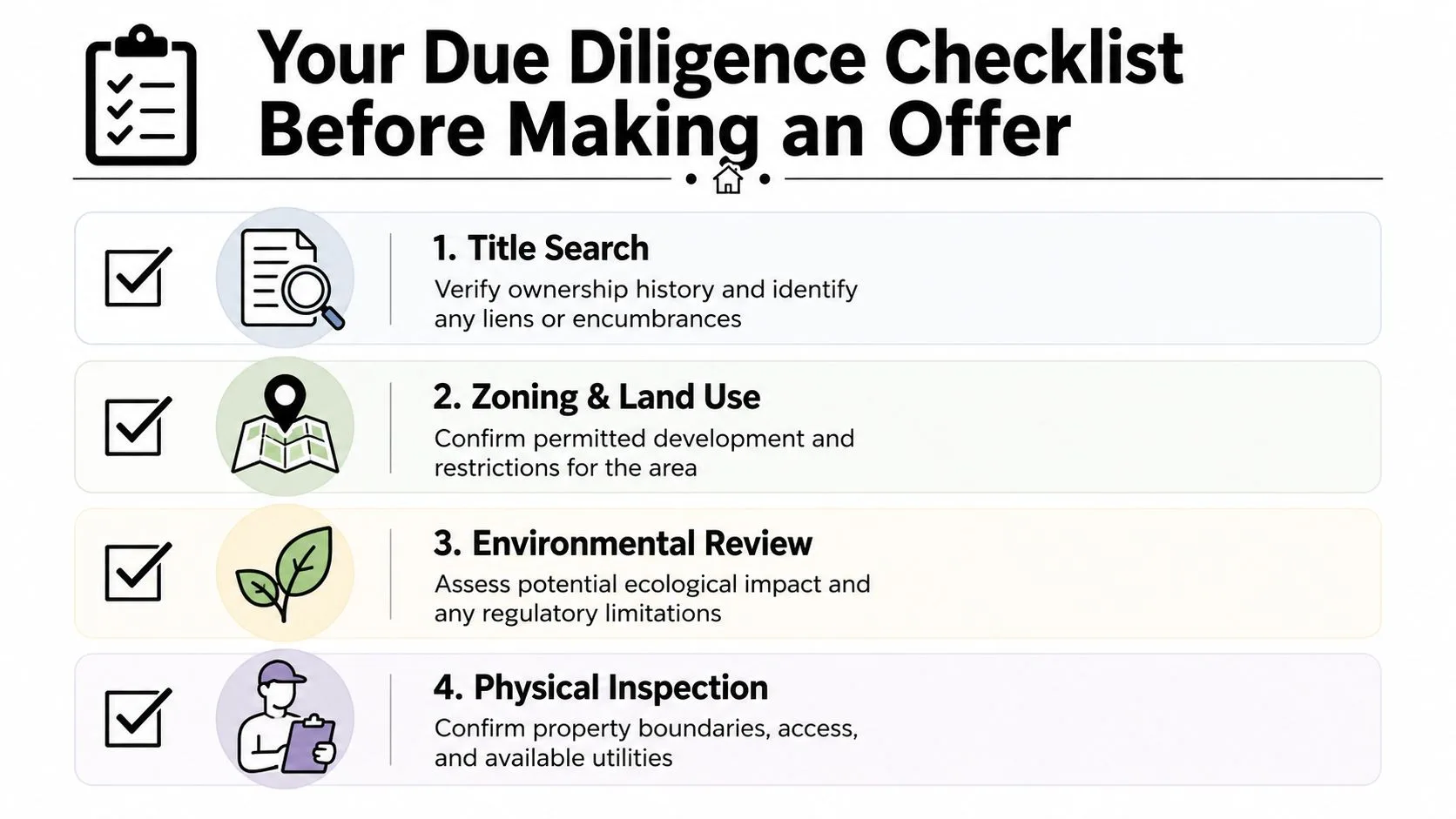
Start with the obvious question and verify it formally. Does the seller own the parcel, and do they have the authority to transfer it?
That review should go beyond the seller's statements and marketing package. You want the ownership chain examined, the deed reviewed, and the parcel status checked so you know you're dealing with private property rather than a land regime that creates transfer problems.
Also check for gravámenes, liens, claims, or other encumbrances that could affect transfer or future financing.
Match the paperwork to the ground
A surprising number of land problems aren't visible until someone compares the documents with the site itself. That means confirming the survey, dimensions, boundaries, and actual physical occupation of the land.
Questions to answer before you make an offer:
- Boundary accuracy: Do the legal dimensions match the parcel being shown?
- Access rights: Is road access legal and documented, or informal and tolerated?
- Neighbor conflicts: Are fences, walls, or uses crossing into the lot?
If the land is rural, irregular, or part of a larger tract that was divided over time, boundary work becomes more important, not less.
Never assume the pretty dirt road leading to a parcel is legally usable just because the seller drives you down it.
Verify use, restrictions, and buildability
Many buyers focus on whether they can own land in Mexico. Fewer ask whether they can use it the way they intend.
Before making an offer, verify the parcel's uso de suelo, local zoning context, and practical development constraints. If your goal is a residence, small compound, equestrian property, or future subdivision, you need to know whether those uses are allowed, limited, or likely to trigger further approvals.
A quick pre-offer review should include:
- Intended use fit: Can the site legally support what you want to build?
- Environmental limitations: Are there conditions or sensitivities that may slow approvals?
- Municipal posture: Is the area receiving development support, or resistance?
Investigate utilities before you fall in love
Utility access is where “cheap land” often stops being cheap.
A parcel can be attractive, well-located, and privately owned, yet still turn into a poor acquisition because water, power, drainage, or roadwork will be more difficult than expected. This is one reason seasoned buyers price the land and the path to usability together.
Use a simple pre-offer screening grid
| Question | Good answer | Warning sign |
|---|---|---|
| Ownership status | Seller can document private ownership clearly | Vague explanation, incomplete paperwork |
| Boundaries | Survey and site align | Dimensions feel approximate |
| Access | Legal, reliable ingress and egress | Shared or informal route |
| Buildability | Intended use appears compatible | Restrictions unclear |
| Utilities | Realistic service path | “Should be easy” with no proof |
The Full Cost of Acquiring and Owning Land
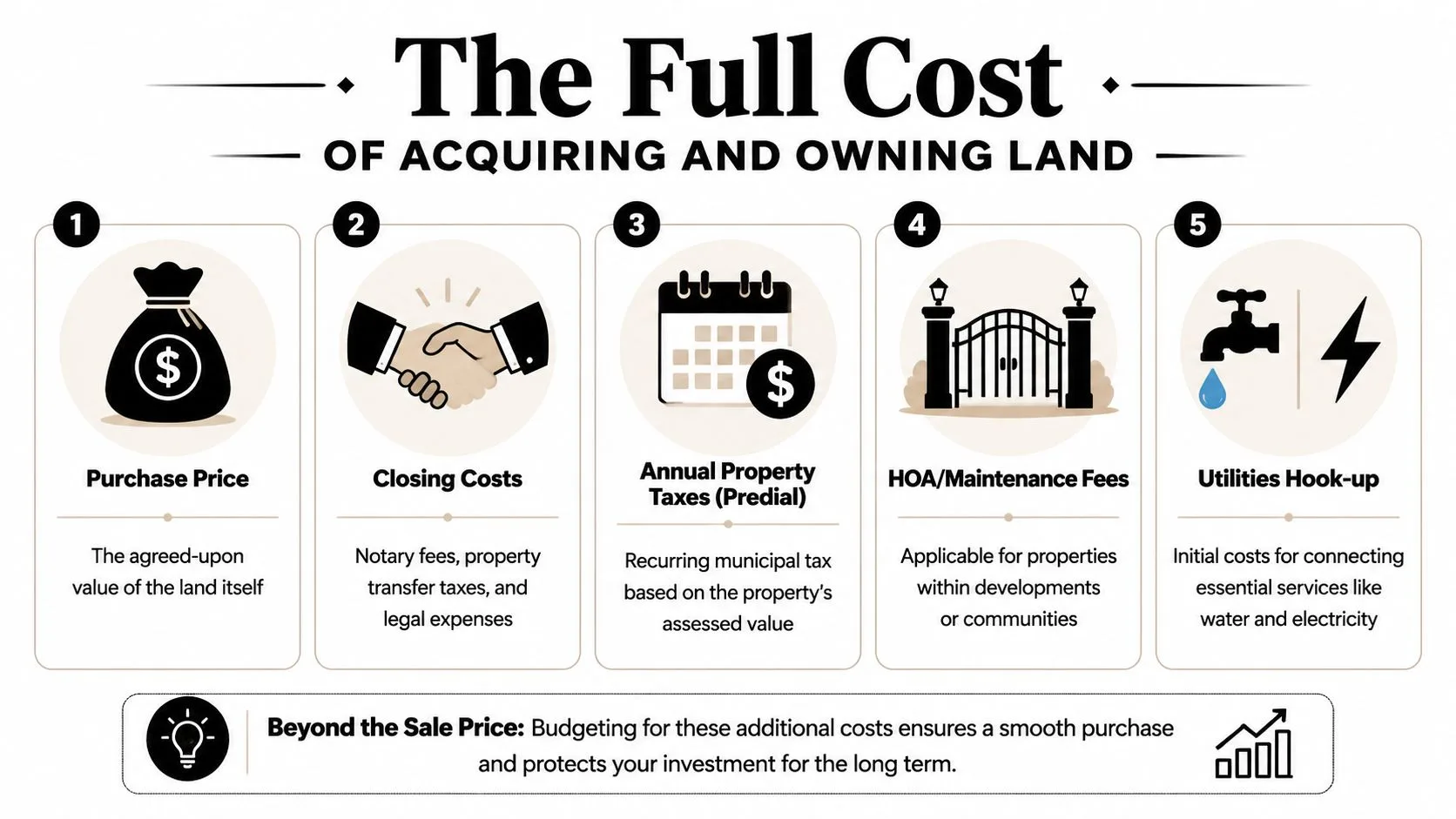
Buyers usually underestimate land cost in two places. First, they focus on closing and ignore pre-construction realities. Second, they compare parcels by asking price without adjusting for terrain, access, and utility strategy.
Transaction costs you should expect
The purchase price is only the opening number. A land acquisition also involves taxes, notary costs, registration expenses, legal review, and supporting documentation. If a trust structure is required in a restricted-zone deal, buyers also need to budget for the trust's setup and ongoing administration.
The exact total depends on the state, municipality, property profile, and complexity of the file. That's why serious buyers ask for a written closing estimate before they treat any parcel as financially viable.
For inland purchases, direct ownership can simplify the structure, but simplification is not the same as zero friction. Land still needs proper legal processing, and the notary's role remains central.
The cost category many buyers miss
Raw land has a hidden invoice attached to it. It's called site readiness.
According to Trading Economics' Mexico land area reference, citing World Bank data and terrain notes, Mexico's land area is 1,943,950 km² in 2023, and the country's terrain includes high mountains, coastal plains, high plateaus, and deserts, with elevation ranging from -10 m to 5,700 m. For a land buyer, that matters because slope, access, and physical conditions directly shape construction difficulty and utility extension.
A flat site near established roads and services is one financial profile. A scenic parcel with grade changes, drainage complications, and difficult access is another.
A more realistic budgeting lens
Instead of asking “What does this lot cost?” ask four separate questions:
- Acquisition cost: What will it take to close properly?
- Holding cost: What will annual ownership require, including predial and any community obligations?
- Preparation cost: What must happen before construction starts?
- Execution risk: Where can physical conditions expand the budget?
If you're comparing inland lifestyle markets, it also helps to understand the broader cost environment around living and building there. A local overview of the cost of living in San Miguel de Allende can help frame that context.
Cheap land often becomes expensive in the trenching, grading, retaining, and utility phase.
A practical cost screen
| Cost layer | What it covers |
|---|---|
| Closing | Taxes, notary, registration, legal support |
| Ownership | Predial and recurring community costs if applicable |
| Pre-build | Survey work, design review, permits, site prep |
| Infrastructure | Water, electricity, drainage, road improvements |
Spotlight on San Miguel de Allende A Premier Inland Market
A foreign buyer narrows the search to two parcels in Mexico. One is near the coast and immediately raises restricted-zone ownership questions. The other is in San Miguel de Allende, where direct ownership is often available and the actual work shifts to title review, land status, access, and utilities. For many high-net-worth buyers, that second path is cleaner and easier to manage.
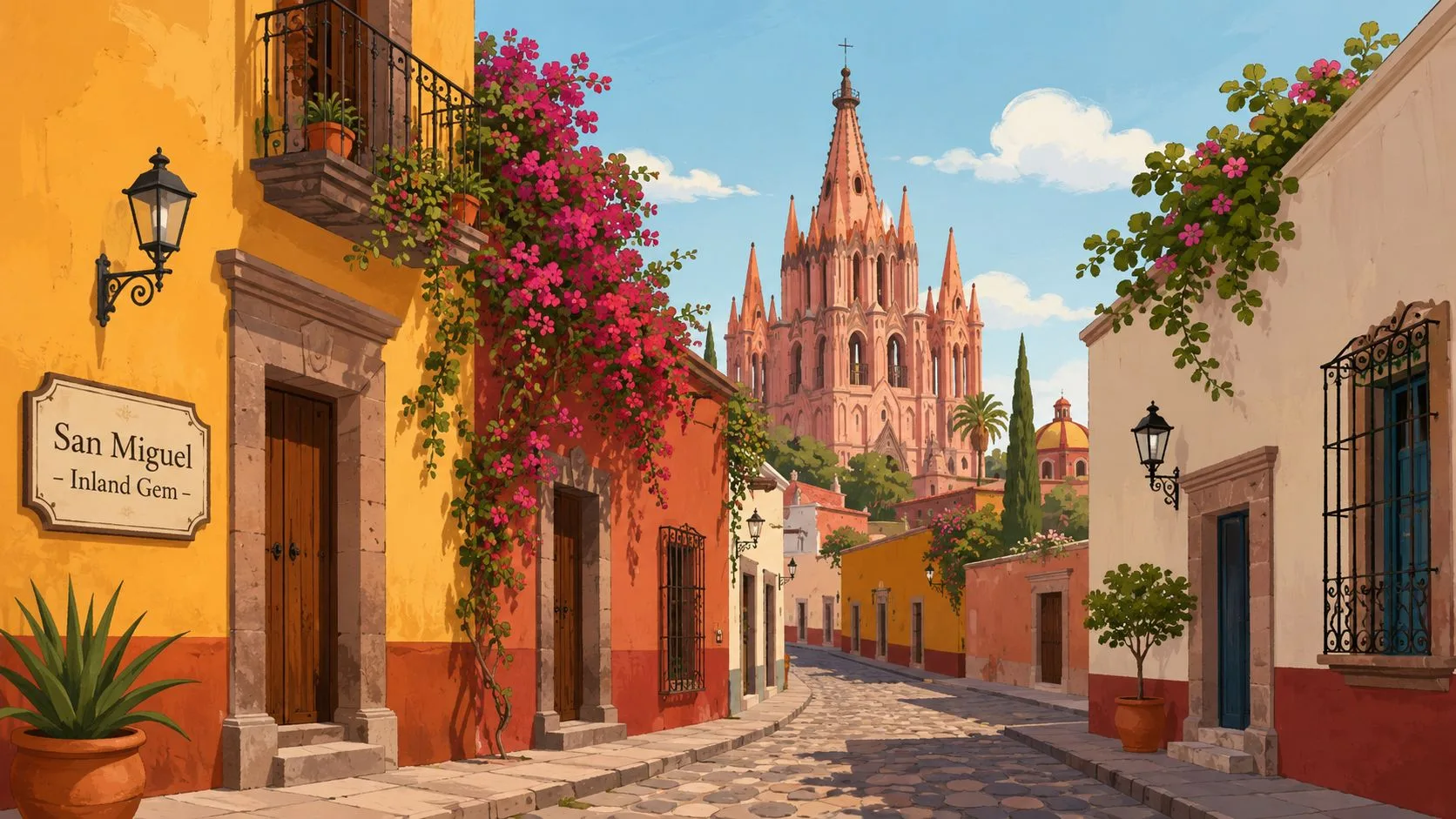
San Miguel de Allende stands out because it sits in an inland market where the ownership structure is usually simpler than in coastal acquisitions. That distinction matters. Many articles on buying land in Mexico spend most of their time on fideicomisos. In San Miguel, the bigger risks are often different. Buyers need to confirm that title is clean, the parcel is not Ejido land unless it has been fully regularized, and the intended use matches what can be built.
Market selection matters as much as legal structure. As Britannica's geography of Mexico explains, Mexico's scale and physical diversity create very different real estate conditions from one region to another. A buyer choosing San Miguel is not just choosing a beautiful town. The buyer is choosing a mature inland market with established residential demand, clearer neighborhood patterns, and a stronger base of local professionals who understand foreign transactions.
Why the inland position matters
In San Miguel de Allende, foreign buyers are often looking at direct-title ownership rather than a bank trust structure tied to restricted-zone property. That removes one layer of administration and cost from the purchase.
It does not remove risk.
In practice, the work becomes more grounded and more important. Verify the chain of title. Confirm whether the land is private property or has any Ejido history. Check road access, water, power, drainage, and topography in the context of your actual build plan. I have seen buyers focus too heavily on the fact that inland ownership is simpler, then miss the issues that delay projects: irregular parcel history, missing utility capacity, or a site that looks buildable until the survey and civil review are complete.
San Miguel also benefits from market legibility. In a city with established neighborhoods and active buyer demand, it is easier to judge whether a parcel fits a long-term residential strategy or only looks attractive on a listing sheet. That context helps buyers avoid fringe sites that are priced well for a reason.
For readers tracking local shifts in development, pricing, and community issues, San Miguel real estate and community news is a useful on-the-ground reference.
What makes San Miguel appealing beyond the legal side
Demand in San Miguel is supported by more than speculation. People buy here because they intend to live here, build here, or hold property in a market with durable lifestyle appeal. That usually creates better long-term support for land values than a story built only on cheap entry pricing.
The city's appeal is easy to see in motion:
San Miguel attracts buyers who care about architecture, walkability, culture, and community. That tends to produce a more disciplined land market. Buyers looking for a future home or legacy asset usually pay closer attention to location, serviceability, and resale depth than buyers chasing a quick appreciation story.
That is why San Miguel deserves special attention in an article about land in Mexico. Inland, direct ownership is often the easy part. Choosing a parcel with clean title, proper status, and realistic build potential is where good acquisitions are won or lost.
Your Path to Secure Land Ownership in Mexico
A foreign buyer can make a perfectly legal purchase in Mexico and still end up with the wrong asset.
I see that most often with inland land. The buyer spends too much time worrying about ownership structure and too little time asking the questions that affect resale, construction, and family transfer later. In San Miguel de Allende, direct ownership is often straightforward. The key separation between a strong acquisition and a problem file is usually title quality, Ejido risk, access, utilities, and whether the parcel fits the buyer's actual plan.
Good land buys are filtered early. Before money goes hard, serious buyers should have clear answers on five points: who owns the land today, whether the title history is clean, whether the parcel is private property rather than Ejido, whether legal and physical access are documented, and whether water, power, and build permissions are realistic for the intended project. If any one of those points stays vague, the right move is usually to slow down or walk away.
That discipline matters more than speed.
The buyers who protect capital in Mexico treat land like a long-hold asset, not a vacation impulse. They expect inconsistencies in files. They ask for supporting documents before they negotiate hard on price. They accept that a parcel can be attractive, well located, and still not worth buying if the paper trail or land status is weak.
If you're considering a land purchase in San Miguel de Allende and want grounded guidance from a team that works with international buyers every day, Inside San Miguel can help you evaluate parcels, spot avoidable risks, and move from interest to closing with far more clarity.