


You're probably doing what serious buyers always do before San Miguel becomes real. You're scrolling listings late at night, saving colonial homes with rooftop terraces, and trying to answer three practical questions at once: Where should I buy, what does good value look like, and what will ownership really cost me once the romance wears off?
That's the right way to approach homes in San Miguel de Allende, Mexico. The city delivers what people hope for. Historic streets, an unusually social international community, strong design culture, and a day-to-day life that feels richer than a resort and more personal than a large city. But buyers get into trouble when they shop on aesthetics alone. In San Miguel, two properties can both be called “luxury” and offer completely different outcomes for walkability, privacy, maintenance burden, rental appeal, and resale flexibility.
The market is also more layered than most aspirational articles admit. San Miguel de Allende recorded 44.5 thousand dwellings and a population of 174,615 in the 2020 census, with population growth of 8.87% from 2010 to 2020, according to Data México's San Miguel de Allende profile. That's large enough to support real neighborhood distinctions, but contained enough that location decisions matter.
Table of Contents
- Your Dream of a Home in San Miguel de Allende
- A Buyer's Guide to San Miguel Property Types and Prices
- Choosing Your Ideal Neighborhood in San Miguel de Allende
- San Miguel Real Estate Market Trends for 2026
- The Step-by-Step Purchase Process for Foreigners
- Essential Due Diligence, Taxes, and Ownership Costs
- Maximizing Your Investment and Planning Your Next Steps
Your Dream of a Home in San Miguel de Allende
Most buyers arrive at the same emotional starting point. They picture mornings with church bells in the distance, coffee in a courtyard, a short walk to the Jardín, and a home that feels more personal than what they left behind in the U.S. or Canada. That dream is legitimate. San Miguel can deliver it.
What changes the experience is whether the house matches the life you'll lead.
A couple may come convinced they want a grand colonial in Centro. Then they spend a week in town and realize they value quiet mornings, easier parking, and fewer stairs more than being in the middle of everything. Another buyer begins with a gated community search, then discovers that daily walks to cafés and galleries matter more than having newer finishes. Both can make smart purchases. Both can also make expensive mistakes if they choose by image instead of fit.
Practical rule: In San Miguel, the best home usually isn't the most photogenic one. It's the one whose trade-offs still feel acceptable after the honeymoon phase.
International buyers usually ask the right questions early. How close is too close to Centro if I want peace? Does “view property” mean steep access every day? Is a renovated colonial a joy to own, or a constant maintenance project? If I won't live there full-time, which homes are easiest to manage from abroad?
Those are the questions that matter more than broad luxury branding. San Miguel rewards buyers who define their priorities in plain terms: walkability, privacy, architectural character, maintenance tolerance, and whether the property needs to work as a second home, a primary residence, or a rental asset.
A Buyer's Guide to San Miguel Property Types and Prices
Buyers often arrive with a price range and a visual preference. What matters more is the exchange they are making between character, convenience, maintenance, and resale appeal. In San Miguel, two homes at a similar asking price can deliver very different daily lives.
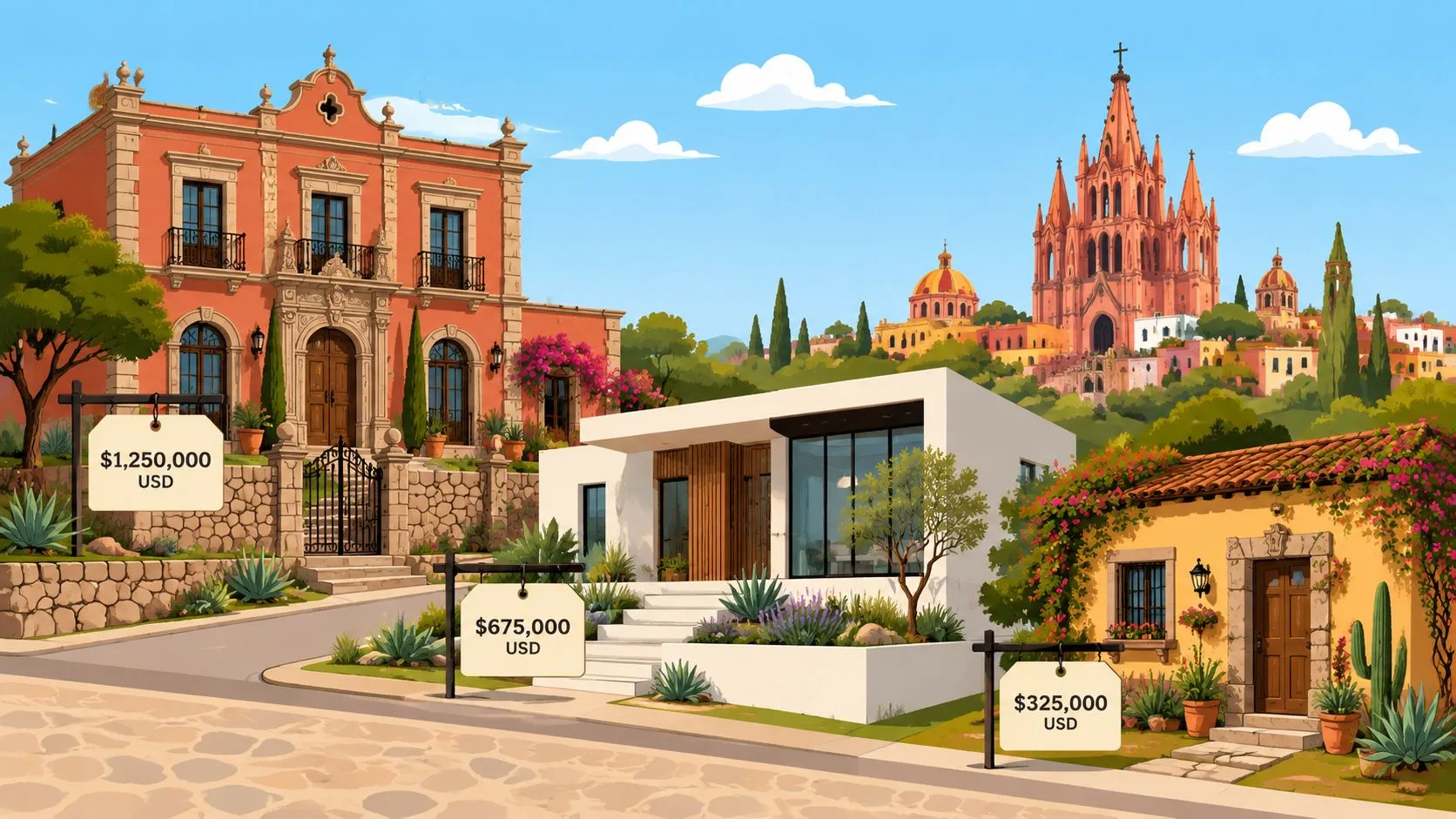
If you're comparing detached options, reviewing single-family homes in San Miguel de Allende is a practical way to see how sharply the product shifts between restored colonials, compact contemporary houses, and newer residences with managed services.
Historic colonials in and around Centro
This is the purchase that attracts many international buyers first. The appeal is clear. Courtyards, stonework, rooftop terraces, antique doors, and a sense of place that newer construction rarely matches.
The question is what you are paying for. With a colonial, a meaningful share of the value often sits in location, architecture, and emotional resonance, not day-to-day ease. A beautifully restored house near the historic core may offer less parking, steeper stairs, older infrastructure, and more ongoing oversight than a newer home farther out.
That trade-off can be worthwhile. Buyers who walk everywhere, entertain in a dramatic setting, and care a great deal about architectural authenticity usually feel well served by these properties. Buyers who want simple ownership sometimes discover that the romance is strongest on day one and the maintenance burden becomes clearer in month six.
Price variation in this category is wide. Condition, block-by-block location, light, views, and renovation quality can change value materially. The purchase price is only part of the commitment. Older homes also tend to require more preventive work, more staff coordination, and a higher tolerance for the unexpected.
Modern casitas and lock-and-leave homes
This segment suits disciplined buyers. A newer or recently updated casita usually gives up some historic atmosphere in exchange for more efficient systems, easier maintenance, and a layout that works better for seasonal use.
For many second-home owners, that is a smart trade. They want a comfortable base in San Miguel, not another property that needs constant supervision from abroad. Newer kitchens, fewer structural surprises, and simpler mechanical systems often matter more than hand-painted tile or old cantera details.
These homes can also make pricing easier to evaluate. You are usually comparing build quality, outdoor space, security, and location efficiency instead of trying to assign a premium to architectural rarity. That tends to produce fewer expensive emotional decisions.
Estates and gated community residences
At the upper end of the market, buyers usually sort into two camps. One group wants scale, privacy, gardens, staff support, and room to host family for extended stays. The other wants predictability, security, and a property that can sit empty for weeks without becoming a management project.
Large custom homes and hacienda-style estates can deliver tremendous presence. They can also carry the highest ownership drag. More square footage means more cleaning, more gardening, more maintenance, and more systems to monitor. If the house will be used heavily, that may be justified. If it will sit vacant much of the year, the economics deserve a sober look.
Gated residences appeal for a different reason. They often offer newer construction standards, easier oversight, and a more controlled ownership experience. The compromise is that they may feel less distinctive than a one-of-a-kind house in the older fabric of town.
A useful value framework is simple:
- Pay for proximity if daily walkability and immersion are central to how you plan to live.
- Pay for character if architectural identity matters enough to justify higher upkeep.
- Pay for scale only if you will use the guest rooms, gardens, and entertaining areas.
- Pay for ease if this will function as a second home and you want fewer operational demands.
Some buyers pay a premium for square meters. Others pay a premium for time saved, lower friction, and a stronger daily routine. In San Miguel, that distinction usually matters more than the listing category itself.
Choosing Your Ideal Neighborhood in San Miguel de Allende
You arrive for a one-month stay and test the life before you buy. On day two, the church bells charm you. By week three, you notice the uphill walk home, the search for parking when friends come for dinner, and how often you use the terrace versus how often you wish for a flatter route to coffee. In San Miguel, neighborhood choice is rarely about prestige alone. It is about which daily frictions are acceptable, and which ones will subtly reduce your enjoyment of the home.
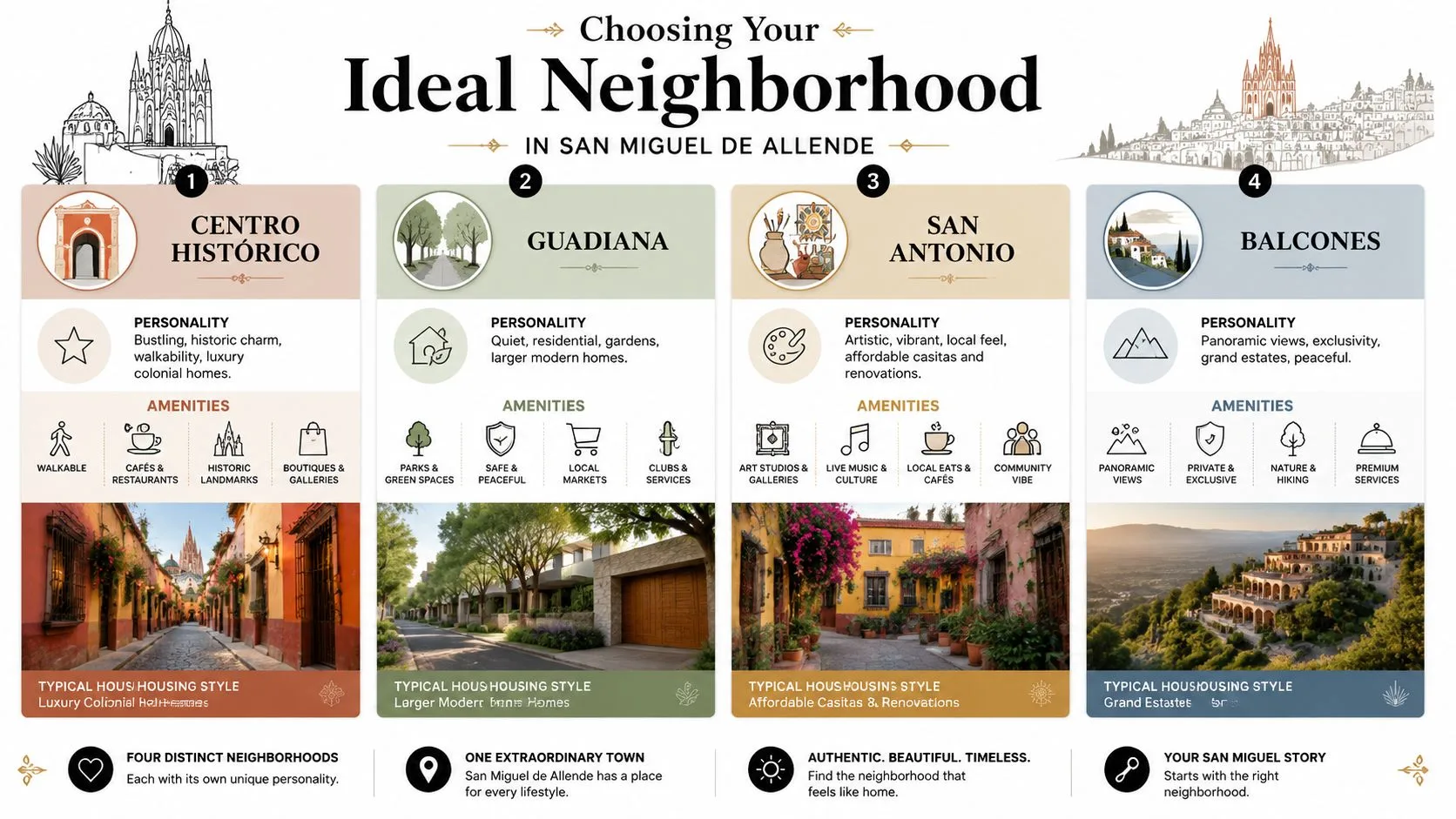
For buyers comparing central locations first, reviewing current context around Centro property in San Miguel de Allende is a practical way to calibrate what walkability, street activity, and historic charm look like in real listings.
The practical trade-offs buyers usually face
Centro Histórico suits buyers who want the city outside their front door. Restaurants, galleries, churches, and daily street life are part of the package. So are noise, tighter parking, older homes that often need more ongoing attention, and a level of activity that can feel festive or tiring depending on your routine. Buyers who walk everywhere usually accept that trade gladly.
Guadiana appeals to buyers who want to stay close to town without living in its busiest rhythm. The atmosphere is more residential, the streets often feel calmer, and the lifestyle tends to be easier for owners who plan to spend longer stretches in residence. The compromise is subtle rather than dramatic. You keep access, but lose some of the instant energy that makes Centro memorable.
San Antonio draws buyers who value texture over polish. It has a mixed fabric, a more local cadence in many pockets, and a wider range of homes, from simpler houses to renovated properties with strong personality. For an investor or end user willing to sort block by block, that variety can create opportunity. For a buyer seeking a uniformly finished luxury setting, it can feel inconsistent.
Ojo de Agua and Balcones attract a different profile. Views, privacy, and larger homes become more realistic here, and many properties have a stronger sense of retreat. The trade-off is practical, not theoretical. Steeper streets, more car dependence, and less spontaneous walkability change how often owners engage with town on foot.
Gated communities such as Vista Antigua, Ventanas, and Malanquin serve buyers who prioritize oversight, security, and predictable operations. That matters for second-home owners who may leave the property vacant for extended periods. The exchange is clear. You often gain easier management and more standardized infrastructure, while giving up some of the organic character that draws people to the historic fabric of San Miguel in the first place.
A neighborhood-by-neighborhood value framework
I advise buyers to judge each area against five questions tied to actual use, not marketing language:
How often will you walk, rather than plan to walk?
A ten-minute route on paper can feel very different once you account for hills, cobblestones, traffic, and carrying groceries.How much character do you want to maintain?
Historic homes can be highly rewarding, but they usually ask more of an owner in repairs, moisture control, and systems upgrades.What level of activity feels good after the novelty fades?
A lively street can support a rich social routine. It can also wear on buyers who value quiet mornings and early nights.How much management friction is acceptable?
Some homes require active oversight. Others are better suited to lock-and-leave ownership and remote administration.Who is the likely resale buyer?
The broadest audience usually sits in homes that balance walkability, good finishes, and manageable upkeep.
Price still matters, but neighborhood value in San Miguel is better understood through cost of ownership than through asking price alone. A less expensive historic home in a prime location can become the costlier decision if it needs constant attention, staffing, or infrastructure work. A newer home outside the core may look less romantic on day one and prove more efficient over five years.
A simple rule helps. Buy Centro for daily immersion. Buy Guadiana for balance. Buy San Antonio for character and flexibility. Buy the hills for privacy and views. Buy gated for lower operational demands.
San Miguel de Allende neighborhood comparison
| Neighborhood | Vibe/Character | Price Positioning | Walkability to Centro | Key Trade-Off |
|---|---|---|---|---|
| Centro Histórico | Historic, social, high-energy, prestige-driven | Premium for location and charm | Excellent | Higher street activity, parking limits, older housing stock |
| Guadiana | Residential, calmer, green, established | Premium, often supported by livability | Good | Less of the immediate buzz of the historic core |
| San Antonio | Artistic, mixed, vibrant, less formal | Broad range depending on block and finish | Good to moderate | More variation in streetscape and housing consistency |
| Ojo de Agua | Elevated, private, scenic, upscale | Upper-tier | Moderate | Hills and reduced day-to-day walkability |
| Balcones | Exclusive, peaceful, view-oriented | Upper-tier to luxury | Moderate to limited | Greater car reliance in exchange for outlooks and scale |
| Gated communities | Structured, secure, easier to manage | Varies by project and finish level | Usually limited | Less historic texture, more separation from town life |
San Miguel Real Estate Market Trends for 2026
A buyer sees two homes at a similar asking price. One is a restored property near Centro with charm, rental appeal, and constant foot traffic outside the door. The other sits in a quieter pocket with better parking, newer systems, and lower day-to-day friction. In San Miguel, market trend analysis matters because price alone rarely explains value.
Why the market stays resilient
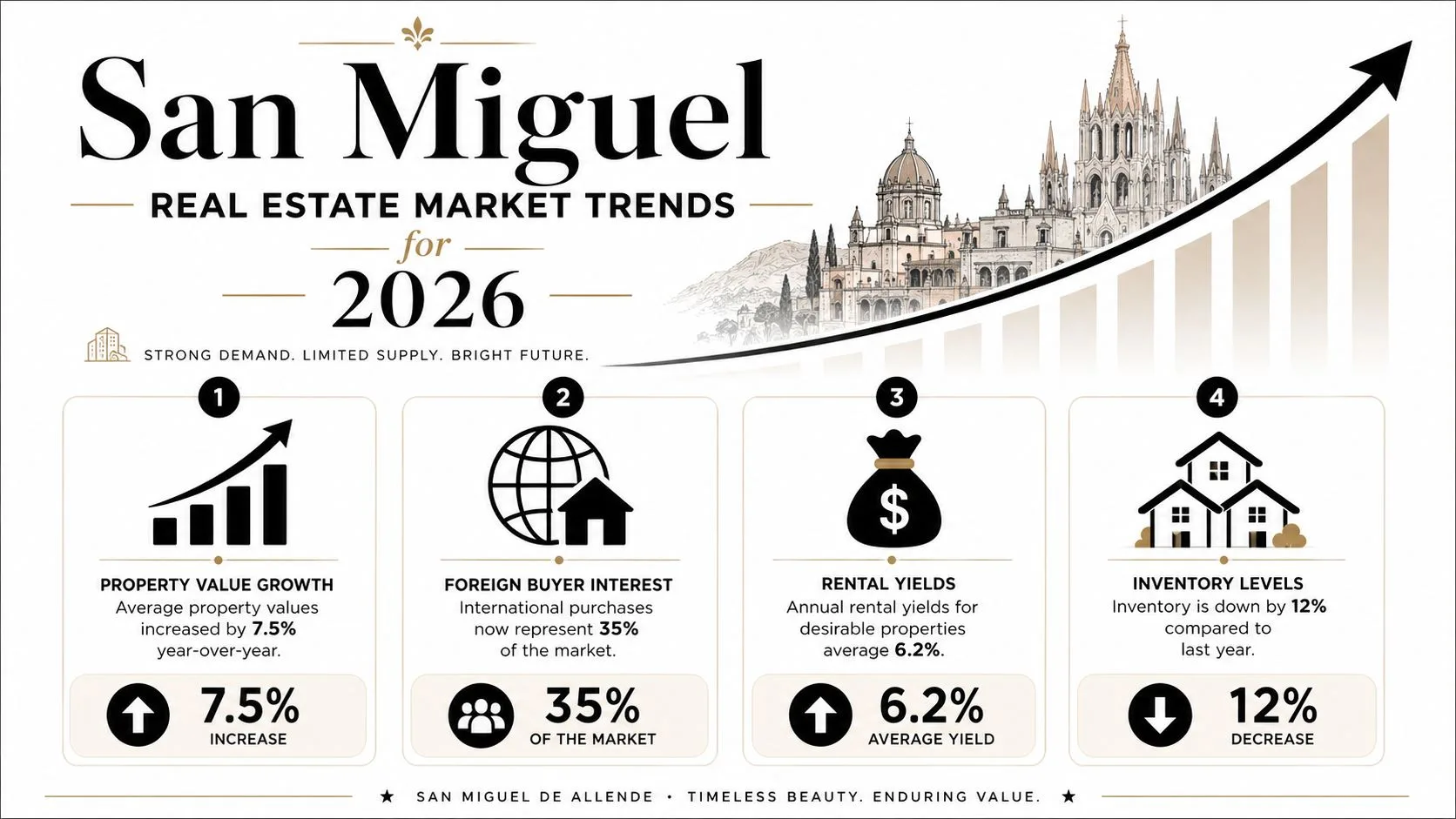
San Miguel continues to hold buyer attention for practical reasons. Supply in the most sought-after areas stays limited by historic preservation, lot constraints, and a buyer pool that is broader than the local luxury segment alone. Well-located homes do come to market, but particularly compelling inventory remains selective once a client wants walkability, architectural character, modern infrastructure, privacy, and easy ownership in the same property.
The market also operates in tiers. Premium demand from foreign retirees, second-home owners, and lifestyle investors sits alongside local family housing and workforce housing. That split matters. It explains why broad inventory counts can sound healthy while qualified buyers still struggle to find the right house at the right standard.
Second-home demand adds another layer. Buyers looking at vacation homes in San Miguel de Allende are usually measuring more than square footage. They are weighing lock-and-leave practicality, staffing needs, guest use, seasonal occupancy, and whether the home can carry part of its cost when they are away.
What 2026 buyers should watch
Price resilience is strongest where replacement is difficult. That usually means restored homes in established neighborhoods, houses with flat walkability, and properties that combine colonial character with updated plumbing, electrical, and water systems. Buyers still pay a premium for beauty, but in 2026 they are more disciplined about hidden ownership costs.
That is a key shift. Discerning buyers are underwriting the full carry, not just the purchase price. A lower acquisition number can lose its appeal quickly if the property needs staff oversight, stonework repair, roof maintenance, frequent water delivery, or extensive upgrades to make it function at an international standard.
Rental demand still influences pricing behavior, especially for turnkey homes in areas with proven guest appeal. But I would not treat every property as an income asset first. The stronger framework is to ask what the home buys in lifestyle terms, then test whether rental use is a realistic bonus rather than the reason to proceed.
In practice, the 2026 market favors buyers who are selective, well-advised, and clear about trade-offs. The winning purchases are rarely the cheapest or the flashiest. They are the homes where location, usability, maintenance profile, and resale depth line up.
The Step-by-Step Purchase Process for Foreigners
Buying in San Miguel is usually simpler than many foreign buyers expect, but only if the file is handled carefully from the beginning. The practical advantage here is location. San Miguel is inland, so the ownership structure is generally more straightforward than in Mexico's restricted coastal zones.
A strong local guide still matters because the process depends on disciplined sequencing, not just a signed offer.
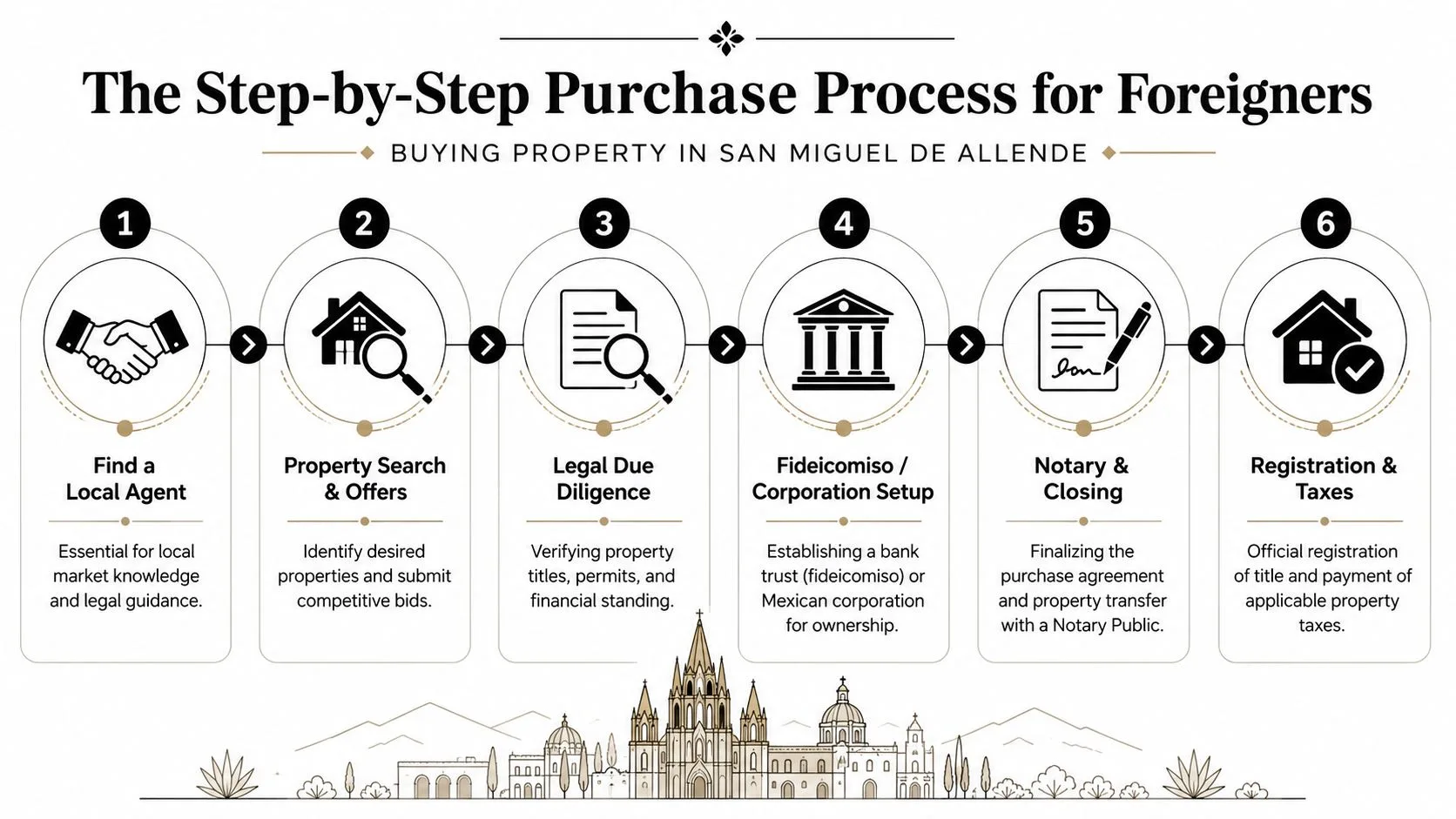
How the process usually unfolds
Define the brief before touring seriously
Buyers waste time when they search by beauty instead of criteria. Decide first whether this is a primary home, second home, or mixed-use property. Clarify your essential requirements: flat walkability, garage, outdoor space, rental potential, staff quarters, or turnkey condition.Work with an agent and legal counsel who know local practice
An estate advisor helps you source and negotiate. The attorney reviews legal risk. The notario público formalizes and records the transaction. These roles are not interchangeable.Make an offer with clean terms
Price matters, but so do contingencies, deposit timing, inclusions, possession date, and how repairs or title issues will be handled if discovered.
A practical overview for U.S. buyers comparing structures and local procedures is available in this guide on buying property in Mexico as an American.
A short video can also help orient first-time foreign buyers before they review contracts and ownership documents.
Complete due diligence before closing pressure builds
This includes title review, confirmation of ownership history, checking for liens or disputes, and verifying that the built reality matches the legal file. If additions were made over time, buyers need clarity on permits and regularization.Move funds through the agreed process and prepare closing
Funds, signatures, tax calculations, and notarial documentation need to align precisely. Cross-border buyers should also plan for timing. International transfers and document certifications can slow down an otherwise straightforward closing.Close and register properly
Possession is only one milestone. Formal registration matters. So does post-closing organization of utilities, management, insurance, and contractor access if any work is planned.
Where foreign buyers need to slow down
The risky moment isn't when you first see the house. It's when you decide you're in love with it and start treating verification as a formality.
Three areas deserve extra discipline:
Historic modifications
Older homes may have evolved over many years. Confirm what is original, what was added, and whether everything material is reflected correctly in the file.Seller readiness
A good property can still have a messy transaction file. Ask early whether the seller's documentation is complete and current.Operational reality
If you'll own from abroad, the transaction should include a plan for management, maintenance access, and practical oversight after closing.
Essential Due Diligence, Taxes, and Ownership Costs
A buyer falls in love with a colonial home in Centro. The price feels justified. Then the actual ownership math starts. Annual upkeep is higher than expected, the roof and courtyard need regular attention, property management becomes necessary, and the home that looked perfect for six weeks a year starts behaving like a small operating business.
That is the right moment to judge value clearly.
In San Miguel, price and value are related but not identical. A higher purchase price may buy walkability, views, architectural pedigree, or outdoor entertaining space. It can also buy more maintenance, more staffing, and more decisions from abroad. Discerning buyers do well here when they measure the full cost of ownership against the way they will truly live.
The ownership budget that matters before you make an offer
I advise clients to underwrite a San Miguel purchase in four separate buckets, because each one reflects a different lifestyle trade-off.
Closing and acquisition costs
Notary fees, taxes, permits, legal work, translations, and registration costs need to be modeled from the start. The exact figure depends on the property, the buyer structure, and the transaction history. A serious budget should come from the closing team handling the file, not from a casual percentage estimate passed around at a dinner party.
Recurring maintenance and staffing
Recurring maintenance and staffing can make many beautiful homes stop looking inexpensive. Older houses often require regular roof checks, waterproofing, stone and plaster care, pool service if applicable, gardening, cleaning, and periodic systems work. A lock-and-leave condo and a restored estate with terraces and a courtyard may have similar emotional appeal, but they do not produce the same ownership burden.
Feature-driven carrying costs
Pools, fountains, expansive gardens, large terraces, rooftop kitchens, and detached guest casitas improve the lifestyle. They also create recurring work. Every additional feature should be treated as an intentional operating choice. If you will use the home seasonally, ask a simple question: who is checking, cleaning, servicing, and paying attention when you are not there?
Location premium versus usability
Centro pricing often reflects convenience first. Buyers pay for proximity to restaurants, galleries, and daily walkability. That premium can be worth every dollar for an owner who wants to live on foot. It is less compelling for someone who prefers quiet nights, easier parking, larger grounds, or newer infrastructure. The right comparison is not cheap versus expensive. It is convenience versus space, charm versus simplicity, prestige versus ease.
This value framework helps buyers avoid a common mistake. They compare homes by list price when they should compare them by total annual cost, practical friction, and actual use.
Taxes and fees deserve the same level of attention as the house itself
Tax treatment depends on the structure of the transaction, the seller's position, and how the property will be used after closing. Buyers should expect transfer-related costs at acquisition and should also ask their legal and tax advisers to explain ongoing property tax obligations, any trust-related costs if applicable, insurance requirements, and the tax consequences of future resale or rental activity.
Cross-border owners need this mapped early. A property that feels manageable at purchase can become expensive if the ownership structure is poorly chosen or if rental plans were never reviewed with counsel.
Due diligence should test future livability, not just legal transfer
Legal review matters. So does operational review.
A disciplined buyer confirms that title is clean, liens are cleared, and the seller has authority to transfer. That is the baseline. The stronger approach is to examine whether the home will be easy to own after closing.
Focus on these points:
Documented improvements
Older San Miguel homes are often renovated in stages. Confirm that material additions, structural changes, terrace work, subdivided spaces, and service areas are properly reflected in the file.Water, drainage, and service reliability
Ask how the property functions in practice. Water storage, pressure, drainage, internet quality, backup systems, and service access affect daily life more than a polished listing description.Access and parking reality
A romantic street can still be inconvenient for drivers, guests, service staff, or owners with mobility concerns. Visit at different times of day if this will matter to your household.Noise and event exposure
Some buyers want to be close to the energy of town. Others want protected quiet. You are buying both the house and its sound profile.Absentee ownership logistics
If you live abroad, identify the manager, housekeeper, gardener, pool technician, keyholder, and repair coordinator before closing. Waiting until after possession usually leads to preventable problems.
The practical test is simple. If a home is beautiful but requires constant attention, specialized contractors, difficult access, or high-touch supervision, its true cost is higher than the asking price suggests.
That does not make it a bad purchase. It makes it the right purchase only for the buyer who wants that version of San Miguel.
Maximizing Your Investment and Planning Your Next Steps
A buyer falls in love with a restored colonial home near the historic core. The terraces photograph beautifully, the address feels prestigious, and the asking price seems justified. Then the real ownership picture comes into focus. Street access is tight, guest parking is inconsistent, water pressure varies, and every repair requires coordination from abroad. In San Miguel, value is never just the purchase price. It is the fit between the house, the neighborhood, and the amount of attention the property will demand from you.
The strongest investments here usually serve two purposes well. They support the way you prefer to live in San Miguel, and they remain practical to hold, use, or rent when you are away. Those are not always the same thing. A dramatic hillside house with views may win on architecture and lose on daily convenience. A simpler home in a walkable area may produce a better ownership experience over time.
Rental performance follows the same logic. Homes that attract steady guest interest usually remove friction. They offer a location people can understand quickly, whether that means easy access to Centro or a clear destination appeal such as views, privacy, or a managed community. They also function well in ordinary ways. Reliable utilities, straightforward entry, usable outdoor space, and a layout that does not create constant service calls matter more than luxury language in a listing.
Before you make an offer, test the property as an operator would, not just as a weekend guest.
Documented improvements
Many older San Miguel homes have been expanded or reworked over time. Confirm that additions, structural modifications, rooftop or terrace work, service areas, and divided spaces are properly reflected in the file.Water, drainage, and service reliability
Ask how the house performs day to day. Cistern capacity, pressure, drainage, internet strength, backup systems, and vendor access shape daily life more than polished finishes.Access and parking reality
Charming streets can be difficult for drivers, deliveries, service staff, or owners with mobility concerns. Visit at more than one time of day if this will affect your household.Noise and event exposure
You are buying the sound profile along with the house. Some buyers want church bells, celebrations, and street life nearby. Others will pay more for protected quiet.Absentee ownership logistics
If you live outside Mexico, line up the manager, housekeeper, gardener, pool technician, keyholder, and repair coordinator before closing. Doing this after possession usually creates avoidable problems.
This is the value framework I use with clients. If a home is beautiful but needs constant supervision, specialized contractors, difficult access, or hands-on management, its real carrying cost is higher than the price sheet suggests. That does not make it a poor purchase. It makes it the right purchase for a buyer who wants that version of San Miguel and is prepared to own it properly.
If you want structured local help, Inside San Miguel offers MLS-connected property search support, bilingual guidance, and coordination with local professionals for buyers evaluating homes in San Miguel de Allende, Mexico.
A careful purchase in San Miguel starts with clarity. If you're ready to compare neighborhoods, review homes that match your lifestyle, and pressure-test the ownership costs before making an offer, Inside San Miguel is a practical place to begin that conversation.