

Most advice on how to buy property in Mexico starts in Cancún, Tulum, or Los Cabos. That's where the confusion begins. Buyers read about bank trusts, Ministry permits, and annual trust fees, then assume every purchase in Mexico works that way.
It doesn't.
If you're buying in San Miguel de Allende, you're dealing with an interior city, not a coastal restricted zone. That changes the legal structure, the timeline, and often the level of complexity. The process is still formal, still document-heavy, and still something to handle carefully. But it's more straightforward than many foreign buyers expect.
This is the practical version. No fantasy about “easy overseas buying,” and no recycled coastal advice that doesn't apply to San Miguel.
Table of Contents
- The Fideicomiso Myth Direct Ownership in San Miguel
- Building Your A-Team The Notario Agent and Lawyer
- From Offer to Keys Navigating the Closing Process
- The True Cost of Paradise Budgeting for Your Purchase
- Finalizing the Deal Payments Currency and Registration
- Conclusion Your Seamless Move to San Miguel
- Frequently Asked Questions
The Fideicomiso Myth Direct Ownership in San Miguel
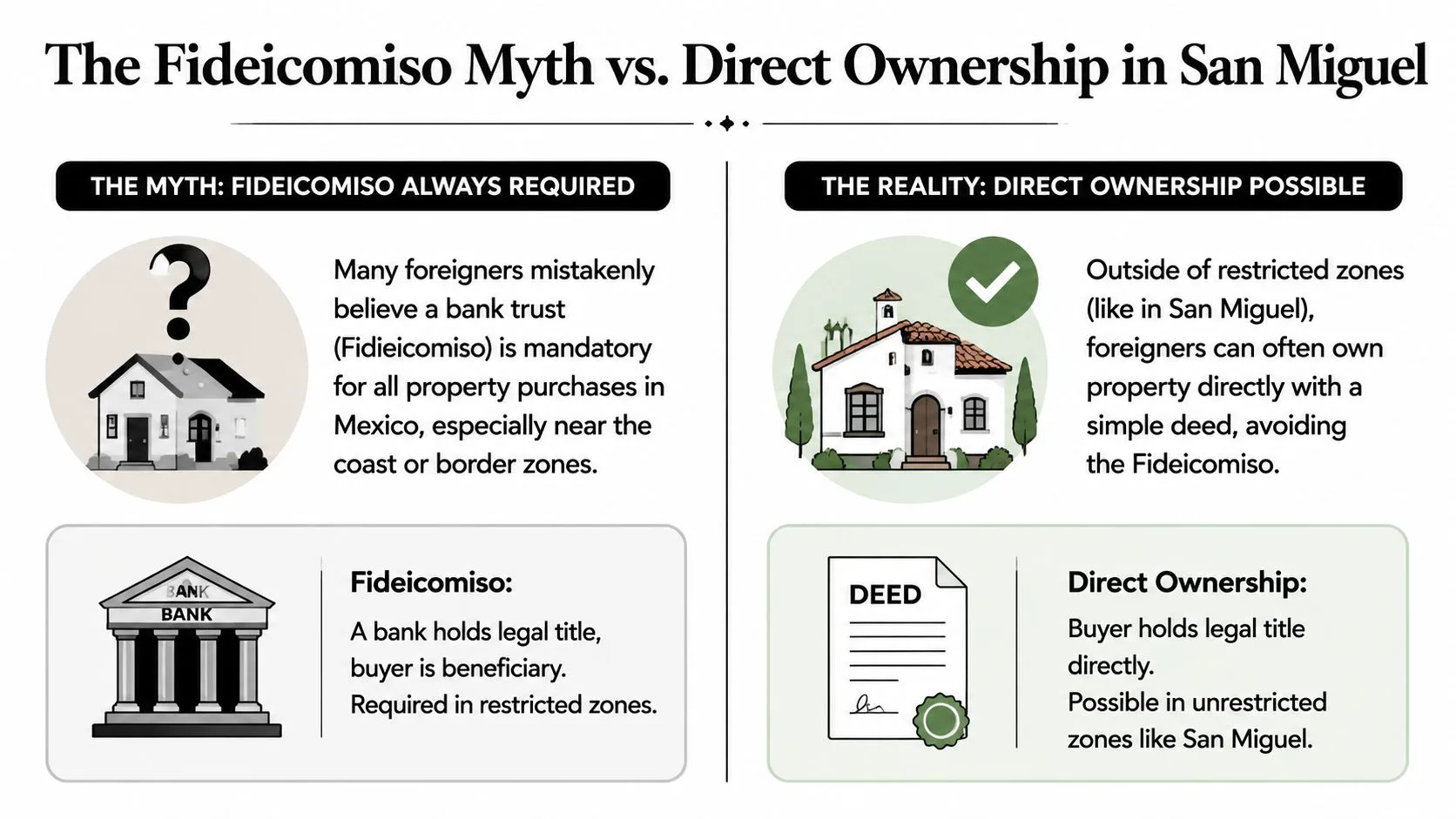
Many foreign buyers start with the wrong assumption. They think every property purchase in Mexico requires a bank trust. In San Miguel de Allende, that is usually false.
Mexican law limits direct foreign ownership only in the restricted zone, which includes property within 50 km of the coast or 100 km of an international border. In those areas, a fideicomiso is the standard structure. Outside that zone, a foreign buyer can usually hold title directly through an Escritura Pública. San Miguel is an interior city, so purchases here generally follow the simpler path.
What this means in San Miguel
This matters for cost, timing, and paperwork.
In San Miguel, foreign buyers can often take title in their own name without opening a bank trust. That usually means fewer documents, fewer parties involved, and fewer bank-related fees than a comparable purchase in a coastal market. The process still requires proper due diligence and formal closing steps, but the ownership structure itself is more straightforward.
I often see buyers arrive with a checklist built for Los Cabos or Puerto Vallarta. That checklist creates confusion in San Miguel because it solves for the wrong legal question. The first question here is not whether a fideicomiso is available. It is whether the property is in the restricted zone. For San Miguel, the answer is generally no.
Practical rule: In San Miguel, start by confirming the property is outside the restricted zone, then structure the purchase for direct ownership from the beginning.
A quick comparison makes the difference clear:
| Location type | Ownership structure for foreign buyer | Key implication |
|---|---|---|
| Coastal or border restricted zone | Fideicomiso | Bank trust required |
| Interior city like San Miguel | Direct title via Escritura Pública | No bank trust required |
What buyers get wrong
A common mistake is applying coastal rules to inland property.
Another is assuming that direct ownership means a loose or informal process. It does not. The deed still has to be prepared correctly. Title still has to be reviewed. Taxes and registration still have to be handled in the proper order. Direct ownership removes one layer of structure. It does not remove the legal work.
This point becomes even more important with lots, ranch parcels, or development property, where zoning, land use, and property history can affect what you are buying. Buyers looking at those opportunities should review the local issues covered in this guide to land in Mexico.
The better question
Buyers get better answers when they ask the right question.
Instead of asking whether foreigners can buy property in Mexico, ask which ownership structure applies to this specific property. In San Miguel, the answer is usually direct ownership in your own name through a standard deed. For many international buyers, that is the detail that turns Mexico from “complicated” into manageable.
Building Your A-Team The Notario Agent and Lawyer
In San Miguel, buyers usually do not need a bank trust. They do need the right people around the transaction.
That distinction matters. Direct ownership is simpler than the restricted-zone structure covered in generic Mexico guides, but it still depends on good coordination between the professionals handling your purchase.

The Notario is not a U.S. notary
Foreign buyers often underestimate this role.
A Notario Público in Mexico is a specially appointed attorney with authority to formalize real estate transfers. The Notario reviews the legal file for the deed, confirms the chain of title, checks for liens and unpaid taxes, calculates transfer costs, and prepares the escritura pública for signature and registration.
In practice, timing matters. I tell buyers to involve the Notario early, because title issues, missing seller documents, permit questions, or tax discrepancies are easier to fix at the start than a week before closing.
The strongest transactions are rarely the fastest ones. They are the ones where the legal file is clean early.
What each professional should do
A good transaction has clear job boundaries.
- Real estate advisor: Guides pricing, neighborhood selection, offer strategy, negotiation, and day-to-day coordination between buyer, seller, and closing parties.
- Lawyer: Reviews contracts from the buyer's side, explains risk, and catches terms that may be unfavorable even if they are common in local practice.
- Notario Público: Formalizes the transfer, verifies the legal status of the property, calculates taxes and fees, and issues the deed for registration.
In San Miguel, the best results usually come when these three roles work in parallel, not in sequence. If you want a practical example of the kind of buyer representation that helps keep a cross-border purchase organized, this overview of a real estate investment advisor shows what that support can include.
Where buyers get into trouble
Problems usually start with assumptions.
Some buyers assume the agent handles legal review. A good agent should spot obvious concerns and keep the process on track, but the agent does not replace your lawyer or the Notario. Others assume the Notario represents them personally. The Notario is a public official responsible for the legality of the transfer, not a private advocate focused only on the buyer's position.
That is the trade-off to understand. The process in an interior city like San Miguel is more direct because there is no fideicomiso layer in a standard purchase, but direct ownership does not mean informal ownership. Contracts still need review. Property records still need confirmation. Closing figures still need to be checked before funds move.
A practical hiring order
Buyers usually make better decisions when they build the team before the negotiation gets serious.
- Choose your advisor first. Local pricing, neighborhood differences, and resale factors should shape the offer.
- Hire your lawyer before the deposit terms become firm. That is when contract language has the most financial impact.
- Open the Notario file early. If any document is missing or any tax issue needs correction, you want time to fix it without pressure.
That approach keeps emotion in its place. San Miguel is a city people fall in love with quickly. The right team lets you enjoy that part without treating the legal process casually.
From Offer to Keys Navigating the Closing Process
In San Miguel, closing is usually more direct than foreign buyers expect. The big reason is simple. In a standard purchase here, you are buying in Mexico's interior, so the process does not carry the extra bank trust layer that dominates so many generic guides about coastal property.
That does not make the transaction casual. It makes the sequence easier to manage if each step is handled in order and the paperwork is reviewed before money changes hands.
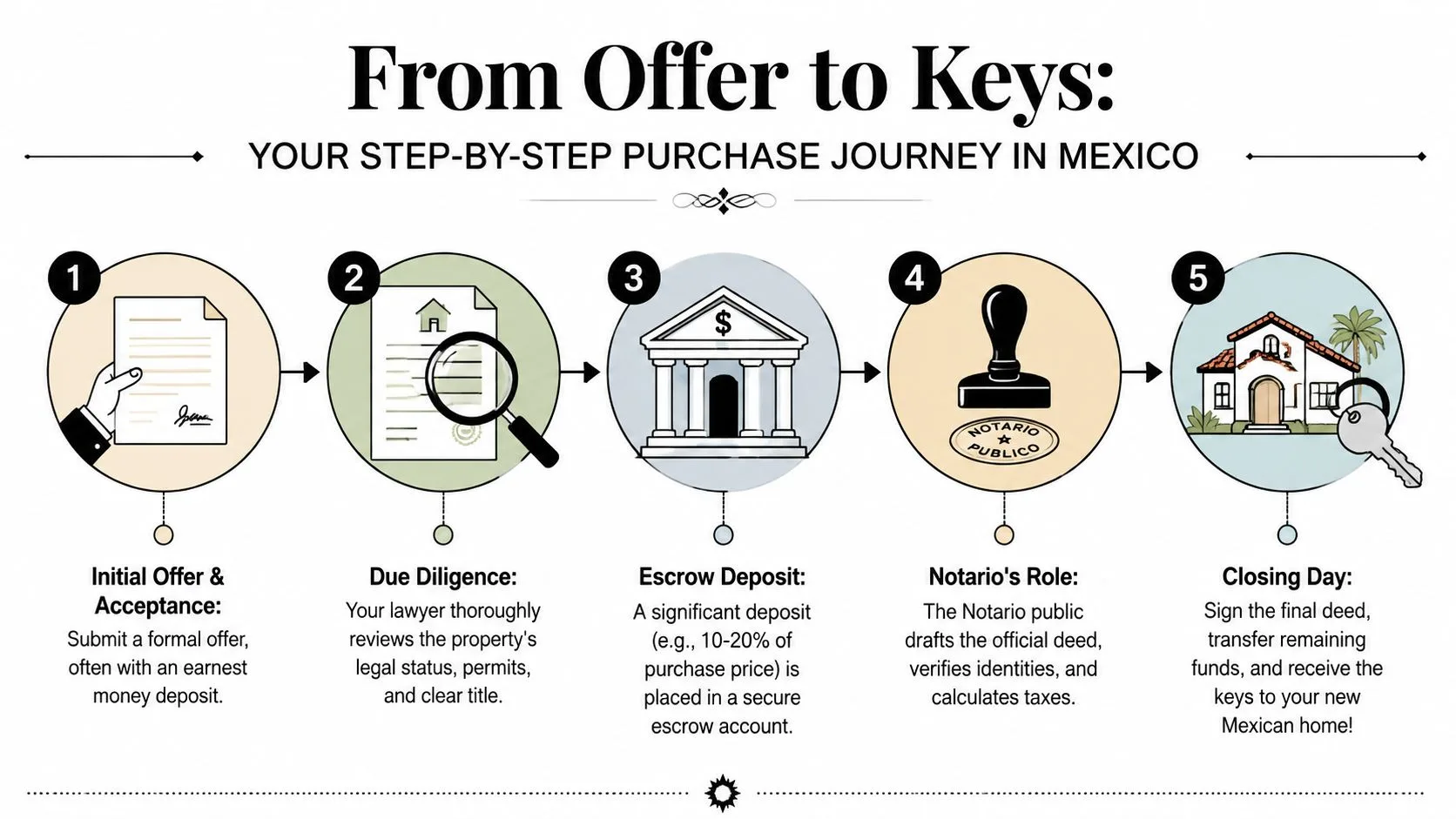
The sequence that usually works best
A typical San Miguel transaction follows a predictable path:
Offer and acceptance
Buyer and seller agree on price, timing, included items, and core terms.Preliminary contract
The first binding agreement sets out the deposit, deadlines, contingencies, and what must happen before closing.Deposit and file review
The agreed deposit is placed according to the contract terms, and the legal review starts. The Notario gathers the official file, and the buyer's lawyer reviews title history, liens, property tax status, utility records, and seller documents.Closing preparation
Final figures are confirmed, payment logistics are organized, and the deed is prepared in Spanish for formal execution.Signing and possession
The parties sign before the Notario, funds are released under the agreed structure, and possession is delivered according to the contract.
One point deserves attention. The controlling legal documents are in Spanish. English translations are useful for understanding the deal, but they do not replace the Spanish version that is signed and registered.
Here's a useful overview before we go deeper:
Where transactions usually go off track
Problems usually start before closing day.
The first pressure point is the deposit. Buyers get excited, the seller wants commitment, and someone sends draft instructions before the legal review is far enough along. I tell clients to slow that moment down. A deposit is easy to send and much harder to recover if the contract language is weak or the property file raises questions later.
The second pressure point is assumptions about the property itself. A home can look immaculate and still need document cleanup. I have seen delays caused by old tax discrepancies, missing marital status records, inconsistent lot measurements, and prior paperwork that never got updated properly. None of that means the deal is bad. It means the file needs to be cleaned up before signing.
The third pressure point is language. If you do not read legal Spanish comfortably, do not rely on summaries or casual explanations. Get the contract explained line by line before you sign or wire funds.
If you are still deciding whether the property will be a second home, rental, or mixed-use purchase, reviewing the local inventory in vacation homes in San Miguel de Allende can help clarify how you plan to use the home before you commit to specific terms.
Buyer's note: The safest transactions are rarely the fastest ones. They are the ones where the contract, title review, and payment instructions line up before the deadline pressure starts.
Closing day in practical terms
Closing in Mexico is formal and document-driven. The Notario's office verifies identity, calculates taxes and fees, prepares the deed for signature, and handles the documents required for registration.
For foreign buyers in San Miguel, that usually feels more orderly than expected. There is less structural complexity than a restricted-zone purchase, but the file still has to be complete. When the preparation has been done properly, closing feels clear. Everyone knows what is being signed, what is being paid, and when possession transfers.
The True Cost of Paradise Budgeting for Your Purchase
The purchase price is rarely the number that catches foreign buyers off guard in San Miguel. The surprise is the cash required to close.
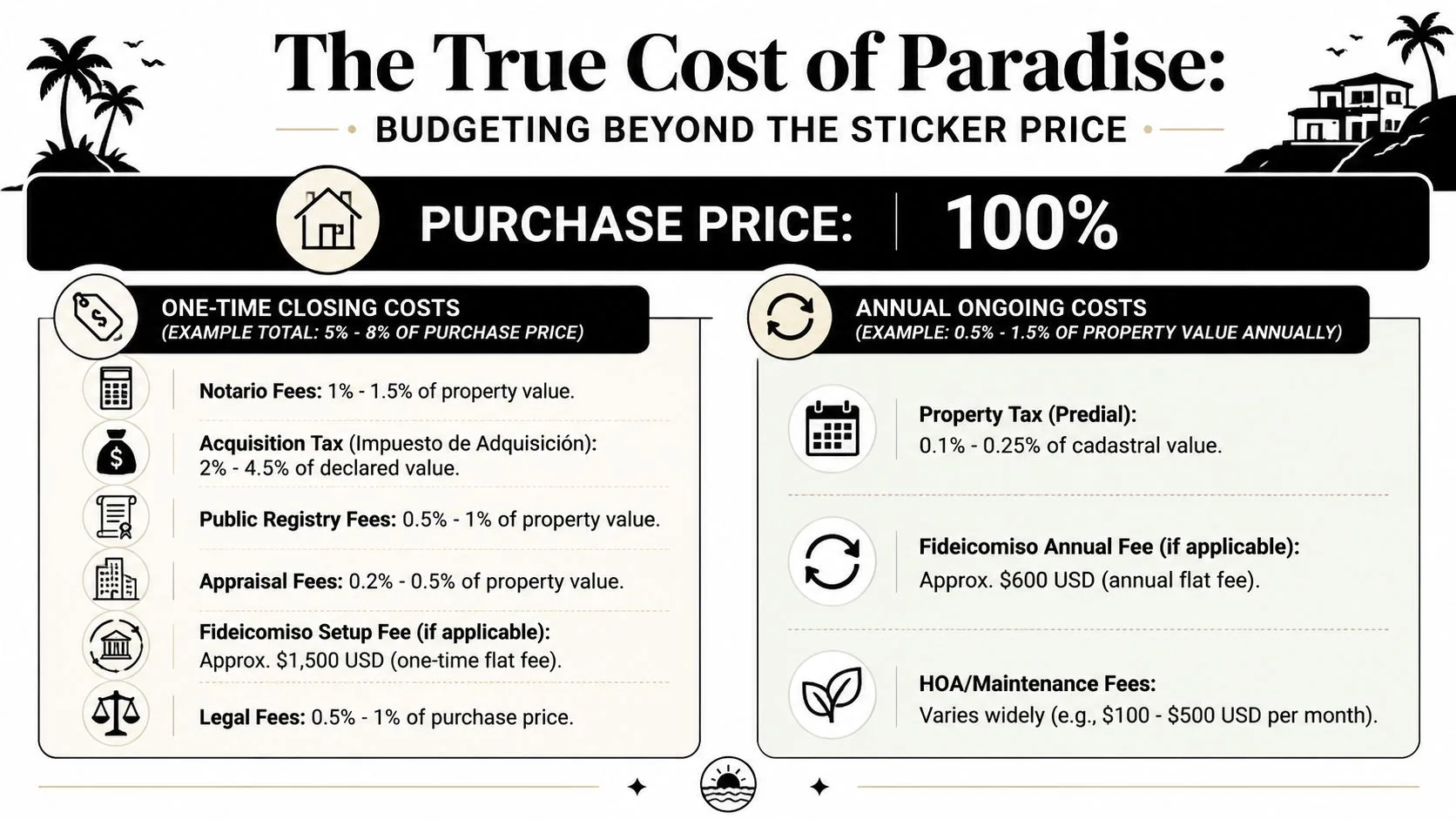
In practice, I tell buyers to stop underwriting only the sale price and start underwriting the full acquisition. In Mexico, closing costs are meaningfully higher than many U.S. and Canadian buyers expect, and the difference usually comes from taxes, notario charges, registration, and transaction fees that are built into the system rather than added as minor extras.
What closing costs actually look like
A useful benchmark comes from the Mexican market overview published by Global Property Guide on buying costs in Mexico. It notes that total round-trip transaction costs in Mexico are relatively high by international standards, with buyer-side acquisition costs commonly driven by transfer taxes, notary charges, and registration expenses.
For a buyer, the practical takeaway is simple. Leave room in your budget beyond the agreed price, even before you start discussing post-closing repairs, furnishings, or carrying costs.
Some costs are percentage-based. Others depend on the municipality, the value assigned for tax purposes, and the specifics of the file. A clean transaction in San Miguel is often more straightforward than a restricted-zone purchase because you are not adding a bank trust structure, but straightforward does not mean cheap.
A working cost breakdown
The exact numbers vary, but buyers should expect these categories to appear on the closing statement. The fee structure described by Global Property Guide's Mexico buying guide and standard closing practice in Mexico generally includes the following items:
| Cost category | Typical charge |
|---|---|
| Acquisition tax or transfer tax | Varies by state and municipality |
| Notario fees | Scaled to the transaction and deed work |
| Public Registry fees | Charged for recording the deed |
| Appraisal and certificates | Required in many transactions |
| Legal review, if separately retained | Varies by scope |
| Agent commission | Usually paid by the seller, but confirm in the contract |
That last point matters. Buyers coming from the U.S. often assume every market allocates costs the same way. Mexico does not. I have seen buyers over-budget for the wrong items and under-budget for the ones that hit at closing.
Why San Miguel can be more efficient
San Miguel de Allende gives foreign buyers one real advantage that generic Mexico guides often miss. In an interior city, a foreigner can usually acquire through direct deed ownership instead of adding a fideicomiso bank trust.
That does not erase taxes or notario costs. It does remove one layer of structure, one set of bank fees, and one recurring administrative obligation that buyers in restricted zones often have to absorb. From a budgeting standpoint, that makes the math cleaner and the ownership structure easier to explain from day one.
If you are balancing purchase costs against your broader relocation budget, this guide to the cost of living in San Miguel de Allende helps put the acquisition decision in context.
Budget from total cash to close, not from the list price.
The right way to think about cost
Serious buyers ask for an estimated closing sheet early. Then they keep a cushion.
That approach solves several problems at once. It protects your earnest money timeline, reduces last-minute wiring pressure, and keeps a good property from becoming stressful because the budget was too tight. In San Miguel, the smoother transactions are usually the ones where the buyer understood the full number early and funded the deal accordingly.
Finalizing the Deal Payments Currency and Registration
Closing in San Miguel usually gets more straightforward at the end, not more complicated. In an interior city where foreign buyers can typically take direct title, the last stretch is less about trust structures and more about execution. Funds have to arrive correctly, the deed has to be signed before the Notario, and the transfer has to be registered without delays.
Financing is often the sticking point.
Many international buyers here purchase with cash, or with funds arranged outside the Mexican retail mortgage system, because local mortgage options can be slower, more restrictive, and more expensive than buyers expect. Buyers who do finance often use liquidity from a home-country property, an investment account, or private banking relationships they already have in place.
Funding the purchase
Treat the payment plan as part of closing preparation, not as an item to solve at the last minute.
I tell buyers to confirm four points early. The purchase price currency. The account that will receive funds. The date each transfer must clear. The documents the receiving party, bank, or Notario will request to support the transaction. That short checklist prevents a surprising number of closing-week problems.
Earnest money and final balance payments also need to match the contract exactly. If the agreement states U.S. dollars, the parties need to know whether settlement will occur in dollars, in pesos at an agreed exchange method, or through a conversion process handled before closing.
Currency handling matters
Cross-border transfers can stall for reasons that have nothing to do with the property itself. Bank compliance reviews, transfer limits, exchange timing, and sender-name mismatches are common. I have seen closings delayed because a buyer assumed a same-day international wire would post immediately, or because a bank requested backup documentation after the transfer was already in motion.
Set this up early with your banker, your agent, and the Notario's office. Confirm the exact beneficiary instructions in writing. Confirm whether any taxes, fees, or utility adjustments must be paid in pesos. Then leave enough time for the funds to clear before signing day.
The final week of closing is the wrong time to sort out exchange rates, wire limits, or missing bank documents.
Registration is what completes ownership
A signed escritura matters. Registration is what gives public effect to the transfer.
The Notario prepares the deed, calculates and collects the applicable taxes and fees, and submits the instrument for registration. Buyers should still ask for confirmation that the filing was submitted and later request the registered deed or proof that registration was completed. Good professionals track this automatically, but serious buyers do not assume.
Possession also has a practical side. After closing, update utilities, HOA records if the property is in a private development, and local tax account records where applicable. That final follow-through is what turns a signed purchase into a clean, usable ownership file.
Conclusion Your Seamless Move to San Miguel
The best starting point for learning how to buy property in Mexico is not a generic national checklist. It's the location.
For San Miguel de Allende, the key advantage is clarity. This is an interior market where foreign buyers can generally hold direct title, which removes the bank-trust structure that dominates so much online advice about coastal purchases. That alone changes the conversation from “complicated and risky” to “formal, manageable, and worth doing correctly.”
The rest comes down to execution. Choose the right professionals early. Let the Notario and your lawyer do their jobs before money becomes exposed. Budget for full closing costs, not just the sale price. Treat the process with respect, and it becomes far less intimidating than most buyers expect.
San Miguel rewards buyers who like beauty, walkability, architecture, and long-term usability over hype. If that's what you're after, ownership here can be both realistic and remarkably straightforward.
Frequently Asked Questions
Can I buy property in Mexico through a U.S. LLC
Usually, buyers looking for a home in San Miguel purchase in their personal name rather than through a U.S. LLC. For residential property, the cleanest path is usually the one that matches the intended use and keeps the structure easy for the Notario, the registry, and your legal team to document.
If you're considering a company structure for estate, tax, or liability reasons, get advice from a qualified Mexican lawyer and your home-country tax advisor before making an offer. Entity ownership can change the paperwork and the analysis.
How are annual property taxes calculated in San Miguel
They're based on the local assessed value process, not on the assumptions many buyers bring from the U.S. or Canada.
The important practical point is that annual carrying costs should be reviewed separately from closing costs. Buyers often focus heavily on acquisition expenses and only later start asking about yearly obligations. Your advisor and lawyer can help you verify the current tax treatment for the specific property you're buying.
Do I need to be in Mexico for the closing
Not always.
Many buyers prefer to attend in person, especially for a first purchase, because it gives them confidence and lets them handle final logistics face to face. But if travel timing is difficult, a properly prepared power of attorney can allow a trusted representative to sign on your behalf. That document has to be prepared correctly for use in Mexico, so don't treat it as a last-minute fix.
Are English contracts enough
No.
The legally binding documents in a Mexican real estate transaction must be in Spanish. An English version may help you understand the terms, but it doesn't replace the official legal text. If you aren't fully comfortable reading Spanish legal documents, insist on a professional explanation before signing.
Is buying in San Miguel safer than buying on the coast
The better answer is that it's usually simpler from an ownership-structure standpoint.
San Miguel doesn't trigger the restricted-zone trust requirement that applies in many coastal markets, so the file is often more direct. That doesn't remove the need for due diligence. Title, liens, taxes, and proper registration still have to be handled carefully in any Mexican transaction.
If you're considering a home, investment property, or relocation purchase in San Miguel de Allende, Inside San Miguel offers local guidance grounded in the practicalities of this market. From identifying the right neighborhood to coordinating due diligence and closing support, the team helps international buyers move from interest to ownership with clarity.