


You're probably in one of two places right now. You've visited San Miguel de Allende and can't stop thinking about it, or you haven't bought yet because every listing feels beautiful but the decision still feels blurry.
That's normal. Buying a vacation home here isn't only about architecture, views, or whether the kitchen photographs well. It's about designing the version of your life you want to step into each time you arrive. Some buyers want a lock-and-leave house near cafés and galleries. Others want a quieter base for months at a time, with room for guests and easier parking. Some are planning for eventual retirement and want the purchase to work now as a seasonal home and later as a full-time residence.
San Miguel rewards clarity. The buyers who end up happiest usually aren't the ones who chase the most dramatic listing first. They're the ones who match the property to the lifestyle. That means asking better questions early: How often will you come? Do you want to walk everywhere? Will you rent it when you're away? Do you care more about historic character or day-to-day convenience?
Table of Contents
- Your Dream of a Home in San Miguel de Allende
- The State of the San Miguel Vacation Home Market in 2026
- Choosing Your Perfect Location A Neighborhood Guide
- The Purchase Process for Foreign Buyers Explained
- Setting Realistic Pricing and Budget Expectations
- From Buyer to Owner Operating a Successful Vacation Home
- Bringing It All Together Closing Financing and Taxes
Your Dream of a Home in San Miguel de Allende
A lot of buyers start with the same mental picture. Morning light on stone walls. Church bells in the distance. Coffee on a terrace before a walk into town. Guests coming for a long weekend and leaving convinced you made the right choice.
That picture matters because it tells you what you're really buying. In San Miguel, the home is only part of the asset. The street, the walk, the noise level, the incline, the view, the ease of getting groceries, and the way the home feels when it's half full or full of family all shape whether the purchase delivers on the life you imagined.
Some owners want the classic colonial experience and don't mind tradeoffs that come with older homes. Others love the city but want newer systems, easier access, and a more predictable lock-and-leave setup. Neither is more correct. The mistake is buying one while expecting the other.
If your interest started with the city's atmosphere and cultural pull, it helps to ground that instinct in a broader understanding of why people choose San Miguel de Allende for lifestyle and long-term living. The emotional appeal is real. The practical side is what turns that appeal into a smart purchase.
The best vacation homes in San Miguel de Allende don't just look right on showing day. They fit the way you'll actually use them in February, in July, with guests, and years from now.
I've seen buyers change direction once they connect the property to real use. A dramatic hillside house can be perfect for holiday stays and entertaining. A quieter house near daily services can be the better retirement move. A beautifully restored home near the center can win as a seasonal base, but only if you're comfortable with the realities that come with historic living.
That's why the right purchase feels less like picking a trophy and more like building a plan for how you want to live.
The State of the San Miguel Vacation Home Market in 2026
The current market for vacation homes in San Miguel de Allende is large enough to be meaningful, competitive enough to require discipline, and specialized enough that not every property performs the same way.
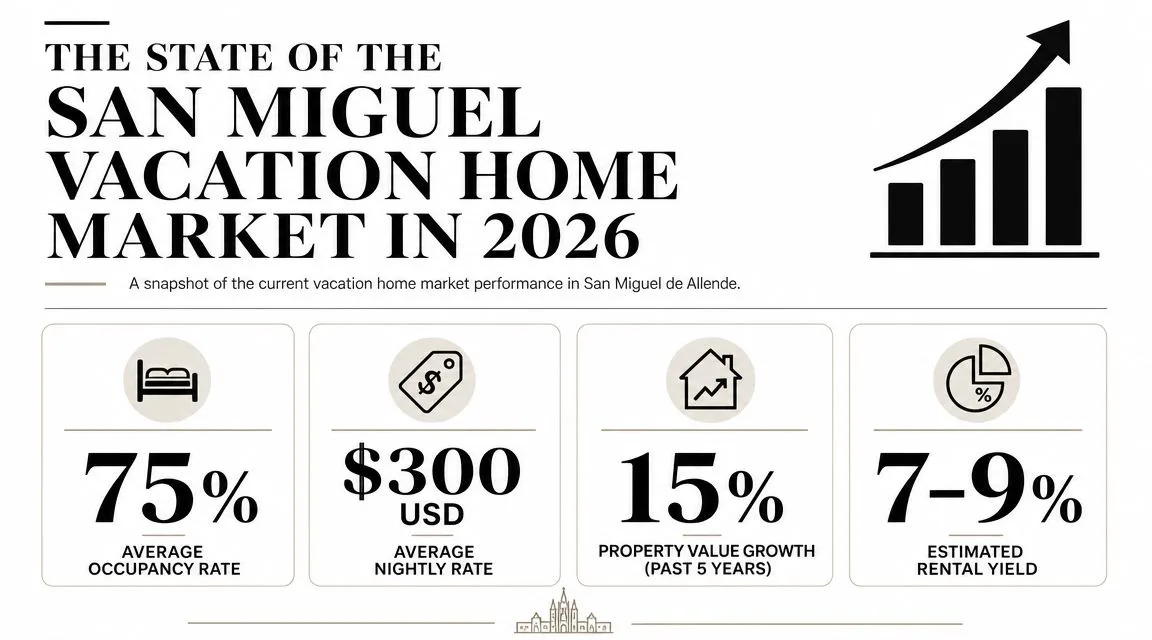
What the market data actually says
According to AirROI's 2026 San Miguel de Allende Airbnb market data, the city has 2,207 active Airbnb listings, with 9.9% annual supply growth, $17,332 in average annual revenue, 30.0% occupancy, $209 ADR, and $63 RevPAR. The same dataset shows that 77.7% of active listings are entire homes/apartments.
Those numbers tell a very specific story. San Miguel is not a casual short-term rental market where any furnished property will do fine. Owners are competing in a destination where private-use homes dominate and guests are often choosing a full-property experience over a room or shared setup.
A separate snapshot from AirDNA's San Miguel de Allende vacation rental overview reports 3,967 vacation rentals, 37% occupancy, a $179 daily rate, and $12,639 in monthly revenue across short-term rentals. The same source context also notes a market study with 4% to 12% long-term rental vacancy, 5% to 6.5% gross rental yields, and 3% to 4.5% net yields after furnishing and management costs. It also points to strong luxury-manager performance in higher-end segments, with 58% to 70% occupancy and $124 to $318 average daily rates depending on property type and management model.
How to read these numbers like an owner
If you're evaluating vacation homes San Miguel de Allende style, focus less on raw demand and more on fit. This is a city where quality, presentation, and location selection shape results.
A practical reading looks like this:
- Supply is real: There are thousands of listings, so buyers shouldn't assume scarcity alone will carry a mediocre property.
- Entire-home demand is strong: Private homes align with how many visitors want to stay.
- Occupancy is selective: A property needs a clear reason to be chosen.
- Rate matters: A well-positioned home can protect pricing better than a generic one.
Practical rule: Buy the home that can win on identity. Walkability, views, architecture, privacy, outdoor living, or turnkey ease. If a property has none of those clearly, it's harder to operate well.
That matters for lifestyle buyers too. If you plan to use the home personally, market performance still affects your decisions. It influences whether professional management makes sense, how much wear the house will take, and whether your home should be designed around frequent guests, occasional renting, or almost entirely private use.
In other words, the market is active, but it isn't forgiving. The better play is to choose a property that's enjoyable for you first and competitive for guests second.
Choosing Your Perfect Location A Neighborhood Guide
In San Miguel, location decides more than value. It decides rhythm. The right neighborhood shapes whether your home feels like a weekend pied-à-terre, a winter residence, or a place you can grow old in comfortably.
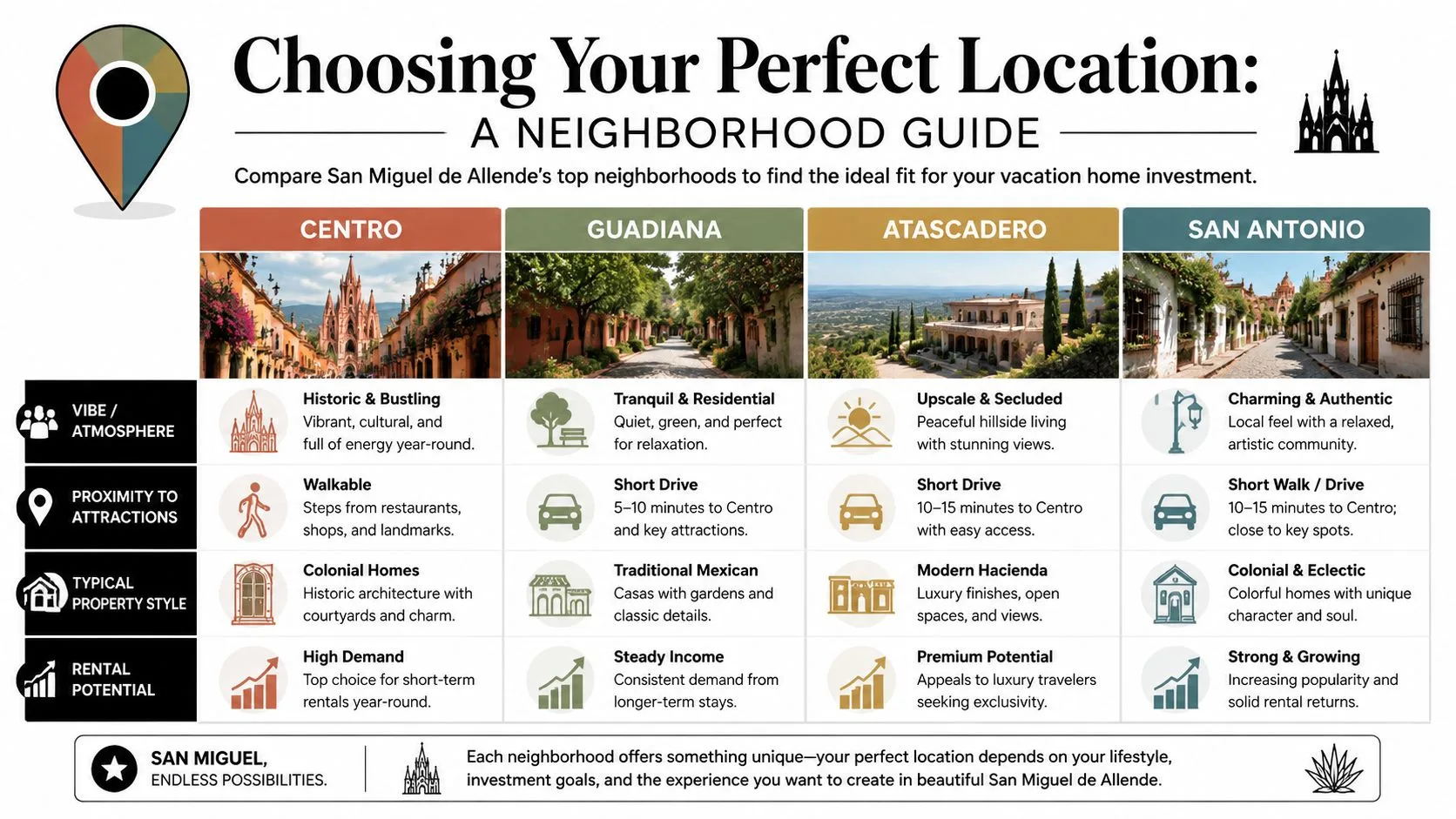
A recurring mistake is shopping by listing style instead of neighborhood logic. The better question isn't where to buy. It's which area fits your use pattern. That's also a key theme reflected by local vacation home guidance focused on neighborhood fit and gated-community tradeoffs.
Centro and the walkable classic San Miguel experience
Centro is for buyers who want direct access to what makes the city famous. You can walk to restaurants, galleries, events, and the social core. For a vacation home, that can be profoundly satisfying. You arrive, put the keys down, and the city starts immediately.
The tradeoff is that Centro asks more of the owner. Streets can be tighter. Parking can be limited or more valuable. Noise, foot traffic, and the realities of older homes are part of the package. If you love authenticity and can tolerate those frictions, Centro often feels worth it.
A buyer profile that tends to do well in Centro:
- Seasonal social owners: They want to entertain, dine out often, and stay in the center of the action.
- Short-stay users: They visit for bursts and want convenience over sheer space.
- Character-first buyers: They care more about atmosphere than simplified maintenance.
San Antonio and Guadiana for longer stays
San Antonio often attracts buyers who want a real neighborhood feel with personality, accessibility, and a bit more breathing room. It can suit people who plan to stay longer, work remotely for part of the year, or want a home that feels integrated into daily life rather than set apart from it.
Guadiana appeals to buyers who want calm without feeling disconnected. Leafier streets, a more residential tone, and practical livability can make it especially good for repeat stays or future retirement. The atmosphere tends to support routine. That matters if your vacation home is gradually becoming your second home, then eventually your primary one.
A simple comparison helps:
| Neighborhood | Best for | Main appeal | Main tradeoff |
|---|---|---|---|
| Centro | Short visits, entertaining, classic city experience | Walkability and historic atmosphere | Noise, access, older-home quirks |
| San Antonio | Creative lifestyles, medium stays, flexible use | Neighborhood energy and practicality | Less formal prestige than prime Centro |
| Guadiana | Seasonal living, retirement planning, quiet comfort | Residential calm and everyday ease | Less immediate tourist energy |
If proximity to green space matters, Benito Juárez Park and the surrounding area deserve attention. Buyers who walk daily, travel with pets, or want a softer edge to city living often find that this part of town changes how a home feels in daily use.
Buy for your longest likely stay, not your shortest. A home that works for four nights may not work for four months.
Ojo de Agua Balcones and gated communities
Ojo de Agua and Balcones often appeal to buyers who want views, privacy, and a stronger sense of retreat. These areas can feel more residential and more removed from the busiest streets. That can be a major advantage for owners who want rest, guest privacy, or a more refined residential experience.
But there's always a tradeoff. More privacy can mean more dependence on driving, steeper access, or less spontaneous walkability. For some buyers, that's a deal breaker. For others, it's exactly why the home works.
Gated communities serve a different type of buyer altogether. They can be ideal if you want security, easier lock-and-leave ownership, shared amenities, and a more managed environment. They're often practical for owners who split time between countries and don't want every arrival to begin with a maintenance issue.
What tends to work best in gated communities:
- Part-time owners: They want predictability and easier oversight while away.
- Future retirees: They want comfort, structure, and manageable living.
- Value-conscious buyers: They understand that lower pricing can sometimes come with more modest finishes.
The right neighborhood isn't the one everyone talks about most. It's the one that makes your version of San Miguel easy to live.
The Purchase Process for Foreign Buyers Explained
Foreign buyers usually worry about the wrong part first. They focus on whether the process will be confusing, when the more important question is whether the file on the property is clean and the people handling the transaction are experienced.
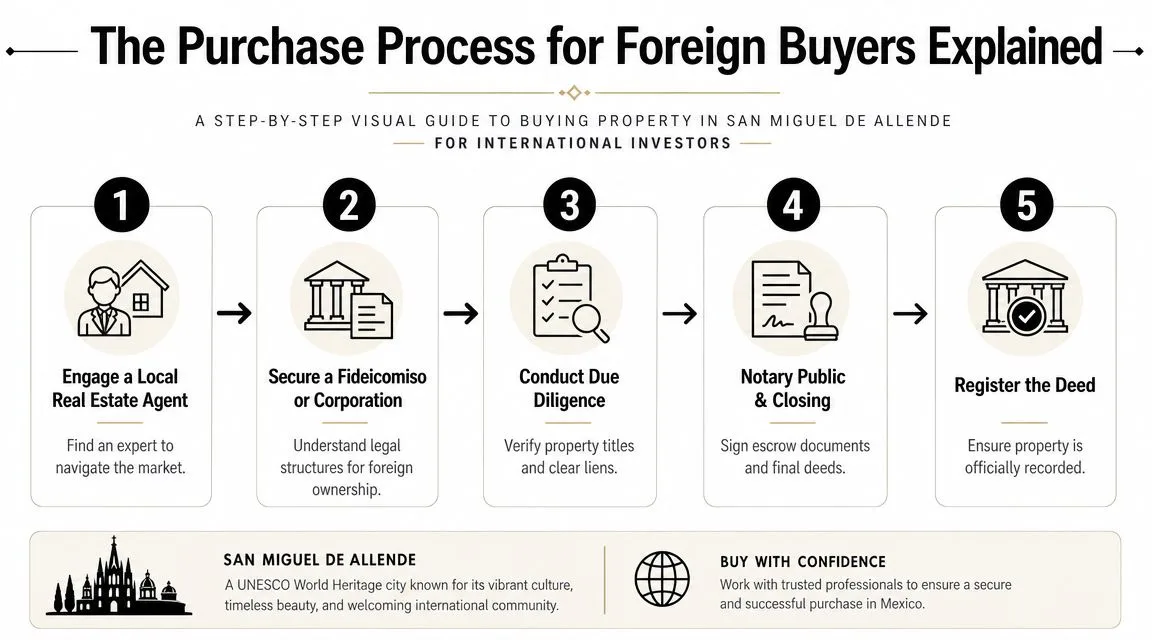
What happens after you decide to buy
The purchase path in San Miguel is usually straightforward when the property is properly documented and the transaction is managed with discipline.
A typical sequence looks like this:
- Choose the property and define terms clearly. Price matters, but so do inclusions, timing, possession, furnishings, repairs, and any contingencies.
- Move the file into due diligence. Here, title, liens, permits, taxes, and ownership history need careful review.
- Coordinate with the notario público. The notario formalizes the legal side of the transfer and verifies that the transaction can close properly.
- Prepare funds and closing documents. International buyers need to align banking logistics early, not at the last minute.
- Close and register properly. A smooth signing day usually reflects good preparation, not luck.
For buyers who want a broader overview of the legal pathway, this guide to buying property in Mexico as an American is a helpful starting point.
Later in the process, many buyers find it useful to hear the mechanics discussed visually as well.
What foreign buyers usually worry about
The first concern is usually ownership structure. In San Miguel de Allende, buyers often find the process simpler than in coastal resort markets. The city is inland, so the bank trust issue that many foreigners associate with Mexico is not usually the obstacle they expected. What matters more in practice is making sure the seller can convey clear title and that the paperwork matches the physical reality of the property.
The second concern is whether the transaction is safe. It can be, provided the deal is documented correctly and reviewed carefully. A beautiful house with weak records is not a good opportunity. A less dramatic house with clean documents often is.
The third concern is emotional. Buyers feel pressure because homes here can be seductive. That's when discipline matters most.
Slow down when a property is exciting. Excitement is useful for choosing. It is terrible for skipping due diligence.
A seasoned advisor, a capable notario, and patient review make the process feel far more manageable. The foreign buyer who does well here is usually the one who stays curious, asks direct questions, and keeps lifestyle goals in view while the legal steps are being handled.
Setting Realistic Pricing and Budget Expectations
The first pricing mistake buyers make is assuming San Miguel is only a luxury market. The second is assuming a lower-priced home must be a bargain. Both shortcuts lead to disappointment.
Why asking price and lived value are not the same thing
In San Miguel, price reflects a combination of location, character, finishes, access, views, parking, privacy, and how easy the property is to use from day one. Two homes can look similar in photos and deliver very different ownership experiences.
That's why the affordability gap matters. A recent video walkthrough of a mid-range San Miguel rental example described a 4-bedroom, 3-bath gated-community home at about 16,000 pesos per month, roughly $850–$900. The same example noted that some gated communities come at lower price points partly because finishes are simpler.
That single example is useful because it corrects a common misconception. Vacation homes San Miguel de Allende buyers see online are often the most polished inventory. The lived market is broader. There are homes that prioritize location, homes that prioritize space, homes that prioritize ease, and homes that deliver value through tradeoffs rather than glamour.
How experienced buyers judge value
The better way to budget is to sort homes into use categories, not aesthetic categories.
Consider this framework:
- For short seasonal escapes: Pay attention to lock-and-leave ease, furnishing quality, and how quickly you can settle in after arrival.
- For retirement planning: Focus on daily livability. Think stairs, access, street conditions, nearby services, and whether the neighborhood will still suit you later.
- For occasional rental use: Favor homes with broad appeal instead of highly personalized design choices.
A useful budget reality check also comes from San Miguel de Allende cost-of-living context for everyday expenses. Not because ownership costs are identical to rental life, but because a smart purchase should fit the wider life you intend to build here.
What doesn't work is buying the prettiest house your budget can reach without accounting for what ownership will require. Sometimes the better move is a less famous location, a stronger floor plan, and fewer deferred improvements. Buyers who understand that usually feel calmer after closing, not just on closing day.
From Buyer to Owner Operating a Successful Vacation Home
Owning well is a separate skill from buying well. Some houses are easy to own because they were chosen with operations in mind. Others become expensive hobbies because the owner never decided how the property was supposed to function.
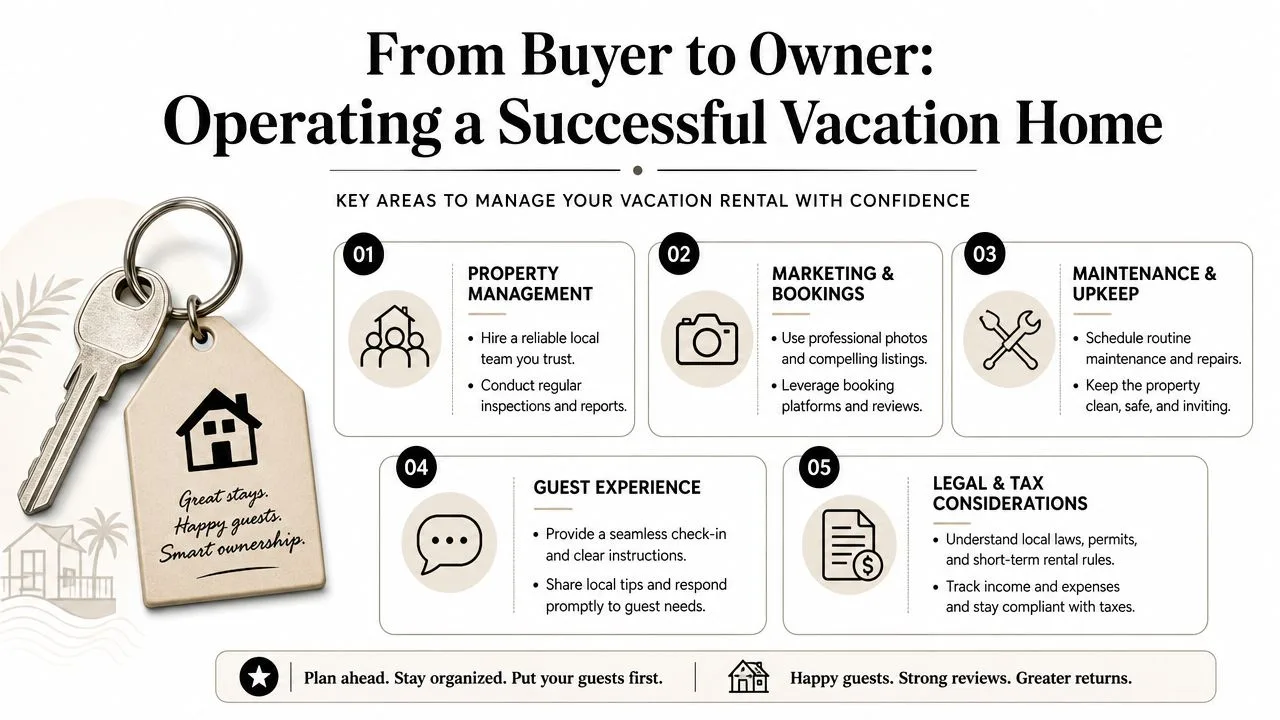
Choose the operating model before you furnish
Start with a simple question. Is this home primarily for you, primarily for guests, or balanced between both?
That decision affects almost everything:
- Private-use first: You can personalize more, store more, and design around your habits.
- Rental-ready first: Durability, clear storage systems, guest communication, and maintenance access become central.
- Hybrid use: You need discipline. The house has to feel warm to you and legible to a guest who arrives without context.
Many owners underestimate how much management style changes the experience. Self-management can work for hands-on owners who spend meaningful time in town and enjoy solving details. Professional management usually works better for owners who value consistency, fast local response, and less day-to-day friction.
What makes a vacation home perform better
The strongest-performing homes usually share a few traits, even when their styles differ.
| Area | What works | What usually causes trouble |
|---|---|---|
| Furnishing | Cohesive, durable, easy to maintain | Overdesigned spaces with fragile pieces |
| Guest use | Clear instructions and intuitive layout | Beautiful homes that are hard to use |
| Maintenance | Regular inspections and preventive fixes | Waiting for a small issue to become urgent |
| Positioning | A clear identity in the market | Generic presentation with no standout reason to book |
For owners who want occasional income, the home should photograph well but live even better. Good light, outdoor seating, comfortable bedrooms, practical bathrooms, and reliable systems matter more than decorative excess. Guests remember whether the shower pressure worked, whether the kitchen was easy, and whether arrival felt smooth.
A successful vacation home feels effortless to the guest because the owner and manager did the hard work in advance.
There's also a lifestyle side to operations that many buyers miss. If you hate dealing with turnovers, maintenance calls, and calendar coordination, don't build a plan that depends on enjoying those tasks later. If you want the home ready whenever you fly in, create a management structure that protects that spontaneity.
The best ownership model is the one you'll maintain. Elegant on paper isn't enough.
Bringing It All Together Closing Financing and Taxes
By the time you reach closing, most of the important decisions have already been made. The final stage is about confirming details, protecting your timeline, and avoiding preventable surprises.
The final checklist before closing
Use the last stretch to verify the fundamentals one more time.
- Confirm the legal file: Make sure all due diligence items are resolved, not merely discussed.
- Review what transfers with the property: Appliances, furnishings, art exclusions, and outdoor items should be written clearly.
- Align timing: Closing dates, possession, utilities, and handover logistics need to match your travel and funding schedule.
- Clarify tax and ownership setup: Ask your accountant and legal team how you'll hold the property and report any income.
- Prepare post-closing operations: Insurance, staff access, keys, digital accounts, and service vendors should be ready before you need them.
Financing deserves a realistic lens. Many purchases in this market are handled without financing because cross-border borrowing can add complexity. When financing is available, buyers should judge it by convenience and strategic fit, not by optimism alone. If financing creates pressure on how you must use or rent the property, it may work against the lifestyle you were trying to buy.
Own with fewer surprises
Taxes matter, but what matters more is having the right professionals explain your obligations in plain language before you close. Property ownership in Mexico comes with recurring responsibilities, and rental income adds another layer if you decide to operate the home as an income-producing asset. The cleanest ownership experiences usually begin with clean records and organized reporting habits.
The final mindset shift is simple. Don't treat closing as the finish line. Treat it as the moment your operating plan begins. The house should already make sense on paper and in practice.
Buyers who do this well usually end up with something far more valuable than a beautiful deed. They own a place that fits their real life in San Miguel.
If you want help narrowing the right neighborhoods, evaluating specific properties, or making sense of the buying process as an international purchaser, Inside San Miguel offers on-the-ground guidance suited to how you want to live in San Miguel de Allende.