

You’re probably in one of two places right now. You’ve spent months looking at homes in Mexico, saving listings, watching neighborhood videos, and picturing a slower, richer life in a place that still feels connected to the U.S. Or you’re further along. You’ve found a property you love, then hit the wall that stops most American buyers. Conflicting advice, vague warnings about trusts, and a lot of people telling you Mexico is “easy” without explaining what actually happens from offer to closing.
Here’s my opinion after guiding buyers through San Miguel de Allende for years. Buying property in Mexico as an American is absolutely doable, but only if you stop treating all Mexican markets as if they work the same way. They don’t.
The biggest mistake I see is buyers assuming a beach purchase in a restricted zone is the baseline for all of Mexico. It isn’t. Inland cities can offer a much cleaner path. That’s why San Miguel de Allende deserves serious attention from U.S. buyers who want ownership without unnecessary structural complications.
There’s also a practical reason this conversation matters now. Mexico isn’t some fringe second-home market anymore. In the second quarter of 2025, Mexico’s SHF House Price Index rose 8.7% year over year, while the average home purchased with a mortgage reached MXN 1,862,524 (USD 97,923) and the median was MXN 1,200,000 (USD 63,090), according to Global Property Guide’s Mexico price history data. Buyers aren’t just daydreaming. They’re acting.
If you want the smartest path, start with the right legal framework, the right city, and the right process. That’s where this gets simpler.
Table of Contents
- Your Dream of Mexico Awaits Introduction to a Smart Purchase
- The Legal Framework for American Buyers Explained
- Why San Miguel de Allende Offers a Smarter Path
- Financing Currency and Making Your Offer
- The Ultimate Due Diligence Checklist Before You Buy
- The Closing Process and Budgeting for All Costs
- FAQ Life as a Homeowner in Mexico
Your Dream of Mexico Awaits Introduction to a Smart Purchase
Most American buyers don’t start with legal structure. They start with lifestyle.
They start with winter light instead of gray skies. Morning coffee in a courtyard. Walkable streets. Better weather. More time. A house that feels like a life decision instead of just another asset. Then they start looking online and run into a mess of partial answers. One person says foreigners can’t own land. Another says you need residency. Another says everything has to go through a bank trust. By that point, a lot of perfectly capable buyers freeze.
That confusion is understandable, but it’s also avoidable.
I’ve seen buyers come in assuming all of Mexico works like a beach market, only to realize later that inland ownership can be far more straightforward. That’s the shift that matters. If you’re buying in the right place, your purchase path can look much more familiar and much less burdened by extra layers.
The smart purchase starts with location choice
A smart purchase in Mexico isn’t just about picking the prettiest home or negotiating the lowest number. It starts by choosing a market that fits your ownership goals.
Some buyers want a resort-style property and accept added structural complexity. Fine. But many don’t need that. They want a secure home, a stable community, and a process they can understand without hiring a small army. That’s exactly why inland cities deserve more attention than they usually get.
Practical rule: If you value simplicity, resale clarity, and holding title in a way that feels familiar, don’t start your search on the coast. Start inland.
Why this isn’t just a lifestyle fantasy
The broader market matters because it confirms what serious buyers already sense. Mexico has become a real cross-border housing market, not just a casual retirement fantasy. The 2025 pricing data cited earlier shows active demand and meaningful price movement, which is why buyers need to think strategically rather than emotionally.
That doesn’t mean you should rush.
It means you should get precise. The right purchase in Mexico comes from understanding where legal friction shows up, where it doesn’t, and how to keep your transaction disciplined from day one. Americans who do that tend to have a much better experience than buyers who chase a listing first and ask legal questions later.
Two paths sit in front of you
There are really two broad paths.
One is the more layered route common in coastal and border markets, where foreign buyers often deal with an added ownership structure. The other is the inland route, where many buyers can hold property more directly and move through the transaction with less structural drag.
If your goal is clean ownership, fewer moving parts, and a purchase that feels more secure on a practical level, I’d push you toward the inland path every time.
The Legal Framework for American Buyers Explained
The legal side sounds intimidating until you separate the rule from the noise. Once you do that, most of the confusion disappears.
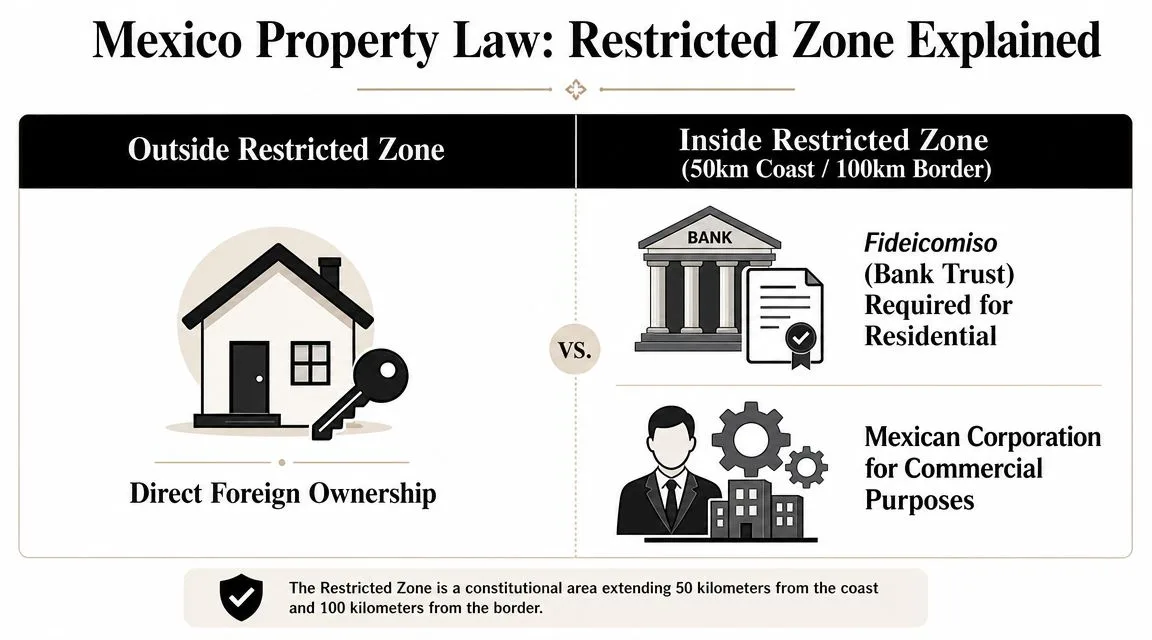
The core fact is simple. Americans can legally buy property in Mexico without residency or citizenship, and the key legal distinction is location: outside the restricted zone, defined as 50 km from the coast and 100 km from international borders, they can hold direct title in their own name, while properties inside that zone require a fideicomiso. This framework was clarified by Mexico’s 1993 constitutional reform, as explained in Pacaso’s overview of buying property in Mexico.
The rule that changes everything
That restricted zone rule is the hinge point for buying property in Mexico as an American.
If the property sits outside that zone, a foreign buyer can generally hold title directly. If the property sits inside it, the buyer usually needs a fideicomiso, which is a bank trust structure used for residential property. That’s why buyers looking at beach towns often hear one set of rules, while buyers looking at places like San Miguel de Allende can follow a simpler path.
What a fideicomiso actually is
A lot of Americans hear “bank trust” and assume they’re giving up control. That’s the wrong takeaway.
Think of a fideicomiso like a purpose-built holding structure where the bank serves as trustee and you are the beneficiary. The bank is part of the legal framework, but the buyer still holds the beneficial rights tied to the property. The structure is legal, common, and workable. I’m not anti-fideicomiso. I’m anti-buying into a structure you don’t fully understand.
What I tell clients is this: a fideicomiso isn’t bad in itself. It’s just more layered than direct ownership. More layers mean more documents, more coordination, and more opportunities for buyers to misunderstand what they’re signing.
Don’t confuse “legal” with “simple.” A fideicomiso is legal. Direct title is simpler.
Fideicomiso vs Direct Title At a Glance
| Feature | Fideicomiso (Restricted Zone) | Direct Title (Unrestricted Zone) |
|---|---|---|
| Where it applies | Residential property inside the restricted zone | Property outside the restricted zone |
| Foreign buyer ownership path | Through a bank trust | In the buyer's own name |
| Core structure | Bank acts as trustee, buyer is beneficiary | Public deed reflects direct ownership |
| Complexity level | More layered | More straightforward |
| Typical buyer experience | More moving parts to explain and manage | Closer to what many U.S. buyers expect |
What this means for your decision
Most U.S. buyers don’t need a legal lecture. They need a decision filter.
Use this one. If you care most about ease, transparency, and long-term confidence, prioritize markets where direct title is available. If you’re set on a coastal location, go in with your eyes open and treat the ownership structure as a major part of the purchase decision, not an administrative footnote.
That’s the mistake people make. They shop for views first and legal structure second. Experienced buyers do the reverse.
Why San Miguel de Allende Offers a Smarter Path
San Miguel de Allende isn’t just attractive. It’s strategically attractive.
For American buyers, the appeal starts with one practical advantage that changes the ownership experience. Foreign buyers in Mexico do not need residency or a visa to purchase property, but the title structure depends on location: outside the restricted zone they can hold title directly, while within the restricted zone they generally must use a fideicomiso. For San Miguel de Allende, this matters because it is inland, so the purchase pathway is typically simpler than coastal Mexican markets, with no trust requirement if the property is outside the restricted zone, as outlined in Taxes for Expats’ guide to buying property in Mexico as an American.

Why inland ownership is cleaner
Direct title matters more than many buyers realize.
It’s cleaner when you buy. It’s cleaner while you own. It’s cleaner when you sell. You don’t spend your first months of ownership trying to decode a structure that felt abstract at closing. You own in a way that feels more familiar to a U.S. buyer, and that familiarity reduces friction.
That’s why I often tell clients to stop treating San Miguel as a compromise if they originally had the coast in mind. For many buyers, it’s the upgrade. Less structural noise. Better walkability. A mature international community. Strong lifestyle value.
Why buyers stay in San Miguel
San Miguel works because it’s not dependent on one buyer profile.
Some clients come for retirement. Some come for part-time living. Some want a lock-and-leave home with character. Some want a full relocation. The city supports all of those paths because it combines architecture, services, culture, and a daily rhythm that people can sustain. You’re not just buying scenery. You’re buying a functioning life.
If you want a clearer sense of the city’s appeal, why buyers choose San Miguel de Allende is worth reviewing alongside property criteria, because neighborhood fit matters just as much as legal structure.
A property can be beautiful and still be the wrong purchase. In San Miguel, the right buy is the one that fits how you’ll actually live.
There’s also a psychological advantage that buyers rarely mention out loud. Direct ownership feels more settled. That matters when you’re wiring substantial funds across borders and making a life decision far from your home system. Confidence isn’t just emotional. It affects how decisively you negotiate, how carefully you perform due diligence, and how comfortable you feel holding the asset long term.
If your priority is a straightforward path with enduring lifestyle upside, San Miguel should be near the top of your list.
Financing Currency and Making Your Offer
American buyers often bring the wrong assumptions into the deal.
They expect a purchase process that behaves like the U.S. market. Standardized listings. Familiar mortgage options. Uniform contract flow. That’s not how this works. You need to adapt early, because the financial mechanics shape everything that comes after.
Start with the financing reality
Most buyers should assume a cash-first mindset.
That doesn’t mean every buyer pays cash from a checking account. It means you should not build your entire purchase strategy around the expectation of a smooth, conventional U.S.-style mortgage process attached to a property in Mexico. Some buyers explore cross-border lending or seller financing, and those options can fit the right scenario. But they are not the baseline I’d advise you to rely on when you begin.
My recommendation is direct. If financing is central to the purchase, get clarity before you shop seriously. Don’t negotiate on a home, then start wondering how the funds will come together. In cross-border transactions, uncertainty on funding weakens your position fast.
Handle currency like part of the deal
Currency isn’t an afterthought. It’s part of your acquisition strategy.
In San Miguel, you’ll often see pricing discussed in a way that makes sense to foreign buyers. But the legal and settlement mechanics of a transaction in Mexico require careful attention to how funds move and how exchange timing affects your final outlay. If you ignore that, your budget can drift for reasons that have nothing to do with the property itself.
Use a disciplined process:
- Set your real acquisition ceiling: Decide the maximum total amount you’re willing to commit before negotiations start.
- Coordinate early with your advisors: Your agent, attorney, and closing professionals should understand how your funds will arrive and when.
- Avoid casual transfer timing: Don’t assume you can wait until the last minute and still control the result.
A buyer who manages currency intentionally looks prepared. Sellers notice that.
What happens when you make an offer
Offers in Mexico are not just emotional signals. They’re operational commitments.
Once you find the right property, you’ll typically move from interest to a written offer and then into a purchase agreement process that formalizes key terms. At that stage, details matter. Price matters, of course, but so do timelines, contingencies, possession terms, included items, and deposit handling.
Here’s the approach I prefer:
- Write cleanly: Keep the offer clear enough that both sides know exactly what’s being agreed.
- Tie money to milestones: Deposits and later payments should align with defined stages in the transaction.
- Leave room for due diligence: Never let enthusiasm erase your right to verify title, taxes, boundaries, and seller authority.
- Get the legal review early: Don’t wait until a “final” version appears to involve your attorney.
If you’re buying property in Mexico as an American, your edge isn’t speed alone. It’s clean preparation. Buyers who understand their funds, their terms, and their review process usually move with more confidence and make fewer expensive mistakes.
The Ultimate Due Diligence Checklist Before You Buy
This is the part buyers most want to rush. That’s exactly why it deserves discipline.
Mexico does not reward casual due diligence. If a listing looks charming and the seller sounds credible, that still tells you almost nothing about the legal integrity of the transaction. You need proof, documents, and independent review. Not optimism.
The checks I consider non negotiable
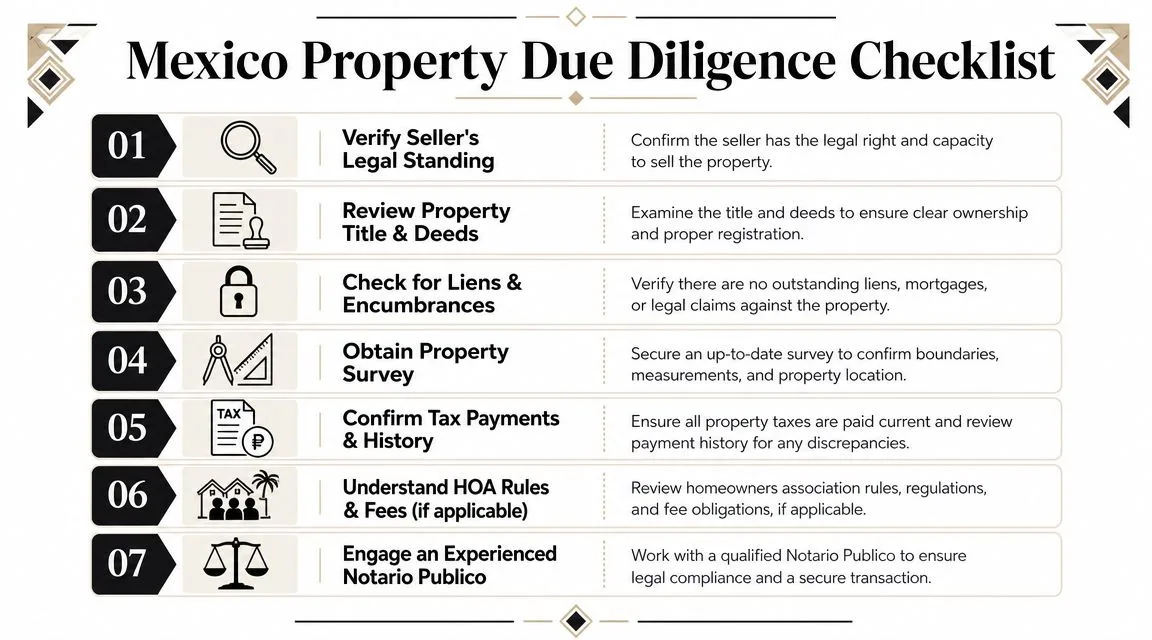
Use this as your baseline checklist before you commit fully:
- Verify the seller’s authority: Confirm the person selling has the legal right to sell. If an entity, heir, or representative is involved, the supporting documents need to match that story.
- Review the deed history: You want a clear chain of ownership and a deed that aligns with the property being marketed.
- Check for liens and encumbrances: A proper review of public records becomes critical. A beautiful house can still come with legal baggage.
- Confirm tax status: Unpaid taxes, missing receipts, or unresolved municipal issues need to be identified before closing.
- Get a survey when needed: Boundaries, construction footprint, and actual site conditions must match what you think you’re buying.
- Understand HOA or condominium rules: If the property sits in a governed community, read the rules before you fall in love with the pool.
- Inspect the house itself: Cosmetic appeal hides defects all the time. Hire a qualified inspector and read the report carefully.
To get grounded in a central neighborhood context, San Miguel’s Centro area overview can help you think beyond the property itself and evaluate location, access, and day-to-day livability.
A quick visual summary helps many buyers remember what matters most.
Who does what in a Mexico transaction
One of the most common mistakes is assuming the Notario Público replaces your independent legal review. That’s not how I advise clients to think.
The notario plays a formal legal role in the transaction. Your independent attorney protects your interests specifically. Those are not the same job. Add an inspector for the physical condition and, where appropriate, a surveyor for land and boundaries. Each professional answers a different risk.
Hire professionals whose incentives are clear. Your attorney should represent you. Your inspector should evaluate the house. Your notario should formalize legality. Don’t blur those lines.
If you want one recommendation to remember, it’s this: treat due diligence as the purchase. The offer is just the opening move.
The Closing Process and Budgeting for All Costs
Closing in Mexico is formal, document-heavy, and entirely manageable if you budget correctly from the start.
What shocks American buyers isn’t usually the legality of the process. It’s the gap between what they assumed closing would cost and what it costs once the transaction reaches the final stretch. That surprise is avoidable.
What the notario actually does
American buyers often misunderstand the notario because they map the term onto a U.S. notary public. That comparison causes problems.
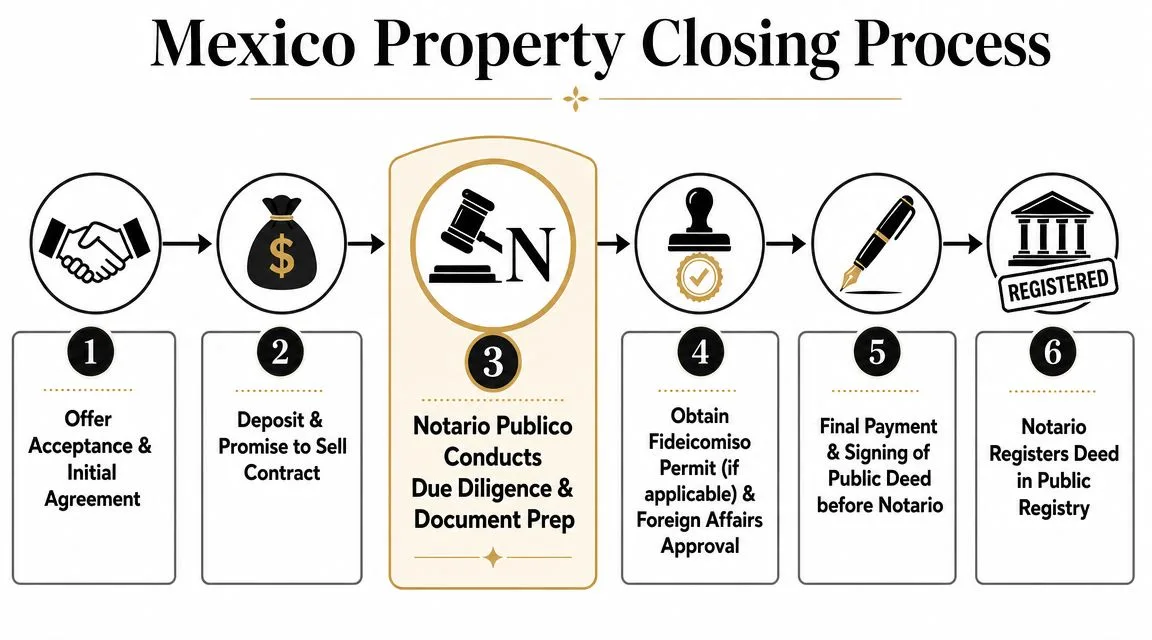
In Mexico, the Notario Público is a government-appointed legal professional with a central role in formalizing the transaction. The notario reviews documentation, helps ensure legal compliance, oversees the deed process, and registers the transaction. That role carries real weight. It is not clerical.
This is one reason I push buyers to get organized early. By the time the file reaches the notario, sloppy assumptions should already be gone.
What closing day looks like
By closing, the main terms should already be settled and the document trail should be in order.
The final stage usually includes review of the closing statement, final funding coordination, execution of the public deed, and the notario’s follow-through on registration. If the property structure or transaction path requires additional approvals or supporting documents, those must be lined up in advance. Closing day is not when you want unresolved questions.
For active buyers who want to compare available opportunities while preparing for the closing phase, current San Miguel property listings are a practical way to see how different homes and neighborhoods align with budget and ownership goals.
Budget for the real cost not the fantasy cost
Here’s the number that matters most for planning. Americans should expect a 5%–8% cost range on resale transactions for notary fees, taxes, and processing fees, according to Wise’s guide to buying property in Mexico. That same guide notes that Mexico’s process isn’t standardized by a national MLS, which is why budgeting and transaction planning often surprise U.S. buyers.
That range is your planning anchor. Use it.
Do not build a purchase plan around the contract price alone. If you can afford the house but haven’t reserved room for transactional costs, you are not ready to close.
A practical budget should account for items such as:
- Notary-related charges: These are part of the legal formalization process and shouldn’t be treated as optional extras.
- Taxes tied to the acquisition: These need to be understood upfront, not discovered in a rush at the end.
- Registration and processing costs: Administrative doesn’t mean insignificant.
- Due diligence expenses: Legal review, inspections, and related verifications are part of the acquisition cost in any serious transaction.
Budget for the purchase, the closing, and the first months of ownership. Buyers who only budget for the sales price create their own stress.
My view is simple. The cleanest closings happen when buyers act like operators, not tourists. Know your total budget. Move funds carefully. Read every document. Keep your team coordinated. That’s how you get through the final stage without drama.
FAQ Life as a Homeowner in Mexico
Owning the property is only the beginning. The better question is whether you’re set up to own it well.
Does owning property give you residency
No. Buying a home and obtaining immigration status are separate matters.
A property purchase can support your broader relocation plans, but ownership itself is not the same thing as residency permission. If you intend to live in Mexico full time or for extended periods, handle the immigration side as its own process rather than assuming your property purchase solves it.
Can you rent out your property
Yes, many owners do, but don’t treat rental activity casually.
If you plan to generate income, get advice on the legal, operational, and tax side before you list the property. Long-term rental strategy, local rules, tenant management, and proper reporting all matter. If you’re evaluating that route in San Miguel specifically, long-term rentals in San Miguel de Allende can help you think through demand and use cases.
What ongoing costs should you expect
Every owner should budget for recurring local expenses, even if the property is used part time.
Expect ongoing obligations such as property tax, utilities, maintenance, insurance, staffing if applicable, and HOA or condominium fees if the property sits in a managed community. The exact mix depends on the home, the neighborhood, and how you use it. A lock-and-leave condo and a large standalone house won’t carry the same ownership profile.
My advice is to build a post-closing operating budget before you buy, not after. That forces you to think like an owner instead of a shopper.
What matters after the purchase
The best ownership experiences usually come down to four habits:
- Keep records organized: Save deeds, receipts, closing documents, invoices, and major repair records from day one.
- Use qualified local help: Good property managers, accountants, contractors, and attorneys save owners from preventable problems.
- Plan before you renovate: Historic areas and community rules can affect what you’re allowed to change.
- Think ahead to resale: Even if you plan to stay for years, maintain the property and paperwork as if you may someday sell.
Owning in Mexico can be immensely rewarding. But the people who enjoy it most are the ones who bought carefully, closed cleanly, and stayed organized once the excitement wore off.
If you’re considering buying property in Mexico as an American and want a practical path focused on San Miguel de Allende, Inside San Miguel offers property searches, neighborhood guidance, and transaction support that can help you move from interest to informed action.