

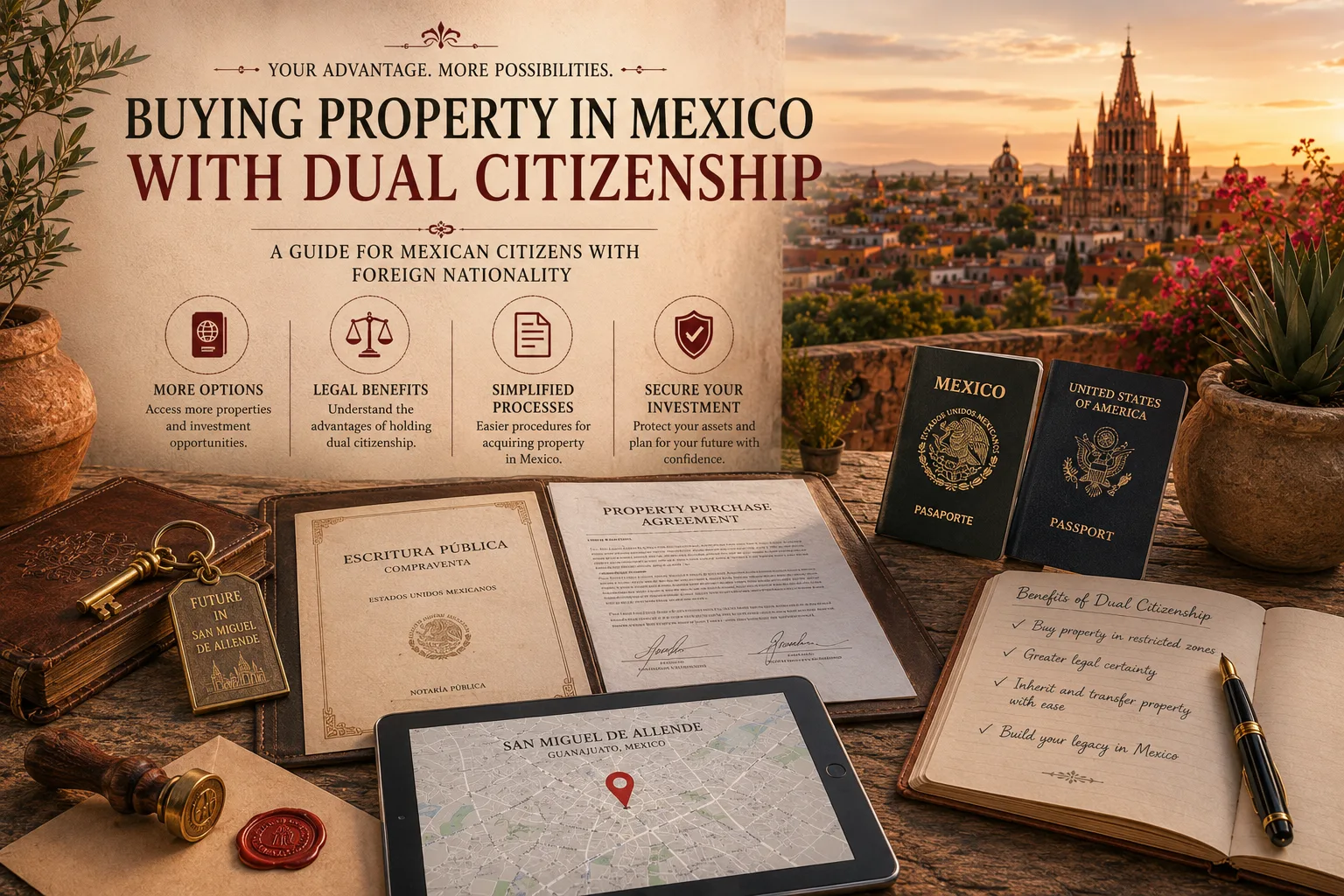
You may be holding two passports, speaking two legal languages at once, and hearing two very different stories about real estate in Mexico. One story says buying is complicated, risky, and packed with special rules. The other says dual citizenship makes everything easy. Neither version is quite right.
What I see most often is a buyer who has a real plan. A couple wants a lock-and-leave home in San Miguel de Allende. A family wants a colonial house they can use now and pass on later. A retired professional wants to stop renting and own something that feels permanent. The confusion starts when they search online and get advice written for “foreigners” as a single category, even though a dual Mexican-U.S. or Mexican-Canadian citizen often sits in a very different legal position.
That difference matters. In many cases, your Mexican citizenship gives you a cleaner path to ownership, more direct control, and fewer moving parts than a non-Mexican buyer would face. It can also create planning questions that generic buyer guides ignore, especially if you already have cross-border assets, a trust, or a spouse with only one nationality.
If you're also sorting out immigration status or long-term relocation, it's worth understanding how permanent residency in Mexico fits into the larger picture alongside ownership, taxes, and day-to-day life. Buying the home is only one piece of the move.
Table of Contents
- Introduction Your Dual Citizenship Is a Golden Ticket
- Unlocking Direct Ownership as a Dual Citizen
- Direct Title vs Fideicomiso Trust A Clear Comparison
- The Purchase Process From Offer to Closing
- Financing Tax and Estate Planning Essentials
- Insider Tips for Buying in San Miguel de Allende
- Conclusion Begin Your Property Journey with Confidence
Introduction Your Dual Citizenship Is a Golden Ticket
A dual citizen usually arrives at this process with a quiet advantage and a loud amount of conflicting advice. Someone tells them they need a bank trust because “all foreigners do.” Another person says they should buy only in cash and keep everything simple. Then a lawyer in the U.S. asks whether the Mexican property should sit inside an existing trust. By that point, even an experienced buyer feels unsure.
The key distinction is simple. If you are a Mexican citizen, your citizenship is not a side note in the transaction. It is the legal fact that shapes how title can be held, how the deed is drafted, and whether a restricted-zone purchase follows the same path as a foreign national or a different one.
That is why buying property in Mexico with dual citizenship deserves its own conversation. The right path for a dual citizen in San Miguel is not the same as the right path for an American-only buyer in Los Cabos, and it is not the same as the right path for a family using a U.S. living trust.
Buying as a dual citizen is often simpler at the deed level and more complex at the planning level.
That trade-off catches people off guard. The purchase itself may be straightforward. The ownership structure behind it may not be. If you understand that from the beginning, you make better decisions and avoid expensive cleanup later.
Unlocking Direct Ownership as a Dual Citizen
For a dual citizen, the main legal advantage is straightforward. You can usually take direct title, or escritura pública, in your own name as a Mexican national.
That point matters more than many buyers realize.
In San Miguel de Allende, the benefit is especially clear because the city sits outside the restricted zone. There is no coastal trust question to solve first. The work is more practical. Confirm the seller has clean title, make sure your Mexican documents line up with the name that will appear in the deed, and structure the purchase in a way that fits your tax and estate plan.
What Article 27 changed in practice
The legal framework changed in the early 1990s, and the practical result for dual citizens is this. If you buy as a Mexican national, you are usually not forced into the same ownership structure used by a non-Mexican purchaser.
That changes the transaction from day one. The first questions are not about which bank will act as trustee. The focus shifts to title review, deed language, marital property rules, source-of-funds documentation, and whether your CURP, RFC, passport, and civil records all support the same identity.
I see this confusion often with U.S. and Canadian clients who also hold Mexican citizenship. They receive general advice meant for foreigners buying in Mexico, then assume it applies across the board. It does not. If you want a useful point of comparison, this guide to buying property in Mexico as an American explains the foreign-buyer path, but a dual citizen should read it as a contrast, not a template.
What the Calvo Clause actually means
The Calvo Clause sounds intimidating, but in practice it is routine. For property purposes, the buyer agrees to be treated as a Mexican national and agrees not to seek foreign diplomatic protection in a dispute over that property.
For dual citizens, this is part of the legal basis for holding title directly. It is not an unusual exception, and it is not a shortcut around due diligence.
A few details deserve close attention:
- Your Mexican identity documents need to support the deed exactly as written. If one document shows two surnames, another drops one, and a third uses a married name, the notario will usually ask for that to be clarified before closing.
- Marital status affects ownership and future transfer. Community property rules, prior marriages, divorce decrees, and inheritance expectations can all affect how title should be drafted.
- Direct ownership reduces one layer of structure, not the legal work. You still need proper due diligence, lien checks, payment traceability, permits where applicable, and a deed that reflects the correct ownership intent.
One more practical distinction matters here. In interior markets such as San Miguel, direct title for a dual citizen is usually the cleanest path because the restricted-zone issue does not enter the file. In coastal markets, dual citizens may still hold direct title as Mexican nationals, but those transactions tend to get more scrutiny because agents, banks, and even some advisors default to the fideicomiso conversation out of habit. The legal right may be clear. The paperwork still has to be handled carefully.
Use your dual citizenship deliberately. It can simplify ownership at the deed level, but only if the file is prepared correctly from the start.
Direct Title vs Fideicomiso Trust A Clear Comparison
For a dual citizen, this comparison should be practical, not ideological. A fideicomiso is not bad. It is a useful instrument for many buyers. But usefulness is not the same thing as necessity.
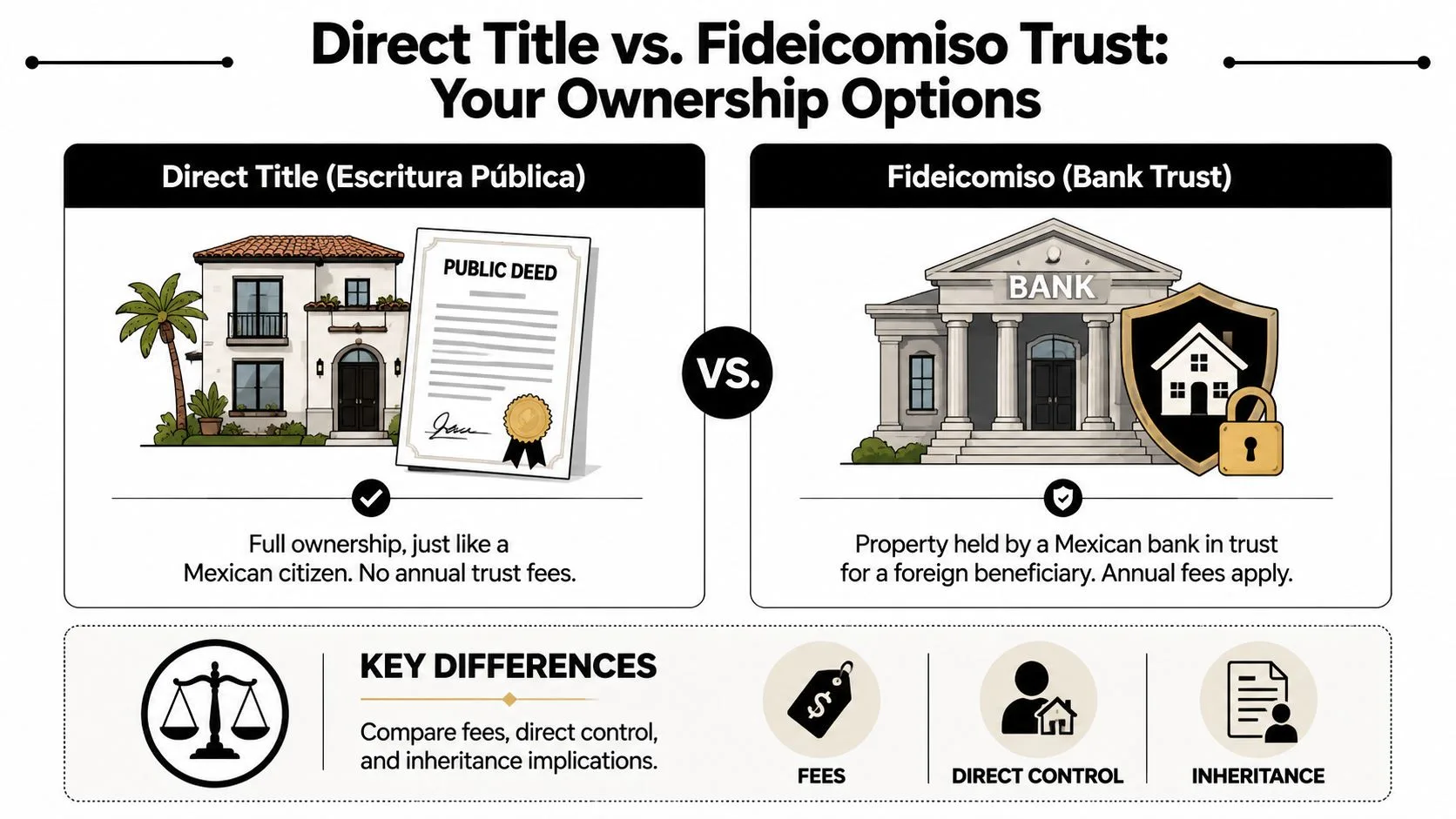
A dual citizen will usually prefer direct title because it removes a bank from the ownership chain. There is less administration, less dependence on trustee procedures, and fewer opportunities for the transaction to become slower than it needs to be.
Why dual citizens usually prefer direct title
Here is the side-by-side view that matters most.
| Feature | Direct Title (Escritura) | Bank Trust (Fideicomiso) |
|---|---|---|
| Legal holder | You hold title in your own name as a Mexican national | A Mexican bank holds title in trust for the beneficiary |
| Typical fit for a dual citizen | Usually the cleanest route | Usually used when a non-Mexican must buy in a restricted zone |
| Ongoing administration | Simpler day to day | Bank administration continues after closing |
| Control | More direct | Filtered through trust terms and bank procedures |
| Cost profile | Standard closing and deed costs apply | Adds a trust layer on top of the transaction |
| Best use case | Dual citizen buying directly, especially in the interior | Buyers who must use a trust, or families who intentionally choose it for structure |
If you are evaluating lots, development parcels, or non-finished property, it also helps to understand how ownership structure intersects with zoning, subdivision, and due diligence. This overview of land in Mexico helps frame those questions from the start.
Later in the process, buyers often benefit from seeing the trust-versus-title issue explained visually. This short video does that well.
When a trust still comes up in conversation
A trust may still enter the discussion even when a dual citizen can hold title directly. The common reasons are family structure, beneficiary planning, or a mixed-nationality couple trying to decide how they want ownership reflected.
That does not mean the trust is automatically superior. It means the conversation shifts from “Do I need this because the law requires it?” to “Am I choosing this because it matches my estate and family goals?”
The mistake is assuming the legal right to avoid a fideicomiso answers the planning question by itself. It doesn't.
What works well is a deliberate choice. What does not work is defaulting into a fideicomiso because someone in the transaction treats every non-local buyer as if they had the same restrictions.
The Purchase Process From Offer to Closing
Once the ownership structure is clear, the transaction itself follows a recognizable sequence. It is not identical to the U.S. or Canada, and the biggest difference is the role of the Notario Público. In Mexico, the notary is not merely witnessing signatures. The notary is a government-appointed legal officer who formalizes the conveyance, reviews critical documentation, calculates applicable taxes and fees, and oversees the deed process.
Who does what in a Mexican transaction
A clean purchase usually depends on three professionals doing their own jobs well.
- The estate advisor helps negotiate terms, gather the right documents early, and keep expectations realistic.
- The notary verifies the legal transfer and issues the public deed.
- Your independent lawyer or advisor, when needed reviews any issues that fall outside the notary's standard scope, especially if the family structure or ownership vehicle is more complex.
In San Miguel and other established markets, transactions move best when those three people communicate early instead of correcting problems at the last minute.
The practical sequence that keeps deals on track
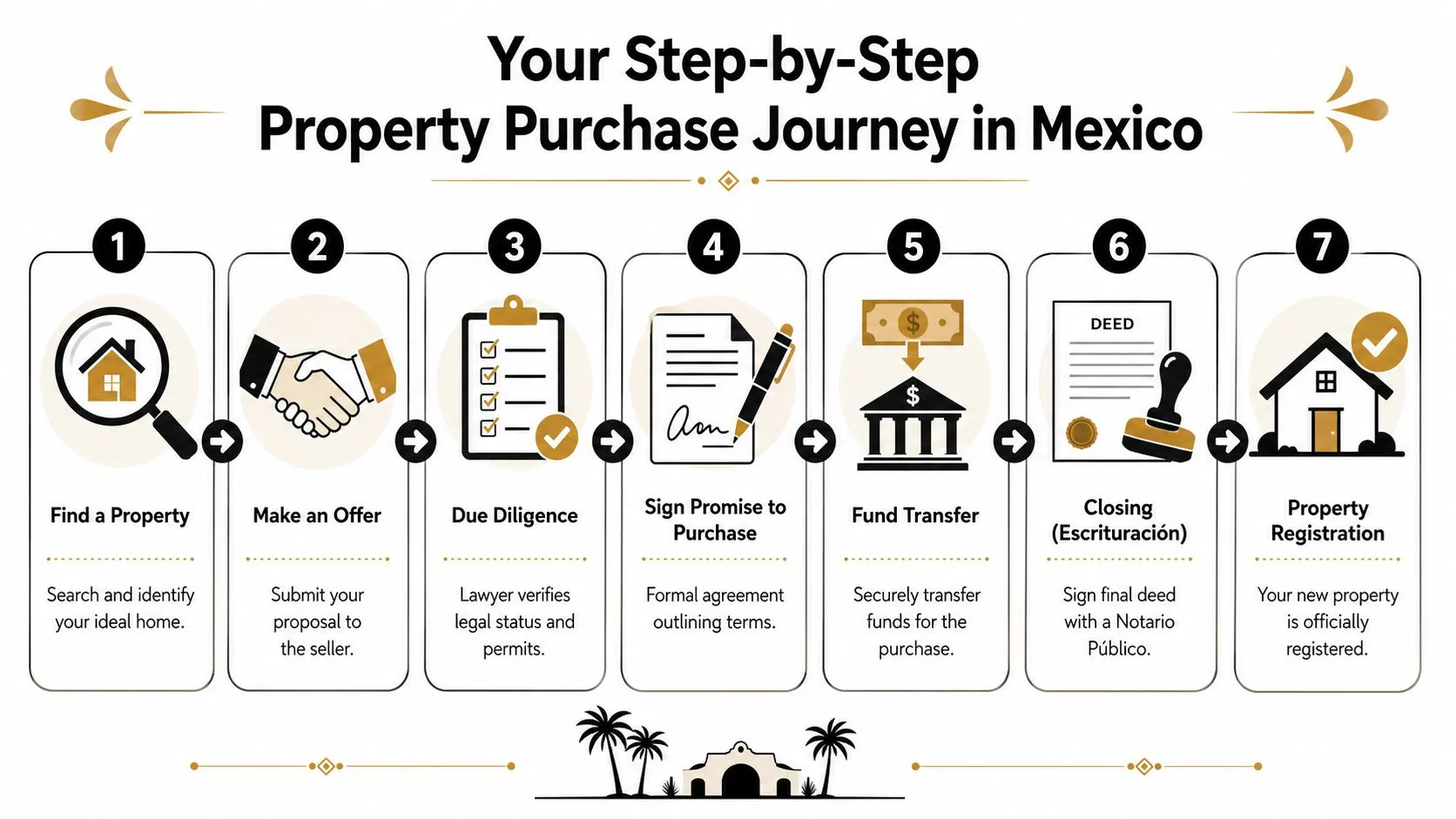
Most purchases follow a path like this:
Property selection and offer
The buyer identifies the property, confirms pricing terms, and submits a written offer or negotiated proposal, at which point fixtures, closing timeline, possession date, and included items should be nailed down.Acceptance and preliminary agreement
Once the seller accepts, the parties usually document key terms in a promissory agreement. At this stage, the deposit structure and deadlines matter.Document collection
The seller provides title documents, tax receipts, identification, and any condominium or regime paperwork that applies. The buyer provides identification, civil status documents, and tax or funding paperwork requested for closing.Due diligence
During due diligence, experienced buyers remain disciplined. Title history, liens, encumbrances, property tax status, utility status, regime compliance, and authority records all need review. If the property has additions, renovations, or special land-use issues, they should be checked now, not after the deed is signed.Funds preparation
Cross-border wiring is often where avoidable stress appears. Buyers should coordinate early with their bank, currency provider, and receiving instructions so money arrives in the form and timing the notary requires.Closing at the notary's office
The final deed is signed, taxes and fees are settled, and the transaction is formalized.Registration
The deed is then submitted for registration, which perfects the transfer in the public record.
Bring more documentation than you think you'll need, and bring it early. Mexican closings rarely fail because the concept is difficult. They stall because one document arrived late, one name was inconsistent, or one marital-status detail was treated casually.
What works is patience paired with precision. What does not work is assuming a Mexico purchase can be improvised in the final week.
Financing Tax and Estate Planning Essentials
A dual citizen buying in San Miguel usually has a simpler title path than a foreigner buying on the coast. The financing and planning questions are still serious. They just show up in different places.
In practice, many affluent U.S. and Canadian buyers purchase with cash, a line of credit from home, or a private family arrangement instead of a Mexican mortgage. Local bank financing exists, but it often feels expensive, document-heavy, and poorly matched to buyers whose income, assets, and tax life are centered outside Mexico. For that reason, I tell clients to decide early whether they are solving for speed, lowest total borrowing cost, asset segregation, or estate simplicity. Those goals do not always point to the same structure.
What you'll pay at acquisition and closing
Closing costs in Mexico are real, and they should be budgeted before you make the offer feel final in your mind. The core items are acquisition tax, notary fees, registration, and the professional costs that come with cross-border advice.
The exact figures depend on the state, the municipality, the declared value accepted for closing, and the legal profile of the property. In San Miguel de Allende, buyers should ask for a written closing estimate from the notary as soon as price and basic deal terms are settled. That estimate is more useful than a generic national rule of thumb because it reflects the actual deed, the transaction value, and the local calculation method.
A realistic budget usually includes:
- Acquisition tax under the local rules that apply to the property
- Notary fees for formalizing the deed
- Public Registry fees to record title
- Legal, tax, and translation costs if your case involves cross-border planning or document review
- Immediate post-closing expenses such as insurance, utility transfers, staff onboarding, or repairs
Buyers looking at homes in San Miguel de Allende, Mexico often focus on price per square meter and renovation budget. The smarter approach is to underwrite the full cost of ownership from day one.
Financing choices affect tax and reporting
The source of funds matters. So does the path the money takes.
A straight cash purchase can reduce closing friction, but it does not eliminate reporting questions in Mexico or at home. If funds are coming from a U.S. LLC, a Canadian corporation, a trust, a retirement account, or a family office structure, that should be reviewed before the contract is signed. I have seen buyers choose an entity for convenience, then spend months cleaning up avoidable tax and succession problems after closing.
Current SAT guidance for 2025 to 2026 puts more attention on transparency, reporting, and the consistency of how assets are held and disclosed. Dual citizens should assume that Mexican real estate ownership can intersect with FATCA and CRS reporting if certain entities or account structures are involved, as explained in this cross-border tax and estate discussion for Americans buying in Mexico.
Estate planning should be done before closing
Direct title is simpler than a fideicomiso in the restricted zone. Simpler does not mean self-executing for heirs.
If you already have a U.S. revocable trust, a Canadian will, or a broader family succession plan, do not assume that document set will work neatly with Mexican probate practice, marital property rules, or local deed formalities. It may coordinate well. It may also create delay, conflicting interpretations, or unnecessary court work for your family.
The usual pressure points are predictable:
- Marital property status needs to match the deed and the planning documents
- Foreign trusts can create administration issues if the local succession path was never mapped
- Entity ownership may help in one jurisdiction and complicate inheritance or compliance in another
- Beneficiary planning should reflect both Mexican procedure and home-country tax treatment
One expensive mistake comes up again and again. Buyers spend heavily to optimize the acquisition, then leave heirs with an unclear transfer path in two countries.
The better approach is usually coordinated planning. Buy the property in the name that makes sense under Mexican law, then align that ownership with a Mexico-aware estate strategy and your existing U.S. or Canadian documents. For dual citizens, that is often the cleanest way to preserve the direct-ownership advantage without creating a mess for the next generation.
Insider Tips for Buying in San Miguel de Allende
San Miguel changes the conversation in an important way. It is in the interior of Mexico, outside the restricted zone. That means the purchase is simpler at the front end because the coastal trust issue is off the table.
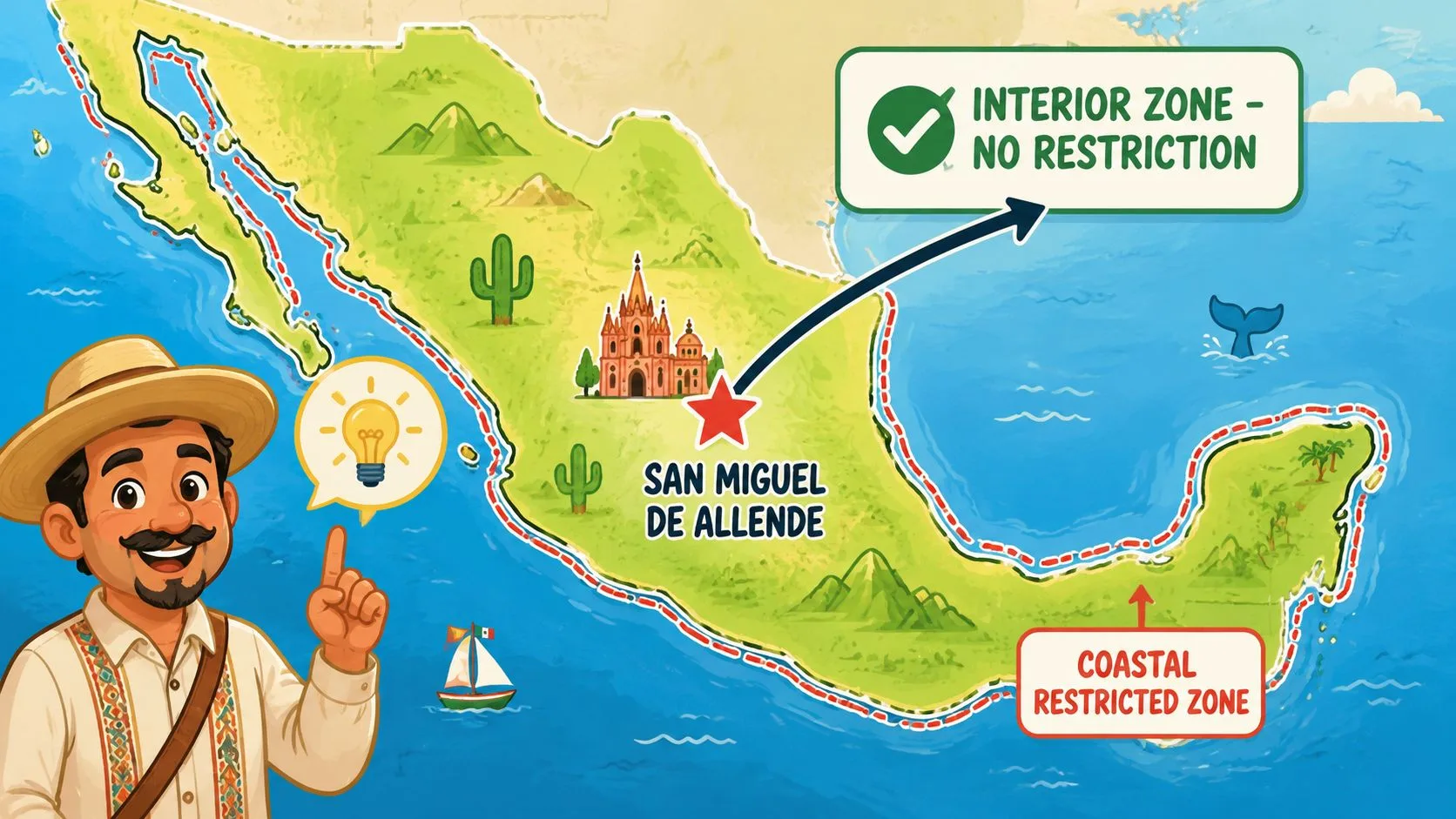
Why San Miguel is simpler than coastal markets
In San Miguel, the legal discussion moves quickly to the things that really affect value and fit. Location. Construction quality. Walkability. Noise. Views. HOA restrictions. Water systems. Rental posture. Future resale.
For a dual citizen, that is refreshing. You are not spending energy on a restricted-zone workaround. You can focus on whether the house matches your life and whether the paperwork behind it is clean.
Local habits that sophisticated buyers should know
San Miguel is an established international market, and it has its own rhythm.
- Centro draws buyers who want architecture and walkability. Beauty is high. So are maintenance expectations and parking compromises.
- Guadiana and San Antonio often appeal to buyers who want a neighborhood feel with easier daily living. They can offer a different balance of access and calm.
- Gated communities suit some buyers well. Others discover too late that they wanted the texture of an in-town house instead.
Many listings are also quoted in U.S. dollars for cross-border clarity, even when the deed work occurs under Mexican legal formalities. That makes negotiations feel familiar to international buyers, but it also means exchange-rate awareness matters during planning and fund transfer.
If you're actively exploring neighborhoods and available inventory, this curated collection of homes in San Miguel de Allende, Mexico gives a good sense of the range, from colonial residences to gated-community options.
Conclusion Begin Your Property Journey with Confidence
Buying property in Mexico with dual citizenship is not just a variation of the foreign-buyer process. In the right circumstances, it is a materially better position. You may hold direct title. You may avoid structures that non-Mexican buyers must use. You may have a cleaner path to control and a more straightforward closing experience.
At the same time, the smartest dual citizens do not confuse legal advantage with automatic simplicity. The deed may be easier. The planning may require more care, especially if there is a spouse from another country, a family trust, or a broader estate plan already in place.
That is the balance worth keeping in mind. Use your Mexican citizenship where it offers an advantage. Slow down where cross-border tax, marital-property, or inheritance issues deserve a real review. When those two instincts work together, the process feels far less mysterious.
A good purchase in Mexico is not only about finding a beautiful property. It is about choosing the right ownership path, documenting the transaction correctly, and setting the property up so it works for your life now and for your family later.
If you're ready to explore ownership in San Miguel with practical guidance from search to closing, Inside San Miguel can help you evaluate neighborhoods, identify the right property, and coordinate the local professionals who keep a transaction clean.