

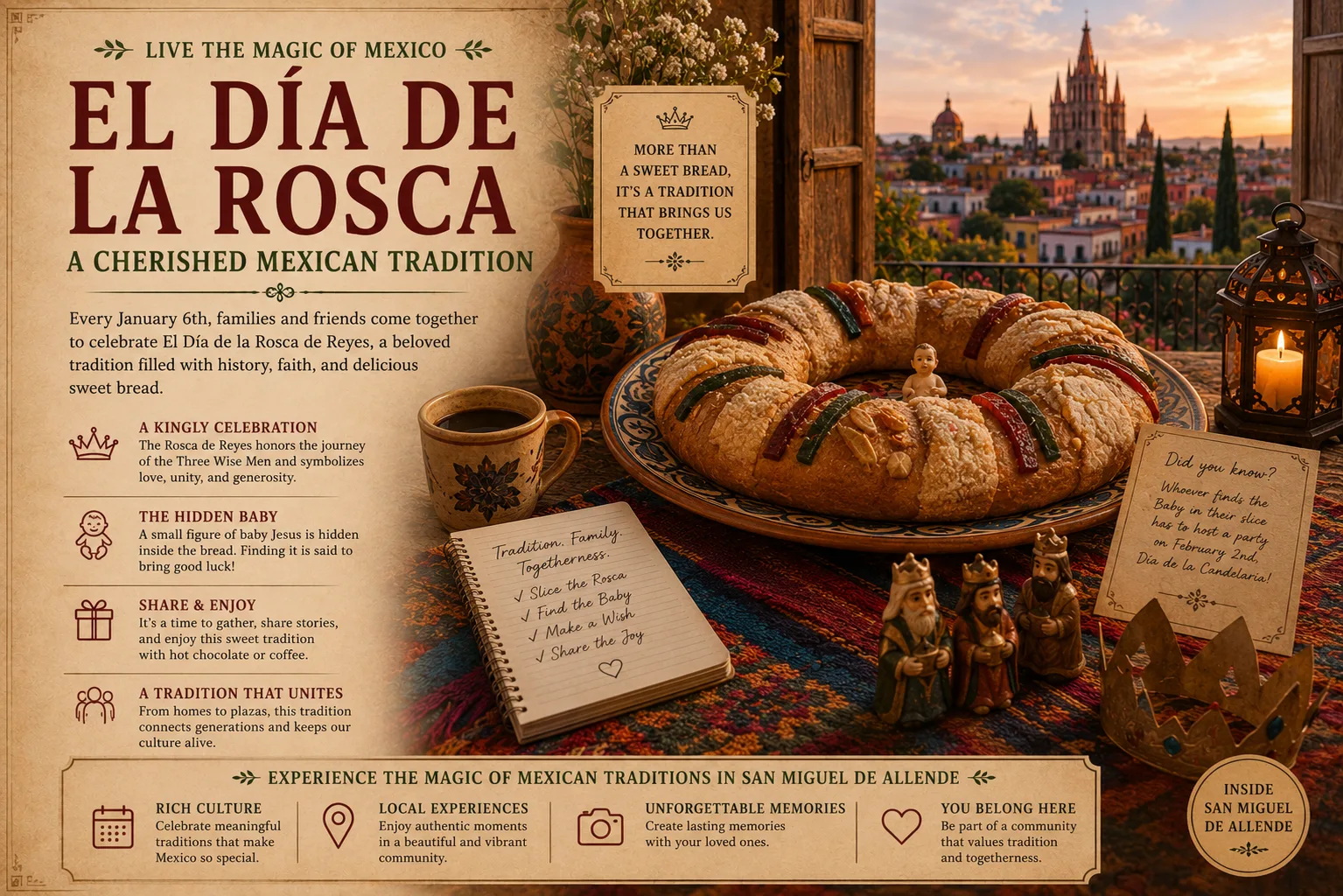
If you're in San Miguel in the first week of January, you can feel the holidays changing shape. The luces are still up, nativity scenes haven't fully disappeared, and the air has that cool, high-desert edge that makes morning coffee taste better. Then the bakery windows shift. Suddenly, there they are. Large oval breads, jeweled with candied fruit, lined up beside bolillos and conchas as if they've been waiting all year for their short, important season.
For newcomers, this is often the first real brush with El Día de la Rosca as a lived tradition rather than a postcard idea. You see people carrying big white bakery boxes to family lunches, office tables filling up with slices, and neighbors asking, half-joking and half-serious, who got “the niño.” In San Miguel de Allende, that matters. This city has a way of turning customs into community, and the Rosca de Reyes is one of the clearest examples.
If you're walking through Centro or taking a morning loop near Benito Juárez Park, you'll notice that this isn't a tourist performance. It's local rhythm. Families, long-time residents, new arrivals, restaurateurs, office staff, and visiting relatives all plug into it in their own way.
Table of Contents
- A Sweet Finale to the Holidays in San Miguel
- The Rich History and Symbolism of the Rosca de Reyes
- Finding the Niño The Social Heart of the Tradition
- Where to Experience Rosca de Reyes in San Miguel
- An Expat's Guide to Participating with Confidence
- More Than a Pastry The Rosca and San Miguel Living
A Sweet Finale to the Holidays in San Miguel
Early January in San Miguel has its own mood. Christmas hasn't fully left, but the town is quieter, a little more reflective. Then the panaderías bring out the roscas, and the season gets one final gathering.
You see them in bakery windows first. Some are modest and plainly beautiful. Others are dressed with bright strips of candied fruit and enough sugar to catch the morning light. People don't buy them casually. They buy them with a plan. Family lunch, office merienda, neighbor drop-in, coffee with friends.
What I like about El Día de la Rosca in San Miguel is that it feels both intimate and public. A rosca can sit at a formal family table, but it also works in a shop back room, at a language exchange, or in a shared courtyard where half the guests were born here and half arrived from somewhere else. That's very San Miguel.
What a newcomer usually notices first
- The timing: It appears right as the Christmas period is winding down, not at the peak of it.
- The size: Many roscas are made for sharing, not for one person to take home and nibble alone.
- The mood: There's always a little suspense around the slicing, even among adults.
In San Miguel, a rosca isn't just dessert. It's an invitation to stay connected a little longer after the holidays.
If you've only seen it from a distance, start simple. Buy a slice with coffee, ask the bakery which version is most traditional, and pay attention to how people talk about it. You'll hear affection, opinions, and a fair amount of strategy about who cuts first.
The Rich History and Symbolism of the Rosca de Reyes
The rosca looks festive, but every part of it carries meaning. Once you know the symbolism, the pastry stops being just a seasonal sweet bread and becomes easier to read. That's useful in San Miguel, where people often assume the tradition doesn't need much explanation.
How the tradition traveled
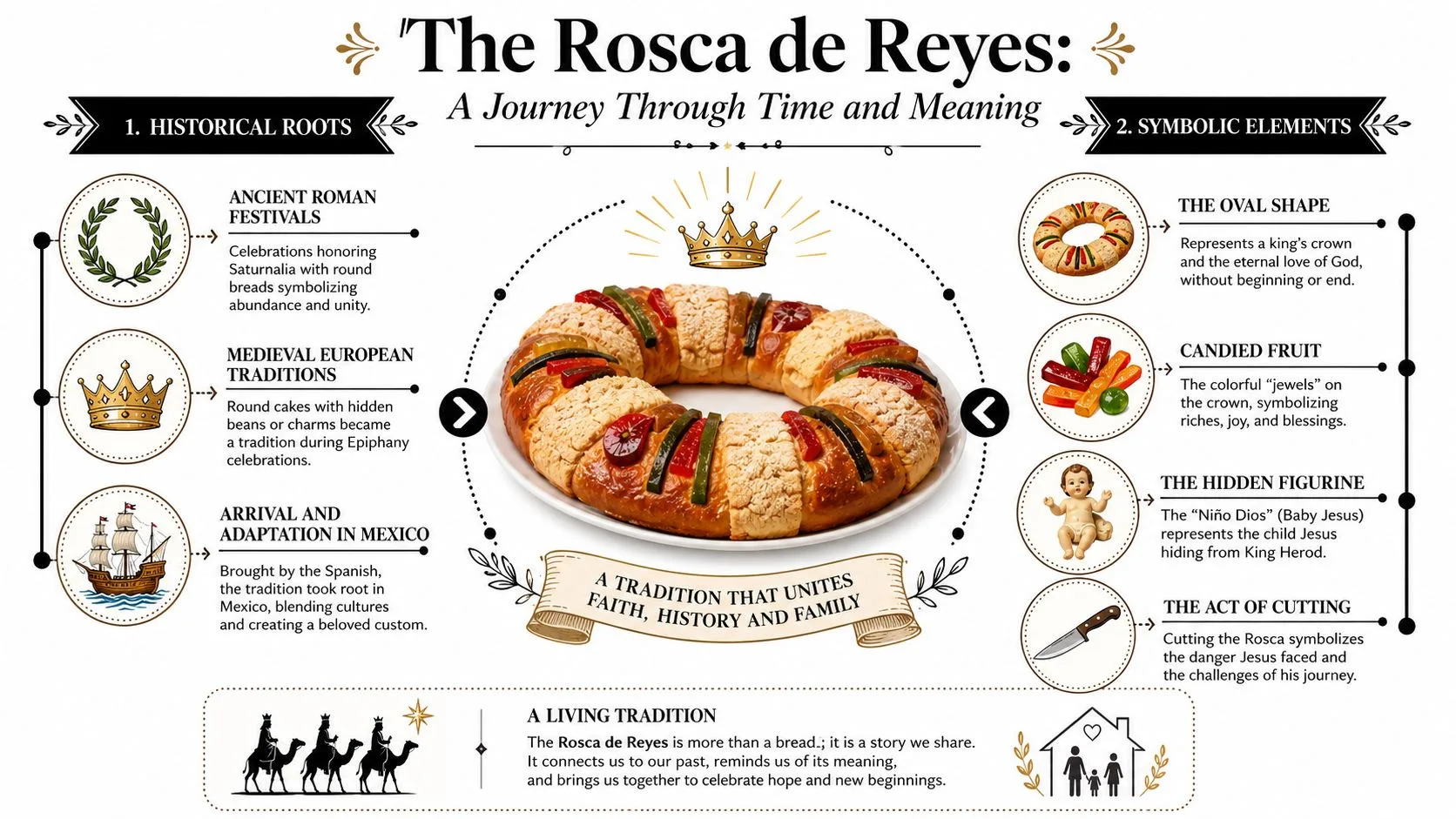
The broad history is well established. The Rosca de Reyes tradition traces back to ancient Roman winter-solstice celebrations, then moved through Europe, becoming the galette des rois in France and the roscón de Reyes in Spain before taking root in Mexico as part of Epiphany on January 6, as outlined in the history of the roscón de Reyes tradition.
That long path matters because it explains why the tradition feels layered. It isn't only culinary. It blends pre-Christian seasonal ritual, Christian feast-day symbolism, and local family practice. In Mexico, those layers settled into something very recognizable and very social.
What each part of the rosca means
The first thing to notice is the oval shape. Traditionally, that form symbolizes the infinite circle of divine love. Some people also read it as a crown. Both interpretations fit the feast and the visual logic of the bread.
Then come the candied fruits. They aren't just decoration. They represent the jewels on the crowns of the Magi, which is why a proper rosca should look ornamental rather than plain.
The hidden figurine carries the strongest story weight. It represents the Child Jesus in hiding, and that hidden element changes the entire experience of serving the bread. Cutting the rosca becomes part ritual, part game, part obligation.
Traditional and modern roscas
One practical detail matters if you're buying in San Miguel and want the most classic version. Acitrón was long considered the traditional benchmark ingredient in an authentic rosca, but because it became difficult to source responsibly, many bakeries shifted to substitutes such as candied papaya or orange. That changes the flavor and, for some families, the sense of what counts as “old-style” versus modern.
A quick guide helps:
| Element | Traditional meaning | What you'll notice in bakeries |
|---|---|---|
| Oval bread | Eternal love, crown imagery | Large shareable shape, not a standard loaf |
| Candied fruit | Jewels of the Magi's crowns | Bright strips or chunks on top |
| Hidden figurine | Child Jesus in hiding | The part everyone is secretly watching for |
| Fruit choice | Marker of style and authenticity | Some shops lean classic, others more contemporary |
Practical rule: If you're curious about authenticity, ask the bakery what candied fruit they use. In San Miguel, that question gets better answers than asking which rosca is “best.”
What doesn't work is assuming every colorful ring-shaped bread is interchangeable. The details matter. They tell you whether the bakery is aiming for nostalgia, convenience, or a more modern local version.
Finding the Niño The Social Heart of the Tradition
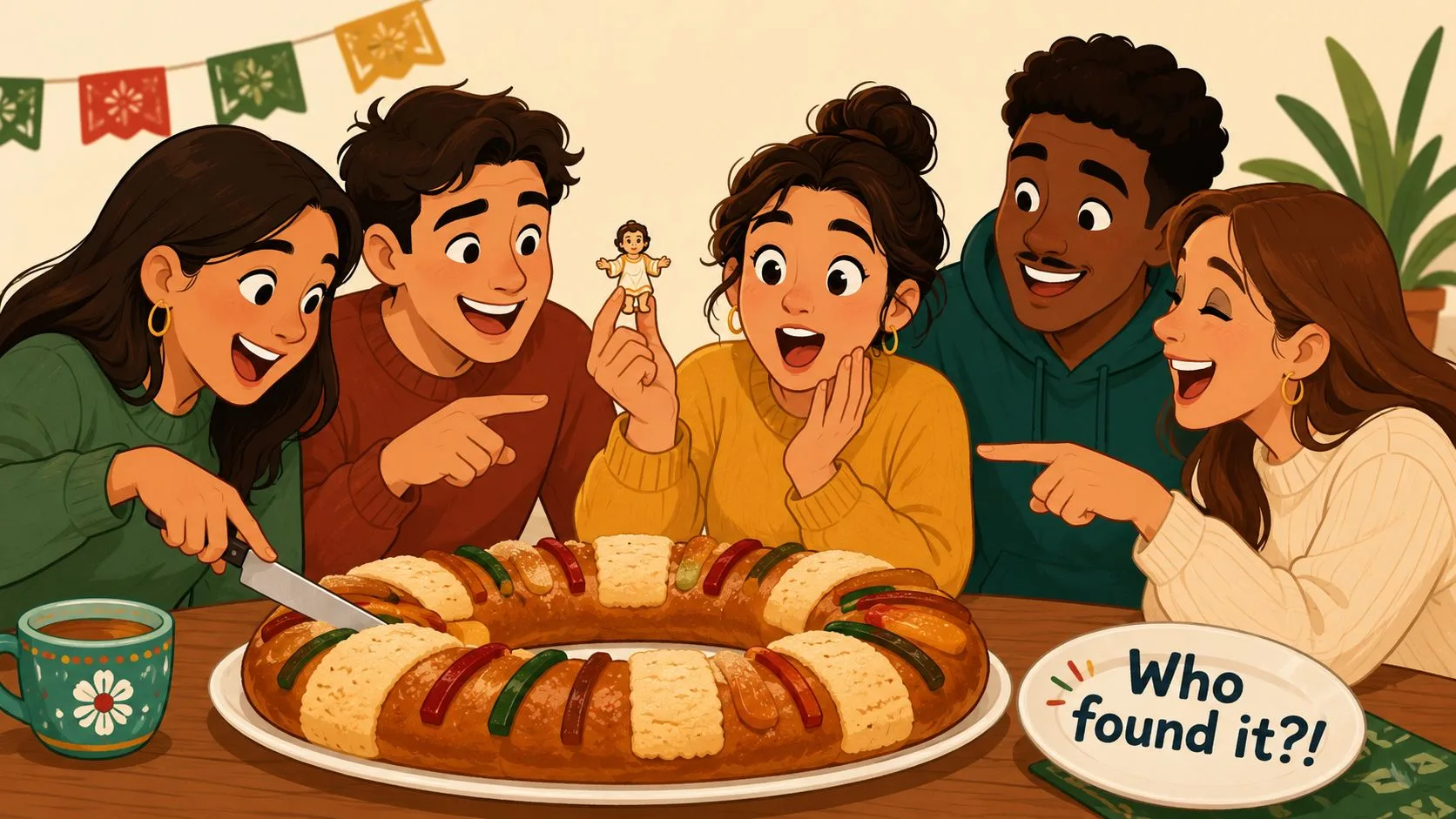
You are standing in a San Miguel living room, a café courtyard, or an office break area. Coffee is being poured, somebody is already laughing, and the room goes oddly attentive the moment the knife touches the rosca. That small pause matters. Around here, the slice is never just a slice.
A Rosca de Reyes gathering can be polished or improvised, family-centered or full of neighbors and newcomers. The social contract is the same. Everyone takes a piece, everyone checks it, and everyone understands that one little figurine can subtly assign the next round of hospitality.
How the ritual usually unfolds
In San Miguel, the custom is familiar enough that locals rarely need much explanation, but mixed groups often have their own style. A family gathering may treat the moment with more ceremony. An art studio, language school, or office will usually play it with more jokes. Either way, the rhythm is easy to follow:
- Someone brings the rosca. It might come from a neighborhood bakery, a host's favorite panadería, or a group order.
- Slices are handed out. People start teasing each other before anyone has even looked down.
- Everybody checks their piece. Some do it discreetly. Some inspect every crumb.
- The niño appears. The person who finds it is now tied to the next gathering in a very public way.
That obligation gives the tradition its social force. In many circles, the finder becomes the padrino for the follow-up celebration on Día de la Candelaria, usually on February 2. Sometimes that means hosting tamales. Sometimes it means paying for part of the food, bringing atole, or helping organize the gathering. The rule is not identical in every household, which is why asking the group what they expect is smarter than assuming one version fits all.
San Miguel handles this especially well because the city is full of mixed tables. Local families, Mexican returnees, long-time expats, recent arrivals, and short-term visitors often end up sharing the same rosca. That mix makes the custom feel welcoming, but it also rewards a little cultural attention. If you want more context for how traditions work across the year here, this guide to festivals in San Miguel de Allende and local cultural traditions helps place Rosca de Reyes in the broader social calendar.
To see the custom in motion, this short video gives a useful sense of the atmosphere and ritual:
A few habits make participation easier if this is your first time:
- Take the slice you're given. Trying to avoid the figurine is noticed immediately, and people will remember it.
- Ask what finding the niño means in that group. Some expect one host. Others split costs or turn it into a potluck.
- Respond with good humor. If you find it, you have been included in the circle.
- Follow through. In San Miguel, people are relaxed about many things, but they do notice who shows up for shared traditions.
If someone hands you a plate with a knowing smile, you're entering the heart of the tradition.
Treating the niño like a party trick misses the point. What keeps this custom alive in San Miguel is the way it turns a holiday pastry into an excuse to gather again, feed people well, and strengthen relationships across families, workplaces, and friend groups.
Where to Experience Rosca de Reyes in San Miguel
You notice Rosca de Reyes in San Miguel before you go looking for it. On January 5 and 6, bakery counters fill up early, WhatsApp groups start making plans, and somebody in nearly every office seems to arrive carrying a big white box. For newcomers, that matters. The tradition is easy to join here because it lives in everyday places, not behind a ticket or a staged event.
In San Miguel, the best experience depends on what kind of participation you want. Buying a whole rosca for friends gives you the full social ritual. Ordering a slice with coffee lets you try it without organizing anything. Accepting a piece at someone's home or workplace usually gives you the most authentic version, because the pastry is only part of what people are sharing.
What to look for in a good local rosca
San Miguel has enough range that you can choose with intention. Some bakeries make a rosca that tastes close to what many Mexican families expect, with candied fruit, soft crumb, and a sweeter finish. Others turn out a more refined version with better lamination, lighter texture, or less sugary topping.
Neither is automatically better. The right choice depends on the table.
If you're bringing rosca to a Mexican household that keeps the custom every year, a more traditional style usually lands best. If you're hosting a mixed group of expats, visitors, and local friends, an artisan version can work well because people who are new to the tradition often respond first to texture and bread quality.
A practical comparison helps:
| If you want | Look for | Possible trade-off |
|---|---|---|
| A classic family-style rosca | Traditional neighborhood bakery | Sweeter flavor, simpler finish |
| A polished artisan version | Café-bakery with a strong pastry program | Less nostalgic feel, more curated style |
| Easy social participation | A place that sells slices | Less ceremony than bringing a full rosca |
| Strong local atmosphere | Markets, offices, home gatherings | Less control over style or ingredients |
Common places you'll see the tradition
These are the settings locals use:
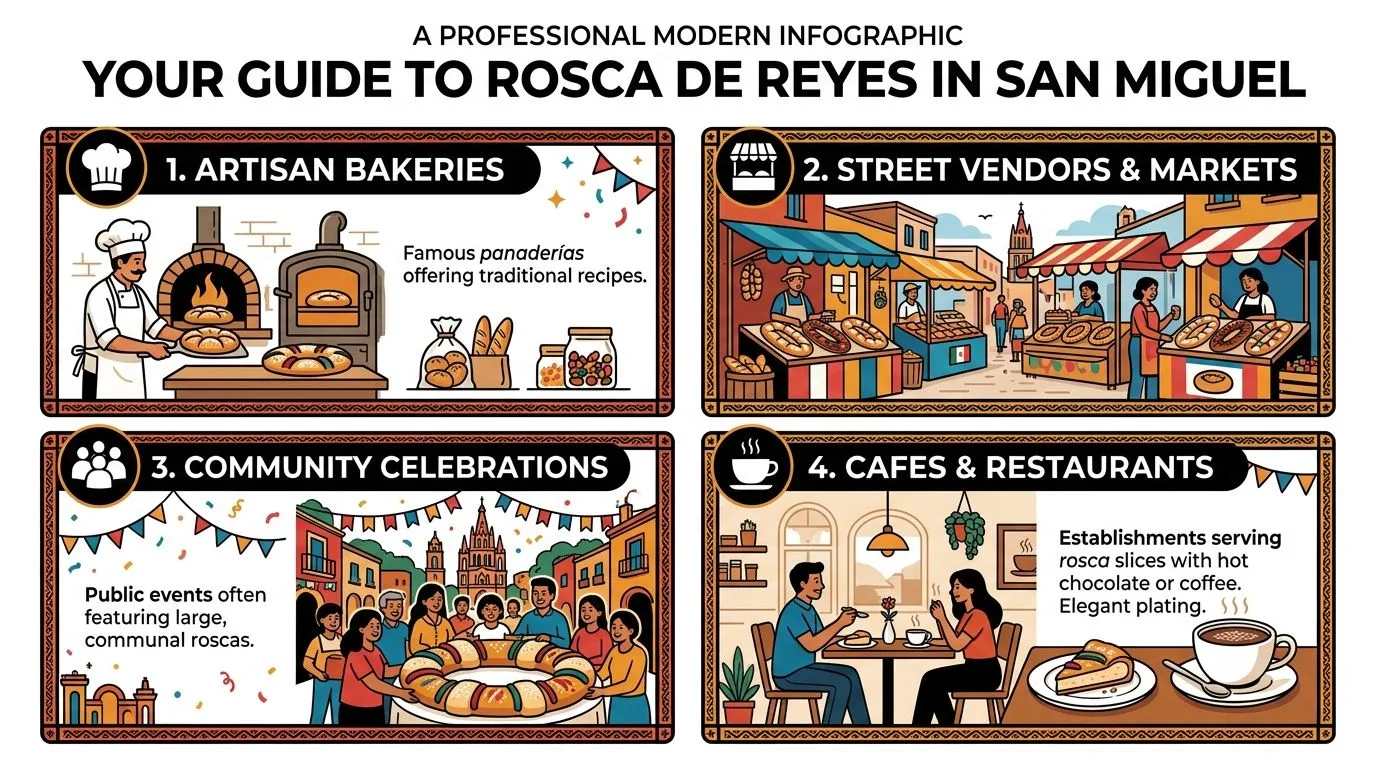
- Artisan bakeries: Places such as Panio and Cumpanio come up often because people trust them for presentation, consistency, and good bread.
- Traditional panaderías: Neighborhood bakeries, including spots locals mention like El Maple, often feel closest to the family-table version of the custom.
- Cafés and restaurants: Many offer seasonal slices with coffee or hot chocolate. That is a good option if you want the experience without committing to a full ring.
- Homes and offices: The custom has the most life here. Someone opens the box, plates come out, and the room starts paying attention.
For a wider sense of how this fits into the city's yearly rhythm, the guide to San Miguel de Allende festivals and local traditions throughout the year helps place Rosca de Reyes in the social calendar.
One practical tip matters more than people expect. Order early if you want a full rosca from a bakery people already trust. By late afternoon on January 6, the best options are usually gone, and the choice gets narrow fast.
The most authentic way to experience El Día de la Rosca in San Miguel is usually the simplest one. Say yes when someone offers you a slice.
An Expat's Guide to Participating with Confidence
Many newcomers hesitate because they don't want to get the etiquette wrong. That's understandable, but this is one of the easier traditions to join well. You don't need perfect Spanish. You don't need family roots in the custom. You just need to show up in good faith.
What to do if you're invited
If someone invites you for rosca, say yes if you can. It's usually a warm, low-pressure gathering, even when the symbolism runs deep.
A few ground rules make it easier:
- Bring something small: Coffee beans, hot chocolate, flowers, or fruit all work better than arriving empty-handed.
- Don't joke too hard about avoiding the niño: A little humor is fine. Making a performance out of escaping responsibility isn't.
- Ask before posting photos: In mixed social groups in San Miguel, some people love sharing everything, others don't.
If conversation slows and you're unsure what to say, ask who usually hosts the Candelaria follow-up in that group. People tend to have stories.
How to host without overcomplicating it
Hosting your own rosca gathering doesn't need to be elaborate. The best versions are simple and relaxed.
Use this checklist:
- Buy the rosca from a bakery you trust. If you're serving a mixed group, ask whether it's more traditional or more modern in style.
- Offer coffee or hot chocolate. That pairing feels natural and doesn't require a full meal.
- Explain the custom briefly for first-timers. One or two sentences is enough.
- Have a plan if someone finds the figurine. Some groups agree on tamales later. Others decide the finder brings part of the next meal.
For newcomers building a life in town, joining rituals like this is one of the easiest ways to move from observer to participant. If you're settling in and still orienting yourself socially, local lifestyle ideas in this guide on what to do in San Miguel de Allende can help you find the right rhythm.
What works best is sincerity. People respond well when they can tell you're trying to participate respectfully. What fails is overproducing the event, turning it into themed entertainment, or stripping out the part that creates connection.
More Than a Pastry The Rosca and San Miguel Living
In San Miguel, the Rosca de Reyes lands so well because it mirrors how the city itself works. History stays visible. Ritual still has social weight. Newcomers are welcome, but they're welcomed into something that already means a great deal to the people who keep it alive.
The pastry evolves, of course. Bakers adjust ingredients, and many now use candied papaya or orange where earlier generations expected acitrón. But the deeper function doesn't change. The rosca still acts as a social contract expressed through food, tying one gathering to the next and turning hospitality into a shared obligation.
Why it fits San Miguel so naturally
San Miguel is full of relationships built across backgrounds. Mexican families, returning seasonal residents, artists, retirees, shop owners, and newly arrived couples all share the same plazas, bakeries, sidewalks, and celebrations. A tradition like this works because it asks something simple of everyone. Sit down. Share bread. Accept the possibility that you'll be called on to host the next moment.
That rhythm matters. It's one of the reasons life here feels textured rather than anonymous.
For anyone drawn to the design, craft, and everyday rituals that shape local life, this look at artisan design and lifestyle in San Miguel de Allende pairs naturally with the spirit of the season.
Some cities are easy to visit and hard to enter. San Miguel is different. If you participate, it opens.
When people talk about quality of life here, they often mean homes, walkability, weather, or beauty. Those matter. But traditions like El Día de la Rosca are what turn those advantages into belonging.
If you're exploring what it really means to live well in San Miguel de Allende, Inside San Miguel offers a grounded view of the city through its neighborhoods, homes, traditions, and everyday lifestyle. It's a useful starting point whether you're planning a visit, considering a move, or looking for the kind of local context that helps San Miguel feel like home.