


You're probably somewhere between inspiration and overwhelm right now. You've saved courtyard ceremony photos, bookmarked boutique hotels, and imagined a candlelit dinner under the San Miguel sky. At the same time, you're asking the practical questions that matter: Which venue works for your guest count, who can manage local logistics from the ground, and should you rent a private estate or look at buying one if you already know you'll return to San Miguel again and again?
That mix of romance and logistics is exactly what defines a successful San Miguel de Allende wedding. The city gives you golden light, historic architecture, walkable charm, and a cultural atmosphere that feels layered rather than staged. It also asks you to plan carefully. Streets are narrow, venues operate very differently from one another, and guest comfort depends on decisions that often get overlooked early.
A strong plan doesn't make the celebration feel less magical. It makes the magic work.
Table of Contents
- Envisioning Your Dream San Miguel Wedding
- Your Planning Foundation Legalities Budget and Timeline
- Assembling Your Local Dream Team
- Choosing the Perfect San Miguel Wedding Venue
- Designing an Unforgettable Guest Experience
- Navigating Local Rules and Cultural Nuances
- Your Final Checklist and Day-Of Schedule
Envisioning Your Dream San Miguel Wedding
A couple lands in San Miguel for a scouting weekend, tours three properties, and realizes the key decision is not décor. It is how they want everyone to live the weekend. A private estate creates a residential rhythm. Guests settle in, dinners feel personal, and the celebration can unfold like a well-hosted house party. A hotel or full-service venue changes the flow. Rooms, ceremony, cocktails, and transportation are easier to coordinate, which matters if you are hosting a larger group or older relatives.
That choice shapes more than the wedding day. In San Miguel, venue selection often overlaps with real estate thinking. Some couples rent a villa for the weekend and use it as the social center for welcome drinks, recovery brunch, and family time. Others look at estates they may want to use again, either as a future vacation base or as a purchase that serves both lifestyle and entertaining goals. The right property can do both, but only if access, staffing, parking, neighborhood context, and event permissions match the vision.
San Miguel stands apart because the city itself is part of the experience. It is a colonial cultural center with strong visual character, walkable pockets, and real logistical limits. Cobblestones affect transport timing. Church bells, grade changes, and narrow streets affect procession routes and guest comfort. Those details are not drawbacks. They are part of what makes weddings here feel specific to place, provided the plan respects how the city functions.

Couples who get San Miguel right usually build a full gathering, not a single evening. The strongest weekends have a clear center of gravity: where guests meet, how they move through the city, and which moments should feel festive versus quiet. That may mean a rooftop welcome party, a rehearsal dinner in a courtyard, a wedding day in a private estate, and a final brunch close to where guests are staying. It may also mean cutting one extra event so transportation and energy stay manageable.
If your taste runs toward architecture, handmade detail, and houses with real character, San Miguel gives you more than generic luxury. That sensibility runs through the city's broader artisan design and lifestyle culture in San Miguel de Allende, and it shows up in the weddings that feel most grounded here.
Practical rule: Start with the weekend you want guests to experience. Then choose the property, venue team, and event format that can support it without strain.
Emotion matters here. So does operational fit. The best San Miguel weddings hold both.
Your Planning Foundation Legalities Budget and Timeline
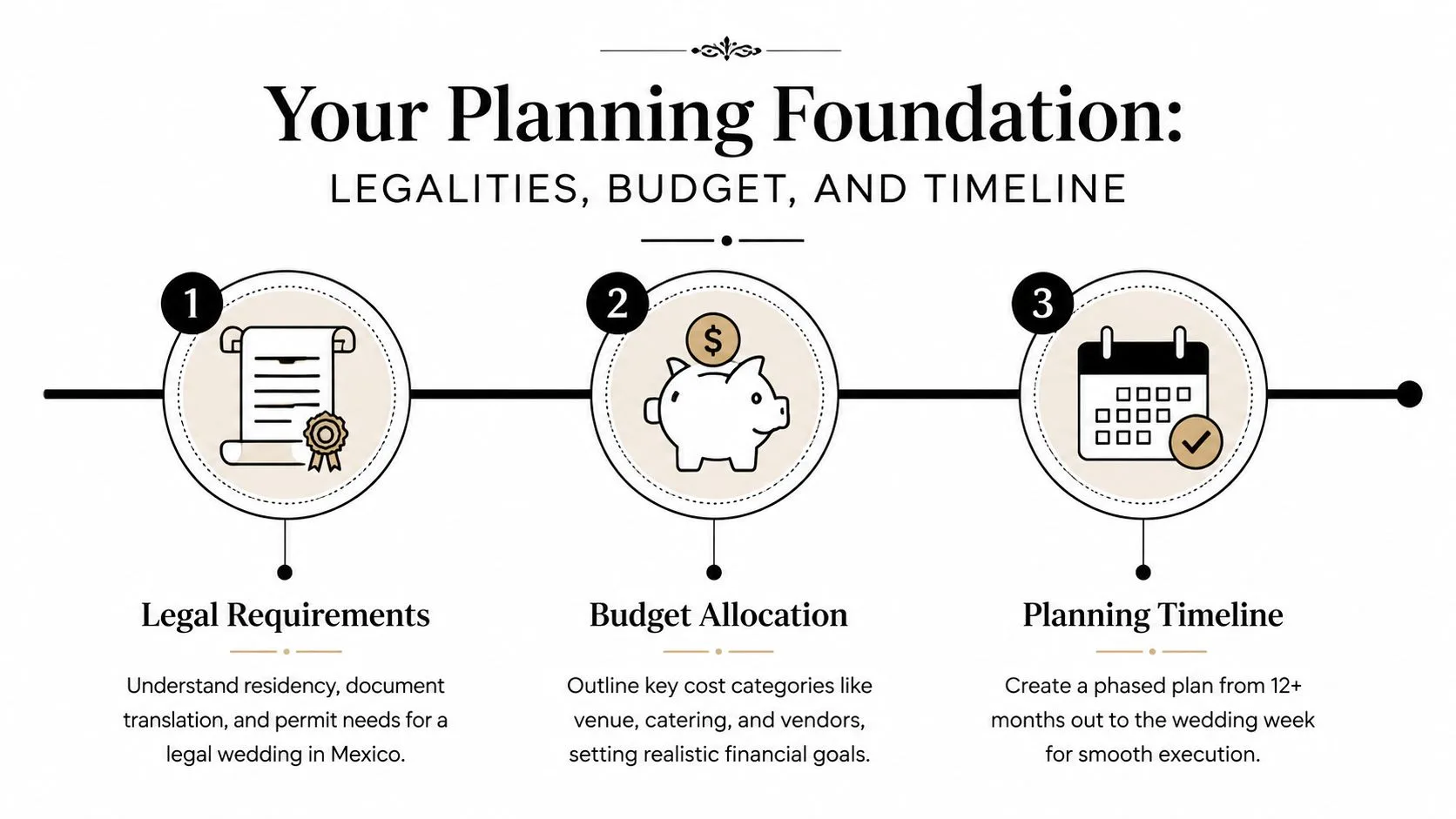
The couples who stay calm during planning usually make three decisions early. They define what kind of ceremony they're having, how they want to allocate money, and how far in advance they need to move on the date.
Start with the ceremony type
Before design, music, or tablescapes, decide whether you want a civilly legal ceremony in Mexico or a symbolic or religious ceremony in San Miguel with the legal paperwork handled elsewhere. This is the foundational fork in the road.
A civil ceremony usually requires more administrative coordination. A symbolic ceremony gives you more flexibility with timing and often reduces stress for international couples who prefer to complete legal marriage formalities at home. Neither option is more romantic. They're different operational choices.
Ask these questions at the start:
- What matters most to you: Do you want the legal marriage to happen on the wedding day in Mexico, or do you want the ceremony experience to be the focus?
- Who is handling documents: Your planner, legal advisor, or venue coordinator should tell you exactly which documents need review and whether translation or local processing is required.
- How much buffer do you want: Administrative tasks are easier when no one is trying to squeeze them into arrival week.
Build a budget around the venue model
Many couples make the mistake of setting a number before deciding what kind of wedding they're hosting. In San Miguel, the venue model drives many downstream costs.
A boutique hotel wedding may simplify lodging, staffing, and guest flow. A private estate can create intimacy and design freedom, but it often adds layers such as rentals, transportation management, backup planning, and off-site accommodations for part of the guest list.
A more useful budgeting method is to break decisions into buckets:
| Priority area | What to evaluate |
|---|---|
| Venue structure | Full-service hotel, historic property, or private estate |
| Guest housing | On-site rooms, nearby hotel block, or dispersed villas |
| Transportation | Arrival transfers, wedding shuttles, late-night return routes |
| Production level | Minimal décor, custom build-out, or multi-event styling |
| Food and beverage flow | Single-event focus or multi-day hosting |
A beautiful estate can look cost-efficient on first review and become more operationally complex once rentals, power, staffing, and transport are added.
That's not a reason to avoid estates. It's a reason to cost them accurately.
Map the timeline around demand and travel
Timing matters more in San Miguel than many first-time destination couples expect. For central Mexico, including San Miguel de Allende, planners identify April and November as the best months to get married because of the comfortable weather, and that concentrates demand into 2 out of 12 months, making venue and vendor booking more competitive according to this wedding timing guide for San Miguel de Allende.
That means your timeline should work backward from seasonality, not just from your engagement date.
A practical planning rhythm looks like this:
- Secure the month and venue first. If you're targeting one of the top weather windows, don't wait for every other detail to feel perfect.
- Book the planner immediately after. The right planner helps shape every later decision.
- Lock guest travel communications early. Many guests will need to coordinate flights, airport transfers, and lodging. A good starting point is understanding how to get to San Miguel de Allende.
- Build the event sequence before design details. Welcome party, rehearsal gathering, ceremony, after-party, and farewell brunch all affect venue selection and transport.
- Leave buffer room. Last-minute compression is what creates avoidable stress in destination weddings.
A calm planning process doesn't happen by chance. It happens when the calendar is doing part of the work for you.
Assembling Your Local Dream Team
A destination wedding succeeds or fails on the strength of the local team. Taste matters, but logistics matter first. If your planner can't coordinate arrivals, vendor timing, venue access, and neighborhood realities in San Miguel, even a stunning design can feel chaotic.
Why the planner decision comes first
The most useful screening question is also the simplest. Ask each planner how many weddings they have planned specifically in San Miguel de Allende. Local guidance for couples recommends that exact benchmark because familiarity with local venues, vendor networks, and municipal logistics is highly place-specific, as explained in these questions to ask a San Miguel wedding planner.
That question tells you more than a portfolio ever will.
A planner may have strong taste and broad destination experience, but San Miguel has its own rhythm. Load-in routes differ by neighborhood. Some venues are easy for production teams and difficult for large guest transport. Some streets look charming in photos and become a challenge when heels, rain, or late-night pickups enter the picture.
When interviewing planners, listen for detail rather than performance. You want someone who answers in operational language.
Ask things like:
- How do you handle dispersed guest lodging? Their answer should include transport sequencing, not just hotel suggestions.
- How do you build a weather backup? Look for venue-specific thinking.
- Who manages final walk-throughs and vendor arrivals? Clear accountability matters.
- How do you time events in residential areas? This reveals local experience quickly.
The right planner doesn't just know vendors. They know how San Miguel behaves when guests are late, traffic tightens, and a celebration needs to keep moving gracefully.
How to vet the rest of the team
Once the planner is in place, the other key hires become easier to assess because you can evaluate fit, not just availability.
For photographers, ask whether they know how to work with San Miguel's varied light conditions. Rooftops, courtyards, churches, and narrow streets all behave differently. For florists, ask what they do well in local conditions and whether they design for architecture rather than against it. For caterers, ask how they handle service style, pacing, and menu flow for an international guest list.
A short vendor review framework helps:
| Vendor | What matters most |
|---|---|
| Photographer | Experience with local light, churches, streetscapes, and fast-moving timelines |
| Florist | Comfort working with courtyards, heat, transport, and installation timing |
| Caterer | Strong service logistics, not just menu ideas |
| Music team | Ability to read mixed guest groups and venue sound realities |
| Hair and makeup | Timeliness, calm energy, and schedule discipline |
If you want a planning contact that sits at the intersection of lifestyle and local property knowledge, one available option is Inside San Miguel's wedding planning service in San Miguel de Allende. That kind of support can be useful when the wedding conversation also includes private-home rentals or estate searches.
The common mistake is hiring each vendor for style alone. The better approach is to build a team that can execute in the city you chose.
Choosing the Perfect San Miguel Wedding Venue
A couple falls in love with a dramatic hacienda online, then realizes too late that half their guests are staying across town, the road is tight for shuttle access, and the rain plan changes the entire reception layout. That is how venue decisions get expensive in San Miguel. The right property has to work as well as it photographs.
San Miguel gives couples real range. You can host an intimate dinner in a courtyard, book out a luxury hotel, or produce a full weekend at a private estate. The decision usually comes down to three practical questions: Where will guests stay, how much production does the property require, and do you want this venue to be a one-time setting or part of a longer real estate plan?
How venue categories behave in real life
Each venue type has a pattern. Once you know that pattern, shortlists get much easier.
Historic haciendas deliver atmosphere and scale. They suit couples who want strong architectural character and a clear separation between ceremony, cocktails, and dinner. The trade-off is operational. Lodging is often limited, vendor load-in can be slower than expected, and transportation needs to be organized early if guests are spread across town.
Boutique hotels in Centro simplify the weekend. Guests can walk to more events, staff is used to hospitality timing, and fewer moving parts sit on the couple's side of the ledger. The compromise is privacy. Hotel weddings usually come with more house rules, more shared spaces, and less freedom to redesign the flow from scratch. For couples comparing hotel formats, the Rosewood Hotel in San Miguel is a useful reference point for what a polished hotel-based celebration looks like in this market.
Private estates and villas give the most control and the most responsibility. They are excellent for families who want the celebration to feel residential, private, and highly personal. They also require honest answers about power, kitchens, restrooms, staff areas, parking, music cutoff, and weather backup. A beautiful house is not automatically an event-ready house.
A quick comparison helps:
| Venue type | Strength | Watch for |
|---|---|---|
| Hacienda | Architectural presence and strong event flow | Off-site lodging, transport, setup access |
| Boutique hotel | Built-in service structure and easier guest coordination | Less privacy, more venue rules |
| Private estate | Full control over atmosphere and schedule | Higher production load and closer operational oversight |
The core decision is not style alone. It is how much complexity you want to own.
When renting or buying a private estate makes sense
This is the point where wedding planning and real estate start to overlap in a useful way.
Some couples want more than a venue for one night. They want a place where parents and siblings can stay together, where welcome drinks happen by the pool, and where the wedding weekend feels like time at home rather than time on a hotel schedule. In San Miguel, that often points toward an estate rental. It can also be a smart first step for couples who are already considering a second home here.
The estate route usually makes sense in four situations:
- You want key family or friends on-site. Shared breakfasts and quiet mornings change the feel of the weekend.
- Privacy matters more than hotel convenience. A private property gives you more control over who is present and how the event unfolds.
- You may buy later. Renting first lets you test neighborhood access, staffing realities, noise patterns, and how the house functions over several days.
- You want the wedding to begin a longer San Miguel chapter. Some couples use the celebration to assess whether they want to return seasonally or purchase in the area.
I give clients one caution here. Do not choose an estate for the photos alone. Choose it because the property can support a serious event. That means confirming service access, rental installation timing, guest circulation, and a realistic rain plan before anyone signs. A house can be extraordinary for living and still be wrong for a wedding.
Designing an Unforgettable Guest Experience
A guest lands in Querétaro, reaches San Miguel an hour later than expected, and steps onto cobblestones in thin heels with no clear pickup point. The ceremony can still be beautiful, but the weekend already feels harder than it should. Guest experience is built in those practical moments.
Treat the weekend like a hosted stay
Start with arrival. Guests need clear airport options, transfer timing that reflects real traffic, and honest notes about terrain, altitude, and evening temperature swings. In San Miguel, small omissions create friction fast.
Housing deserves the same attention. If the couple is using a private estate, I usually advise treating that property as the social anchor, not as housing for everyone. Keep immediate family or the wedding party on-site if the house supports it well, then place other guests in nearby hotels or villas with a transportation plan that is easy to understand. That approach preserves privacy at the estate and keeps the weekend organized.
Good welcome materials usually cover four things:
- Arrival instructions with transfer contacts and realistic drive times
- Lodging options by price point, walkability, and accessibility
- Dress guidance for stone streets, garden paths, and cooler nights
- A clear itinerary showing what is hosted, what is optional, and how guests get between events
Transportation is often the difference between a polished weekend and a scattered one. If guests are split between Centro, gated communities, and rental houses outside the core, assign pickup points and circulate them more than once. Do not expect everyone to solve that on their own after cocktails.
Optional free time matters too. A wedding weekend should have shape, but it should still leave room for the city. A short list of day trips from San Miguel de Allende gives guests useful ideas without turning the official schedule into a second job.
Build in San Miguel, not over it
The strongest weekends feel rooted in the city. That does not require filling every hour with programming. It means choosing a few experiences that belong here and fit the group you have.
For some weddings, that is a welcome dinner with local music and a menu that reflects central Mexico. For others, it is rooftop cocktails the first night, a relaxed gallery visit for early arrivals, or an artisan activity that gives mixed-age groups something easy to do together. A farewell brunch also works well in San Miguel because departures are rarely all at once. It gives the weekend a calm finish.
A visual walkthrough can help you think about pacing and atmosphere across the weekend.
Some couples overprogram because they worry guests will get bored. That is usually the wrong call. Guests remember clear communication, comfortable timing, good hosting, and a sense of place.
If you are renting or considering buying an estate, guest experience should also shape the property decision. Ask whether older relatives can move through it comfortably, whether transport can reach it without confusion, and whether the house supports quiet mornings as well as big celebrations. A beautiful property that photographs well but handles guests poorly will show its limits quickly.
Guests forgive small imperfections when they feel looked after. They don't forgive confusion that could have been prevented with better communication.
The goal is a weekend that feels intentional, generous, and easy to enjoy.
Navigating Local Rules and Cultural Nuances
San Miguel rewards couples who respect local conditions. That doesn't mean the city is difficult. It means the planning works better when local customs, timing, and neighborhood realities are treated as real design constraints rather than afterthoughts.
Callejoneadas permits and timing
A callejoneada is one of the most joyful traditions couples consider here. It can add movement, music, and a distinctly local sense of celebration. It also needs coordination.
Start with your planner and confirm the route, timing, group size, and musicians before promoting it to guests. The route matters because San Miguel's streets are beautiful but not neutral. Some are easier for older guests, formal shoes, or families with children than others.
A clean planning sequence looks like this:
- Define the purpose. Is the callejoneada the main welcome event, a transition to dinner, or a short celebratory moment?
- Confirm the route with your local team. Avoid assuming that the most picturesque streets are the most practical.
- Coordinate municipal permissions through a local expert. This is not the task to hand to a friend or relative.
- Prepare guests properly. Tell them the walk length, footwear expectations, and whether drinks or music are part of the route.
The biggest mistake is treating a callejoneada as spontaneous. It should feel spontaneous. It should not be planned that way.
Noise timing neighborhood awareness and buffers
Noise is where many destination couples get surprised. Outdoor weddings in residential or mixed-use areas need disciplined timing. The issue isn't whether a venue looks private in photographs. The issue is how the property interacts with nearby homes, streets, and sound sensitivity at night.
Ask your planner and venue manager very direct questions:
- When does amplified music need to change or stop?
- Can the party move indoors or to a different zone later?
- What has worked well at this property before?
- Who is responsible for keeping the schedule on track?
Build your reception with a clear energy arc. Start dinner on time. Don't let speeches drift. Protect the dancing window rather than assuming you can make up time later.
Local insight: In San Miguel, schedule buffers are not wasted time. They're what keep a celebration elegant when real-world delays show up.
This applies beyond sound rules. Vendor arrivals, guest transfers, beauty schedules, and religious or symbolic ceremony timing all benefit from extra margin. The city moves beautifully when you stop trying to force it into a rushed template.
Your Final Checklist and Day-Of Schedule
The last month is when good plans either tighten or unravel. The difference usually comes down to one thing: whether everyone knows what happens, where it happens, and who owns each decision.
The final month priorities
By the final stretch, your work is less about adding and more about confirming.
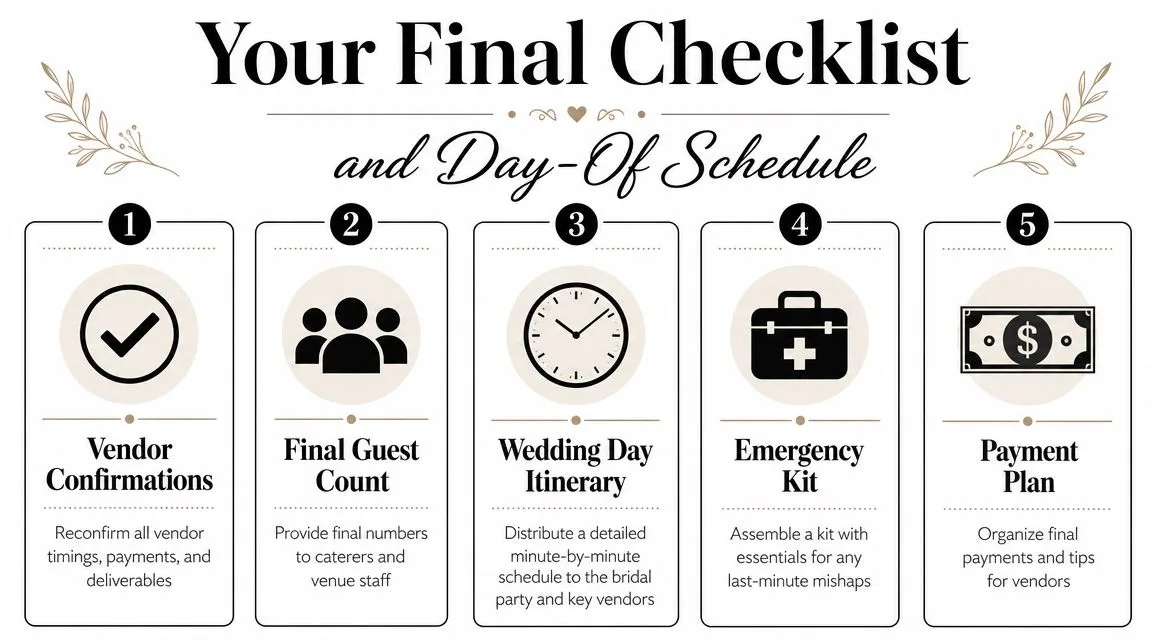
Use this checklist:
Vendor confirmations
Reconfirm arrival times, setup windows, balances, contact names, and deliverables. Don't rely on old email threads alone.Guest count lock
Final numbers affect seating, catering, transport, welcome bags, and staffing. Late uncertainty creates a chain reaction.Wardrobe and personal items
Keep wedding attire, accessories, vows, rings, and ceremony items in one controlled plan with named handlers.Transportation matrix
Confirm every route: airport arrivals, rehearsal events, ceremony shuttles, and late-night returns. Share pickup instructions clearly.Emergency kit and contingency file
Pack practical items and create a short printed backup sheet with key contacts, schedule milestones, and payment notes.
A final-review table helps keep responsibilities visible:
| Item | Owner |
|---|---|
| Master schedule | Planner or lead coordinator |
| Family communication | Designated family liaison |
| Personal items | Trusted attendant |
| Vendor payment tracking | Planner, couple, or financial point person |
| Transportation updates | Planner or transport captain |
A day-of schedule that protects the experience
The strongest wedding-day timelines feel generous, not crowded. They give hair and makeup enough room, protect photography windows, and keep guests from waiting too long between moments.
A sample rhythm might look like this:
- Morning preparation with a quiet, organized setup and breakfast delivered where the wedding party is getting ready.
- Early detail photography before rooms become cluttered.
- A first look or private moment, if you want one, timed before guest movement starts.
- Guest arrivals with staff or signage guiding flow.
- Ceremony with a built-in pause afterward rather than an immediate rush.
- Cocktail hour while portraits and family photos finish efficiently.
- Dinner and toasts paced tightly enough to protect the dance portion.
- Dancing and late-night transition with transportation already staged for departures.
The details that save the day are usually small. Water in holding rooms. Extra time for family portraits. A defined person who can answer guest questions. One printed version of the schedule in every active zone.
A San Miguel de Allende wedding often leaves couples wanting a longer relationship with the city. That's common. Once you've hosted family here, learned the neighborhoods, and seen how private homes and hospitality properties function, it's natural to start thinking beyond the wedding weekend and toward seasonal stays, investment, or ownership.
If your wedding search is also becoming a property search, Inside San Miguel can help you evaluate private estates, neighborhood fit, and the practical side of renting or buying in San Miguel de Allende after the celebration.