


Most advice about whether San Miguel de Allende is safe gives you the wrong frame. It answers the tourist version of the question with a simple yes, then leaves out what matters if you’re buying a home, renting for months at a time, or planning daily life here.
A better question is this: How do you live safely in San Miguel de Allende once it stops being a postcard and starts being your routine? That’s the question buyers should ask before choosing Centro over a hillside colonia, before deciding whether a gated community is worth the trade-off in walkability, and before assuming that a beautiful colonial house is secure just because it has thick walls and a carved wooden door.
San Miguel’s safety picture is more nuanced than the headlines and more practical than the usual travel blogs suggest. Independent benchmarking places the city in a higher band with a composite score of 2.85/5.0, while also noting that the scoring is pulled upward by broader Guanajuato conditions even when lived experience in the historic core is closer to Moderate, according to this San Miguel safety benchmark. For most international buyers, that means you shouldn’t think in slogans. Think in zones, habits, home design, and how you move through town.
Safety also belongs in the same conversation as lifestyle, budget, and neighborhood fit. People comparing homes here usually weigh charm, walkability, and carrying costs at the same time, which is why a clear view of San Miguel de Allende cost of living matters alongside any safety discussion.
Table of Contents
- Rethinking the Question About Safety in San Miguel
- The Real Crime Data Behind the Headlines
- A Neighborhood-by-Neighborhood Safety Guide
- Navigating Everyday Risks and Common Scams
- Protecting Your Property A Guide for Buyers and Renters
- Emergency Resources and Healthcare in San Miguel
- Frequently Asked Questions About Safety in San Miguel
Rethinking the Question About Safety in San Miguel
“Is San Miguel de Allende safe?” is not a very useful buying question. A better one is whether your day-to-day life here will be set up in a way that reduces avoidable risk.
That distinction matters. A retiree renting a lock-and-leave condo near Centro, a family buying a house in a lower-density area, and an owner who leaves town for months at a time are dealing with different safety realities. I tell clients to stop looking for a citywide yes-or-no answer and start evaluating exposure at the property level.
For owners and long-term residents, safety usually comes down to three decisions. Where you live. How your home is secured. How much of your routine depends on isolated streets, late-night driving, or leaving a property empty.
Practical rule: Don’t buy or rent based on reputation alone. Choose based on the exact block, street lighting, pedestrian activity, parking setup, sight lines, and whether your normal routine is mostly walkable or mostly car-dependent.
San Miguel works well for residents who make those choices carefully. It is less forgiving for buyers who assume charm equals low risk everywhere, or that a beautiful house automatically makes a practical house. In real estate, I see this most often with standalone homes that have weak perimeter security, poor exterior lighting, or easy access from a quiet side street.
Budget affects safety choices too. Buyers comparing neighborhoods should weigh security costs alongside purchase price, maintenance, and daily convenience. A lower entry price can come with higher carrying costs if you need monitored alarms, better locks, exterior cameras, or property checks while traveling. That is part of the overall math of ownership, just like taxes and upkeep in this guide to the cost of living in San Miguel de Allende.
The useful question is narrower and more practical. Does the neighborhood fit your habits? Does the property type match how often you travel? Will you feel comfortable returning home after dinner on your usual route, not just during a sunny showing at noon?
Buyers who ask those questions usually make better decisions. They also worry less after closing, because they bought with local conditions in mind instead of relying on a slogan about whether San Miguel is “safe.”
The Real Crime Data Behind the Headlines
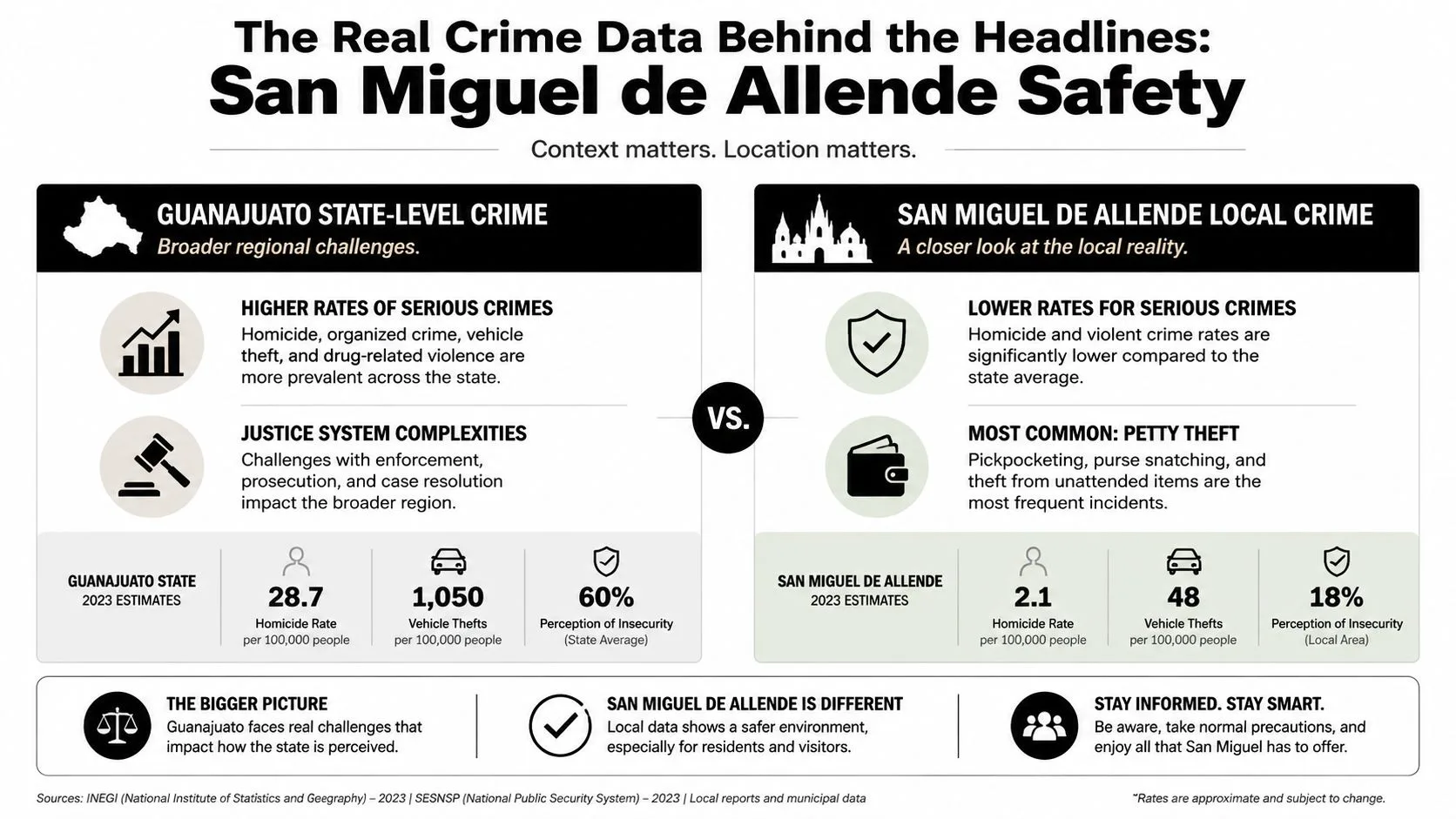
State-level headlines about Guanajuato often distort how buyers assess San Miguel. For a property owner or long-term resident, the better question is narrower. What risks show up in daily life here, and where do they show up?
A 2026 safety review citing SESNSP data reports 6,813 total incidents in the municipality in the most recent year versus 5,855 the year before, a 16.4% year-over-year increase, with the population in that analysis held at 176,322. That implies a per-capita rate rising from 3,320 per 100,000 to 3,864 per 100,000, according to this municipal safety review for San Miguel de Allende.
Those numbers deserve attention. They also require context before anyone uses them to judge a purchase.
Interpreting the Numbers in Practice
Municipal totals combine places that function very differently. They include busy central streets, lower-density residential zones, road corridors, and outlying areas where visibility, traffic patterns, and response times are not the same. Buyers get into trouble when they treat one municipal figure as if it describes every block equally.
That distinction matters a great deal in San Miguel. Owners in and around Centro Histórico properties in San Miguel de Allende usually benefit from stronger pedestrian activity, more commercial presence, and more consistent street observation. Owners on the edges of town often get more privacy, larger lots, and better views, but they also take on more responsibility for perimeter security, lighting, and access control.
I tell clients to read crime data the way an insurer would. Start broad, then narrow quickly to the property type, the street, the arrival pattern after dark, and how often the home will sit empty.
Municipal statistics help frame the risk. They do not replace walking the block at 9 p.m., checking road access, and evaluating how a house performs when no one is home.
Why owners should focus on exposure, not just totals
Residents do not experience crime as an annual chart. They experience it through routines and vulnerabilities. A lock-and-leave condo near active streets carries one set of considerations. A detached house on a quiet lane with intermittent occupancy carries another.
For buyers and renters, exposure usually comes down to four practical questions:
- How do you arrive home most nights? Walking through active, well-lit streets feels different from driving the last stretch on a quiet road with little foot traffic.
- How often is the property empty? Part-time use increases the importance of alarms, camera coverage, trusted staff access, and regular property checks.
- How visible is the home from the street and from neighbors? Privacy is attractive, but reduced sight lines can lower passive deterrence.
- How dependent are you on peripheral routes? A home can feel peaceful during a daytime showing and much less convenient if every dinner, errand, or airport run depends on isolated roads after dark.
Many international buyers often misread the market. They compare purchase prices and views, but not the ongoing security standard each property requires. In practice, safety in San Miguel is highly local. Good decisions come from matching the home to your habits, your travel frequency, and the level of oversight you are willing to maintain year-round.
A Neighborhood-by-Neighborhood Safety Guide
For buyers, safety is never just about crime. It’s about friction. How often do you need a car, how deserted does your street feel at night, how easy is it to notice unfamiliar activity, and how much of your routine happens on foot. Those details shape whether a home feels easy to live in.
The strongest rule is simple. Walkability and passive surveillance usually improve day-to-day comfort. Seclusion can be beautiful, but it often asks more from your security setup and your transport habits. That doesn’t make one choice right and the other wrong. It means every neighborhood solves one problem while creating another.
What changes from one area to another
Centro gives owners something many markets can’t. Constant activity. That comes with noise, visitors, delivery traffic, and the occasional nuisance, but it also means a lived-in environment where people are around, businesses stay alert, and movement at most hours feels normal.
Areas just outside the center often strike the balance many long-term residents want. You keep access to the historic core without depending on it for every errand. Streets can feel calmer, but the trade-off is that the quiet some buyers love can also reduce the natural visibility that discourages opportunistic problems.
Hillside and edge neighborhoods appeal to buyers who want views, larger homes, or gated formats. Those can be excellent choices, especially for owners who value privacy and controlled entry. But privacy has a cost. Once you reduce foot traffic and add driving dependence, safety becomes more about systems than street life.
San Miguel de Allende neighborhood safety profile
| Neighborhood | Vibe & Character | Walkability to Centro | Common Security Profile | Best For |
|---|---|---|---|---|
| Centro | Historic, active, highly social, tourist-facing | Highest | Stronger day-to-day visibility, more policing presence, more petty-theft awareness needed | Buyers who want to walk almost everywhere |
| San Antonio | Mixed residential, creative, lived-in feel | Good in many parts | Generally practical for full-time living, but street-by-street variation matters | Residents who want balance between access and local feel |
| Guadiana | Quiet, established, residential | Good | Usually calmer than the core, with less bustle and fewer eyes on the street late | Buyers who want a refined residential setting close in |
| Balcones | Elevated, view-oriented, more car-reliant in many spots | Limited on foot for most people | Greater dependence on vehicles and route planning, especially after dark | Owners prioritizing views, space, and privacy |
| Vista Antigua and similar gated communities | Controlled-access, orderly, more suburban in layout | Usually car-dependent | Entry control and managed environment help, but outside-route exposure still matters | Part-time owners and buyers wanting built-in structure |
One way to narrow the field is to compare your habits against the neighborhood, not your aspirations against the marketing. If you say you want to walk to dinner three nights a week, don’t buy a house that requires a car every evening. If you travel often, don’t underestimate the value of controlled access or nearby neighbors who notice when something is off.
For buyers looking closely at the historic core, a focused Centro neighborhood guide from Inside San Miguel helps clarify what different parts of Centro feel like in real life, not just on listing photos.
Buyers often overpay for romance and under-evaluate routine. In San Miguel, routine is what determines whether a property feels secure.
Navigating Everyday Risks and Common Scams
Most long-term residents in San Miguel don’t spend their time worrying about dramatic scenarios. They manage ordinary urban risks. That’s the right mindset because the most common problems tend to be the ones that interrupt everyday life rather than define it.
Data Mexico reports that in October 2025, the most frequent complaints were theft with 168 cases, injury with 79, and other common-law crimes with 74, together accounting for 54.8% of complaints that month, according to the Data Mexico profile for San Miguel de Allende. That pattern tells buyers something useful. Practical caution matters more than dramatics.

What residents actually watch for
The common issues are familiar to anyone who has lived in a busy destination city. Unattended bags. Phones left on café tables. Wallets handled carelessly in a market. Vehicles used as temporary storage. Small lapses become easy opportunities.
Injuries also belong in the practical safety discussion here. San Miguel’s sidewalks, cobblestones, slopes, and staircases are part of the charm, but they also punish distraction. Good shoes and basic caution do more for some residents than any alarm system.
If you’re testing daily life before buying, a long-term rental in San Miguel de Allende can reveal these patterns quickly. You learn which streets stay active, where you feel comfortable after dinner, and how much you rely on walking versus driving.
Simple habits that lower exposure
- Handle cash and cards discreetly. Don’t sort bills or leave cards exposed in crowded settings.
- Treat parked cars as visible storage. If something matters, take it with you. Don’t leave it on a seat, under a jacket, or in an easy-to-guess compartment.
- Use ATMs selectively. Choose machines in well-trafficked, well-lit settings and avoid turning a withdrawal into a long sidewalk pause.
- Respect the terrain. Uneven streets and dim corners create injury risk, especially at night or after a long evening out.
- Keep your routine legible to yourself. Know how you’re getting home before you leave. Unplanned late-night movement is when judgment slips.
Street-smart habit: In San Miguel, the question isn’t only “Is this area safe?” It’s also “Am I making myself easy to target or easy to ignore?”
That distinction matters. The city is easier to live in when your habits are quiet, predictable, and low-profile.
Protecting Your Property A Guide for Buyers and Renters
Tourist safety advice usually stops at pickpockets and taxis. Property owners need a different conversation. They need to think about entry points, vacancy periods, service access, who notices unusual activity, and whether the house itself invites attention or resists it.
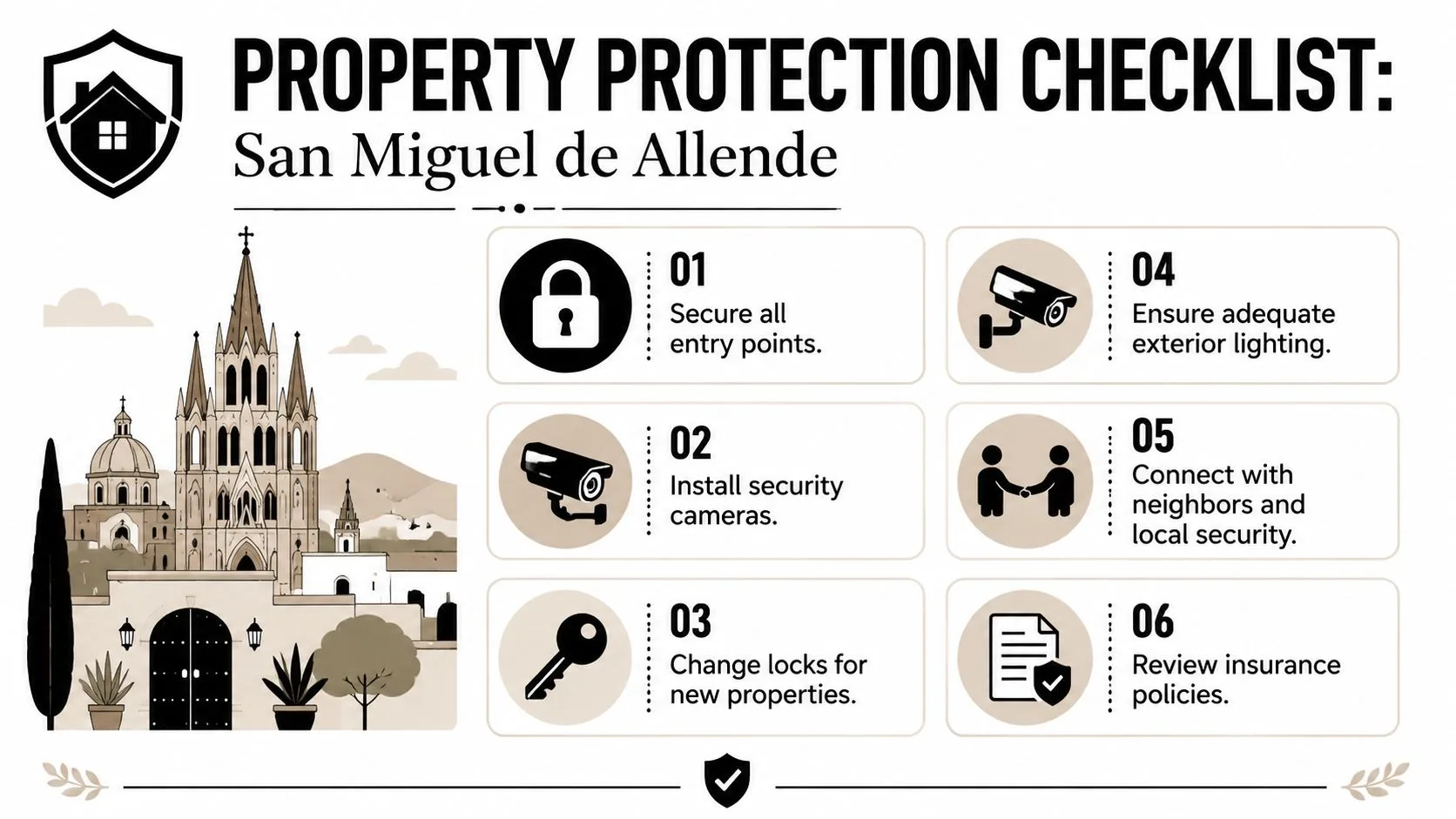
An independent expat guide notes that residents focus more on petty crime, car and home break-ins, robberies, vandalism, and pickpockets than on violent crime, and it specifically recommends secure doors and gates, alarms, and not leaving valuables in vehicles, according to this expat guide on living in San Miguel de Allende. For buyers, that advice is more useful than broad reassurance because it points directly to what local homeowners commonly do.
How property type changes your security plan
A colonial home in or near Centro often benefits from location. Neighbors, vendors, staff, and passersby create natural oversight. But older homes also require scrutiny. Historic charm can hide weak locks, secondary doors that don’t seal properly, rooftop access points, or garages that are convenient but not especially secure.
A house in a non-gated residential colonia can work very well for full-time living if the street has stable occupancy and the home has been updated intelligently. These properties usually do best when owners improve layered security rather than relying on one dramatic feature, such as a tall wall with poor lighting.
Gated communities change the equation. They reduce random access and create more controlled entry, which many part-time owners value. But gates don’t replace diligence inside the property line. Once a buyer assumes the gate solves everything, standards often slip where they matter most.
What works and what does not
The security features worth paying for are usually straightforward:
- Strong perimeter control. Solid doors, quality locks, working gate hardware, and limited casual access.
- Useful lighting. Not decorative lighting. Lighting that clearly covers entries, parking areas, and side paths.
- Visible monitoring. Cameras and alarm systems are most effective when they support fast response from owners, staff, or neighbors.
- House-sitter logic. If you travel often, someone should know the home’s patterns, deliveries, and maintenance schedule.
- Vehicle discipline. Don’t let the car become a storage locker for tools, luggage, electronics, or paperwork.
What doesn’t work is security theater. Oversized gates with weak side entries. Cameras no one checks. A beautiful front door with an unprotected service entrance. Owners often focus on the dramatic facade and miss the ordinary vulnerability.
For international purchasers, buying property in Mexico as an American also means building a due-diligence team that can review practical issues around occupancy, maintenance, contractors, and access. That’s one place a local advisor such as Inside San Miguel can help as part of a broader purchase process, alongside legal and property-specific review.
Emergency Resources and Healthcare in San Miguel
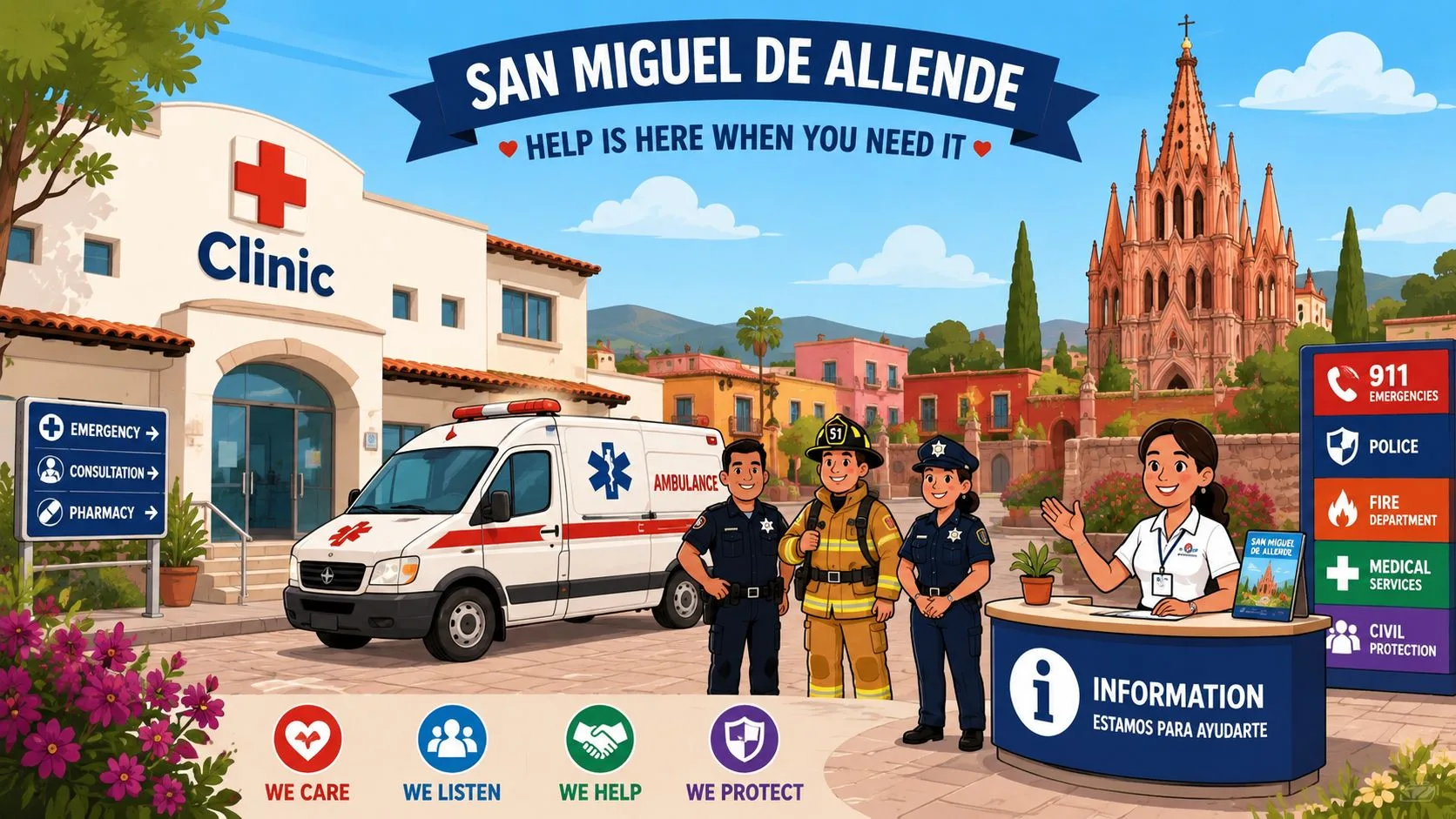
Crime prevention gets most of the attention, but many buyers feel calmer once they understand response systems. A city becomes easier to trust when you know what you’d do after a fall, a medical issue, a vehicle problem, or a genuine security concern.
What to prepare before you need help
Before moving into any property, keep a written emergency sheet in the house and in your phone. Include your address exactly as a driver or responder would need it, nearby landmarks, building access instructions, gate codes if relevant, and the phone numbers you personally rely on. If you don’t speak fluent Spanish, keep a short written description of your home location in Spanish as well.
Also prepare for health issues the way residents do, not the way tourists do. Know which clinic or hospital you’d use for something minor versus something urgent. Ask whether your preferred providers have English-speaking staff available. If you live in a gated development or on a less obvious street, make sure guests, house managers, and drivers can locate the property easily.
A useful local overview is embedded below:
How residents reduce stress in real emergencies
Residents who settle in smoothly usually do a few things early:
- They test directions in advance. A home that is easy to find in daylight can be confusing at night.
- They brief everyone with access. Staff, tenants, and guests should know who to call and how to describe the property.
- They don’t rely on memory. Medical details, medications, allergies, and emergency contacts should be written down.
- They treat mobility as part of safety. San Miguel’s hills and stone surfaces make falls and strains more relevant than many newcomers expect.
The reassuring part is not that emergencies never happen. It’s that residents who prepare for them rarely feel overwhelmed when something small goes wrong. In practical terms, preparedness is part of what makes San Miguel livable for retirees, part-time owners, and full-time residents alike.
Frequently Asked Questions About Safety in San Miguel
Is San Miguel de Allende safe for solo women living here
For a long-term resident, the better question is whether your daily routine feels easy and predictable in the part of town you choose.
In many cases, yes. Solo women often feel most comfortable in neighborhoods with regular foot traffic, nearby shops, reliable car service access, and streets that stay active into the evening. A beautiful house on a quiet edge-of-town road can feel far less comfortable than a smaller place near cafés, groceries, and neighbors who notice who comes and goes. For buyers planning to live alone, proximity matters as much as price per square meter.
Is driving at night a good idea
Sometimes, but it should be a property decision, not an afterthought. Night driving in the center can be manageable once you know the one-way streets, parking patterns, and pedestrian flow. On the outskirts, the trade-off changes. Roads are darker, signage is less clear, and routine errands can start to feel harder than they did during a daytime showing.
Buy for the life you will live. If you dislike night driving now, San Miguel will not make you enjoy it.
Do gated communities solve the problem
They reduce some risks, especially for part-time owners who leave a property empty for stretches of the year. Controlled entry, staff presence, and more formal community rules can deter opportunistic problems.
They do not replace solid doors, good exterior lighting, an alarm system, camera coverage, and a neighbor or property manager who will notice if something looks off. Gated living also brings trade-offs. Many developments require more driving, less spontaneous walking, and more dependence on staff or delivery access.
Are police visible in the areas buyers usually consider
Yes, especially in the historic center and other high-traffic areas where buyers often begin their search. That visibility helps many newcomers feel more at ease, but it should not be the main reason to choose a home.
For buyers and renters, the useful test is specific. Is the street active when you will be coming home. Does the entry feel exposed. Can deliveries, guests, and service providers find the property without confusion. Does the house have the level of security that matches how often you travel. Those questions lead to better decisions than treating safety as a citywide yes-or-no issue.
If you’re weighing neighborhoods, property types, or the trade-offs between walkability and privacy, Inside San Miguel offers local guidance for buyers who want a realistic view of how homes function in day-to-day life, not just how they look in listing photos.