

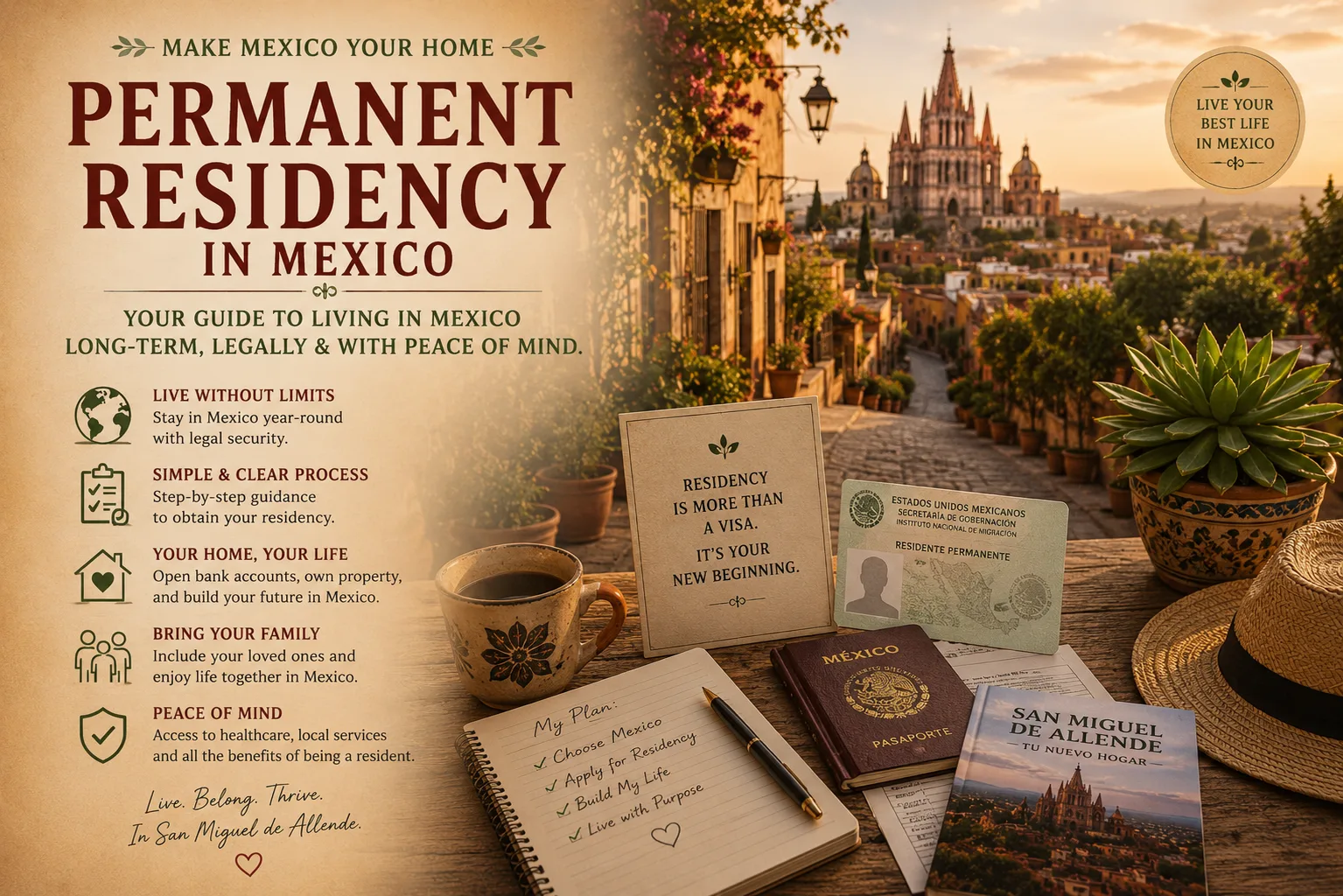
You've probably already done the fun part. You've looked at homes in Centro, compared neighborhoods like Guadiana and San Antonio, and started picturing what daily life in San Miguel de Allende would feel like. Then the practical question hits: before buying, relocating, or settling in for the long term, what do you need to do about residencia permanente in Mexico?
That question matters more than most buyers expect. In San Miguel, residency isn't just an immigration issue. It affects how confidently you plan your move, how you organize your finances, how you enter Mexico after approval, and how cleanly you structure your life once you're no longer just “trying Mexico out.”
For clients targeting a full move, a retirement base, or a serious second home in the city, permanent residency is usually the point where the plan becomes real. The paperwork can feel intimidating at first, but the process is more manageable when you understand which path fits you, which documents matter, and where most applicants get tripped up.
Table of Contents
- The Dream and the Paperwork Why Permanent Residency Matters
- Are You Eligible Key Pathways to Residencia Permanente
- Your Document Checklist for a Successful Application
- Applying Abroad vs In Mexico A Strategic Comparison
- Residency and Real Estate in San Miguel de Allende
- After You Get Your Card Avoiding Common Mistakes
The Dream and the Paperwork Why Permanent Residency Matters
San Miguel has a way of making people commit emotionally before they're ready administratively. One visit becomes three. A seasonal stay turns into a serious property search. A couple who meant to “rent first” starts talking to a notario and comparing floor plans in Ojo de Agua.
That's usually when residencia permanente Mexico stops sounding like legal jargon and starts looking like the foundation of the move.

Why this matters in real life
For retirees, it creates a stable long-term footing. For families, it gives structure to a move that might otherwise stay vague for too long. For property buyers in San Miguel, it often brings clarity. You stop planning around short stays and start planning around living here properly.
Mexico's permanent residence framework sits inside a formal migration system, not an improvised workaround. Official migration data also place that system in a broader international context. For example, 36,067 Mexican nationals were officially resident in Spain as of 01/01/2024, according to Mexico's migration statistics summary. That matters because it shows Mexico's residency rules operate within an established pattern of global mobility, family relocation, and long-term settlement.
San Miguel attracts exactly that kind of mover. Not just tourists. Not just short-term renters. People come here to build routines, own homes, host family, and create a second chapter that lasts.
What permanent residency changes psychologically
Temporary status keeps many people in a wait-and-see mindset. They delay decisions. They postpone home upgrades. They keep one foot out the door.
Permanent residency changes that. It tells you, and the institutions around you, that your life in Mexico is meant to be ongoing.
Practical rule: If you already know San Miguel is more than a trial run, treat residency planning as part of your relocation strategy, not as paperwork you'll “figure out later.”
A lot of people first fall for the city's architecture, walkability, and social life, then realize they need a legal structure to support that dream. If you're still deciding whether the city fits your longer-term plans, this look at the best Mexican city for expats helps frame why San Miguel keeps landing on serious buyers' short list.
Are You Eligible Key Pathways to Residencia Permanente
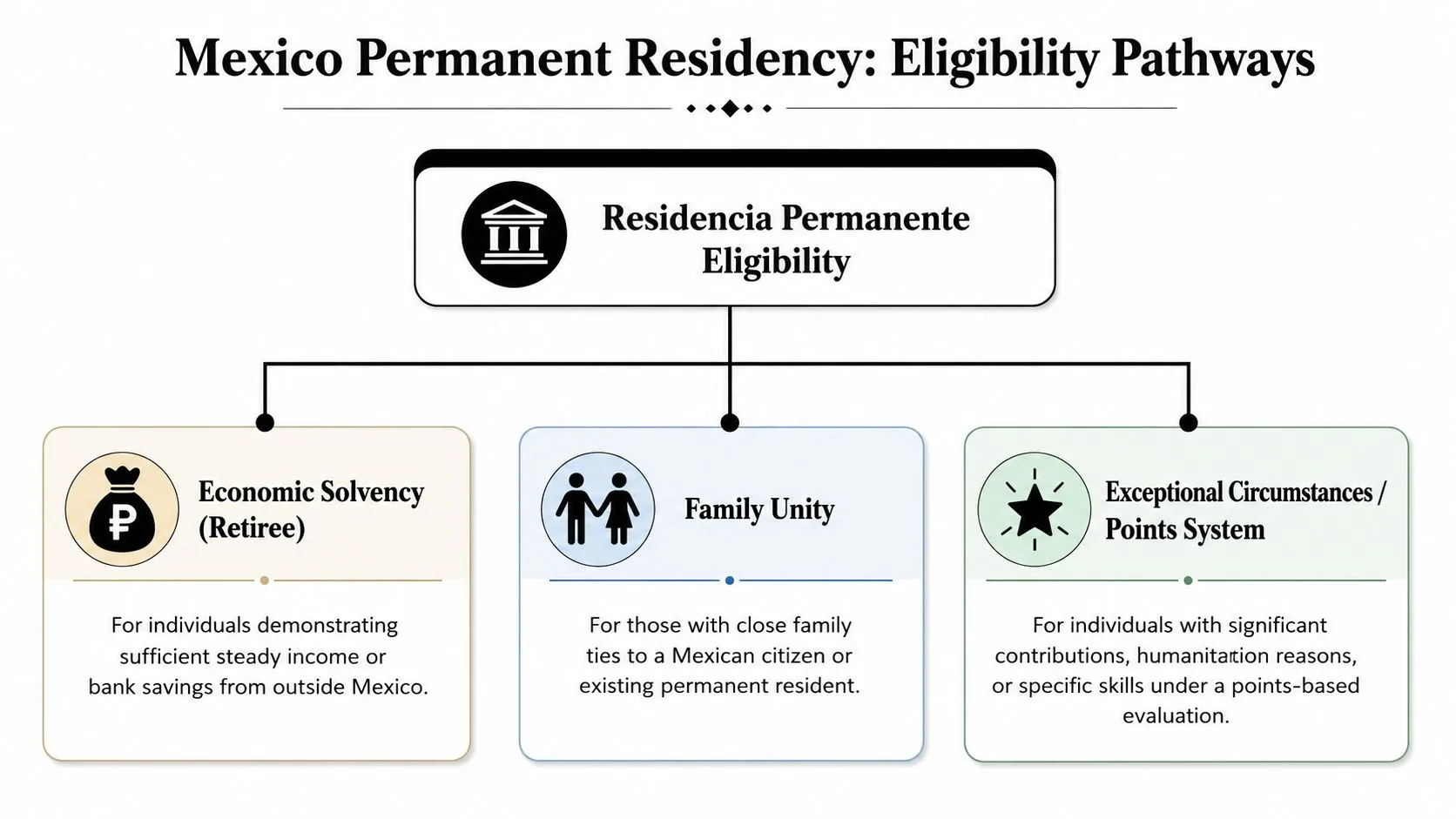
Focus on identifying the single lane that fits your situation. That is how good residency planning starts.
In San Miguel, I see the same pattern with buyers who are ready to make an offer on a home, but have not clarified their immigration strategy. They spend hours reading rules that do not apply to them, then miss the one path that does apply. Permanent residency is much easier to handle once you stop treating it as a general research project and start treating it as a case file.
The routes that matter most in practice
For buyers, retirees, and long-term expats aiming for San Miguel de Allende, most successful applications fall into one of three categories. Economic solvency. Qualifying family ties. Conversion after holding temporary residency.
Each route asks a different question. Can you prove stable income or assets outside Mexico? Can you document a family relationship in a form Mexican authorities will accept? Have you already spent enough time in the system as a temporary resident that permanent status now makes more sense?
That distinction matters because the best strategy for a retired couple buying in Centro is different from the best strategy for someone married to a Mexican national, and both are different from the strategy for a temporary resident who is tired of renewals.
Economic solvency for retirees and financially independent applicants
This is the lane many San Miguel clients pursue first. They are not relying on Mexican employment. They are funding life here through retirement income, investments, rental income, or savings.
The practical issue is not whether you are wealthy on paper. It is whether your file shows orderly, believable financial support. Consulates usually respond better to clean monthly statements, consistent balances, and a clear source of funds than to a pile of disconnected accounts. A high net worth can still produce a weak case if the records are incomplete or hard to follow.
For luxury buyers, there is a common misunderstanding here. Owning expensive property or planning a large purchase does not automatically strengthen a residency case. Immigration officers want proof that your income and assets meet the standard they are applying, not proof that you like high-end real estate. I often tell clients to separate the purchase story from the residency story, then line them up carefully so one does not create confusion for the other.
Family-based eligibility
Family unity can be the cleanest path on paper and one of the messiest in real life.
A valid relationship is only the starting point. Marriage certificates, birth certificates, prior divorce records, name changes, apostilles, and translations all have to fit together. If one document shows a shortened name, an old surname, or a different place of birth format, the file can stall while you fix a problem that could have been caught early.
This route is often strong for spouses, parents, and children in qualifying situations. It is less forgiving of sloppy preparation than applicants expect.
In family-based cases, the relationship may be real, but the application succeeds only if the paperwork proves it cleanly.
Upgrading from temporary to permanent
Some applicants already live in Mexico with temporary status and have reached the point where renewing no longer makes sense. That is common in San Miguel. People rent for a few years, settle into a neighborhood, decide they want to buy, and realize they would rather stop organizing life around expiration dates.
Permanent residency can simplify long-term planning. It gives established residents more confidence to buy, remodel, furnish, and structure their life here without wondering whether another renewal cycle is around the corner. For expats comparing lifestyle markets before settling, this overview of the best places to retire in Mexico is a useful benchmark, especially if San Miguel is competing with coastal areas.
A practical self-check
Use these questions to identify your strongest lane:
- Are you living on retirement or investment income? Your case may fit economic solvency.
- Do you have a qualifying relationship to a Mexican national or permanent resident? Family unity may be the stronger route.
- Are you already in Mexico as a temporary resident and ready to stay long term? An in-country transition may be the better strategy.
- Are you planning to buy property in San Miguel soon? Choose the residency path that matches your timeline, because immigration delays can affect how confidently you move on a purchase.
The goal is not to force yourself into every possible category. The goal is to build the strongest case from the facts you can prove. That is how applications get approved with less stress, fewer surprises, and a clearer path to owning and living in San Miguel full time.
Your Document Checklist for a Successful Application
Strong cases get weakened. Not because the applicant doesn't qualify, but because the file is sloppy.
Good applications are boring. Names match. Dates make sense. Financial records are sequential. Family documents are legalized properly. Photos meet the requested format. Nothing raises a needless question.
Core documents almost every applicant should organize
Start with the obvious items, but don't treat them casually.
- Valid passport: Bring the original and keep a clean copy set ready.
- Application form: Complete the official form carefully and make sure it matches your supporting documents.
- Photos: Follow the requested format exactly. If the instructions specify a certain size or recency, don't improvise.
- Proof of legal stay where relevant: If you're applying outside your country of nationality, this can become important quickly.
Financial evidence needs to be orderly
For economic solvency cases, the presentation matters almost as much as the underlying finances. Officers don't want a puzzle. They want a clear record.
Use this standard:
- Monthly statements in sequence: Don't skip months.
- Readable records: If a statement is hard to interpret, replace it.
- Stable source documentation: Payroll or pension records should line up with the bank history.
- No last-minute patchwork: If one account is weak, don't bury the file in extra pages from unrelated accounts unless the route clearly permits it.
One of the most common reasons applications fail is weak solvency proof. That isn't usually because people lack resources. It's because they submit the wrong proof, incomplete proof, or proof that doesn't track month by month.
Family cases need more than certificates
For family-based applications, the biggest misunderstanding is assuming the relationship document is enough.
Official guidance for this category warns of a recurring failure point: applicants often misunderstand the need to show that the family bond has existed continuously for at least two years before the application. The same guidance notes that success rates can drop to 45% when supporting evidence is insufficient, and about 25% of rejections are tied to foreign documents that lack proper apostilles or certified translations, according to Mexico's family unity visa guidance.
That's the difference between a technically eligible applicant and an approvable one.
What to prepare for family unity files
- Relationship document: Marriage certificate, birth certificate, or other official proof matching the qualifying relationship.
- Evidence the bond is ongoing: If the rule requires continuity, the file should reflect continuity.
- Apostille or legalization where required: Foreign documents usually need to be prepared for Mexican use properly.
- Certified translation if needed: Don't assume a bilingual officer will overlook a formal requirement.
A family case can look obvious at the kitchen table and still fail at the window if the paperwork doesn't prove continuity cleanly.
The checklist I'd use before any appointment
| Item | What to confirm before filing |
|---|---|
| Passport | Name matches all supporting documents |
| Photos | Correct size, recent, and compliant |
| Financial statements | Monthly, complete, and in order |
| Payroll or pension records | Same period covered as the statements |
| Family documents | Official, legible, and properly legalized |
| Translations | Certified where required |
| Copies | Clean copies of everything, organized in the same order as originals |
Common mistakes that waste time
- Name mismatches: Middle names, married names, and abbreviations create avoidable friction.
- Over-explaining instead of documenting: A letter won't fix missing legal evidence.
- Using unofficial translations: If certified translation is required, a helpful bilingual friend doesn't solve the issue.
- Turning up with “almost everything”: In immigration, almost complete often means not complete.
If your file feels messy now, that's good news. You've found the problem before an officer does.
Applying Abroad vs In Mexico A Strategic Comparison
A client flies into Querétaro for a week of house tours in San Miguel, falls in love with a property, then realizes the residency strategy should have been decided before the first showing. That happens more than it should. The filing route affects timing, document prep, travel, and, in practical terms, how confidently you can move from “we're thinking about Mexico” to “we're ready to buy.”
For permanent residency, the key question is not which route sounds easier online. The question is which route fits your current facts. Where your income is documented, what status you hold today, how often you are crossing borders, and whether a property purchase is on the horizon all matter.
The route you choose should match your life now
Applicants still based in the U.S., Canada, or Europe usually do better starting abroad. Their bank statements, pension records, and tax trail are already outside Mexico. A consular filing keeps the case anchored where the evidence already lives, which often makes the review cleaner.
That matters if San Miguel is part of a planned relocation and not just a trial stay. Buyers who want to line up residency before they make an offer tend to feel more in control of the purchase. They know what status they are working with before earnest money, closing schedules, and notario timelines enter the picture.
Applying inside Mexico can be the better move for people who are already here with a status path that supports a change of condition. I usually recommend this route only when the current immigration history is clean and the supporting file is organized exactly as the officer will want to see it. Local presence does not fix weak paperwork.
What changes in practice
The consular route usually gives better clarity earlier in the process. You handle the visa step abroad, enter Mexico with the right sticker in the passport, and then complete the card process in Mexico. For buyers and retirees planning a serious move to San Miguel, that sequence often reduces last-minute surprises.
The in-country route can save a trip abroad, but it asks for more discipline than many applicants expect. The file has to line up with your current legal stay in Mexico, and financial evidence has to be consistent from one month to the next. If there is a gap, mismatch, or unclear source of funds, the process slows down fast.
I see one pattern repeatedly. Applicants choose the Mexico route because they are already here house-hunting, not because their case is better suited for INM. That is how a simple strategy decision turns into weeks of avoidable delay.
How to compare the two options without the usual oversimplified chart
| Issue to weigh | What it means in real life |
|---|---|
| Where your records are strongest | If your income, pension, and banking history are outside Mexico, a consular case is often easier to present cleanly. |
| Your current immigration status | In-country filing only makes sense if your existing status supports the change and your entry history is in order. |
| Your property timeline in San Miguel | If you want residency clarity before making a purchase decision, applying abroad often gives a steadier runway. |
| Travel tolerance | Consular processing may require planning around appointments abroad. In-country filing may reduce travel but can involve more follow-up inside Mexico. |
| Document risk | Cases with uneven statements, name variations, or unclear financial sourcing usually face more friction inside Mexico. |
| Stress level during relocation | Buyers juggling movers, pets, school decisions, and closings usually benefit from choosing the route that creates fewer variables, not fewer forms. |
My practical advice for San Miguel buyers
If you are still in planning mode and your goal is to buy a home in San Miguel within the next year, I usually prefer getting the residency strategy settled before the property search becomes urgent. It is easier to negotiate a purchase when your immigration plan is already clear.
If you are already living in Mexico part time and considering a conversion here, slow down and review the case before filing. I would rather tell a client to wait, clean up the record, and file properly than rush an application because they are in town for a few weeks.
For buyers comparing ownership structures and timing, this guide to buying property in Mexico as an American is a useful next read because it connects residency status to the way a purchase is handled.
Choose the route that matches your documents, your status, and your purchase timeline. That is the strategy that saves money, protects your schedule, and keeps a San Miguel move from getting derailed by paperwork.
Residency and Real Estate in San Miguel de Allende
For San Miguel buyers, permanent residency isn't just an immigration milestone. It often simplifies how the purchase feels and how the ownership structure fits your life.
That matters because the people buying in San Miguel usually aren't looking for a casual transaction. They're buying a primary home, a retirement property, or a base they expect to use seriously over time.
Why San Miguel is different from the coast
San Miguel de Allende is in Mexico's interior. That changes the ownership conversation.
A practical point many foreign buyers miss is that permanent residents in interior markets like San Miguel can hold title directly in their own name, rather than dealing with the coastal trust structure that buyers hear about so often. That distinction is one reason permanent residency carries special weight here. It aligns your immigration status more closely with the way you want to own and use the property.
If you're weighing the legal side of a purchase, this overview of buying property in Mexico as an American gives a useful cross-border perspective.
What this changes during a purchase
In real transactions, permanent residency often helps by reducing uncertainty. You're not trying to build a long-term life on top of a short-term identity. Your notario, advisor, and support team can work from a more settled foundation.
That doesn't replace due diligence. It improves the context around it.
The practical advantages usually show up in areas like:
- Long-term planning: You buy with the assumption that you'll remain legally established.
- Administrative consistency: Your status supports daily life decisions tied to the property.
- Ownership confidence: The purchase feels like part of a settled relocation, not an experiment.
A short walkthrough can help make the connection between residency, lifestyle, and ownership clearer:
What works best on the ground in San Miguel
The buyers who have the smoothest experience usually coordinate three tracks at the same time: immigration timing, property due diligence, and local legal execution.
That means:
- Don't wait until the last minute on residency paperwork if your home search is already serious.
- Use local professionals who know San Miguel's closing rhythm, including how notaries and real estate processes move here.
- Keep your documents consistent across both worlds, especially names, marital status records, and identity documents.
San Miguel rewards preparation. A buyer who handles residency and property planning in parallel usually has more options and fewer avoidable surprises.
After You Get Your Card Avoiding Common Mistakes
Approval feels like the finish line. It isn't. It's the point where a different set of practical habits starts to matter.
The first confusion usually comes at the airport. People assume that once they have the card, travel becomes automatic. It becomes simpler, yes, but only if you use the status correctly.
What changes after approval
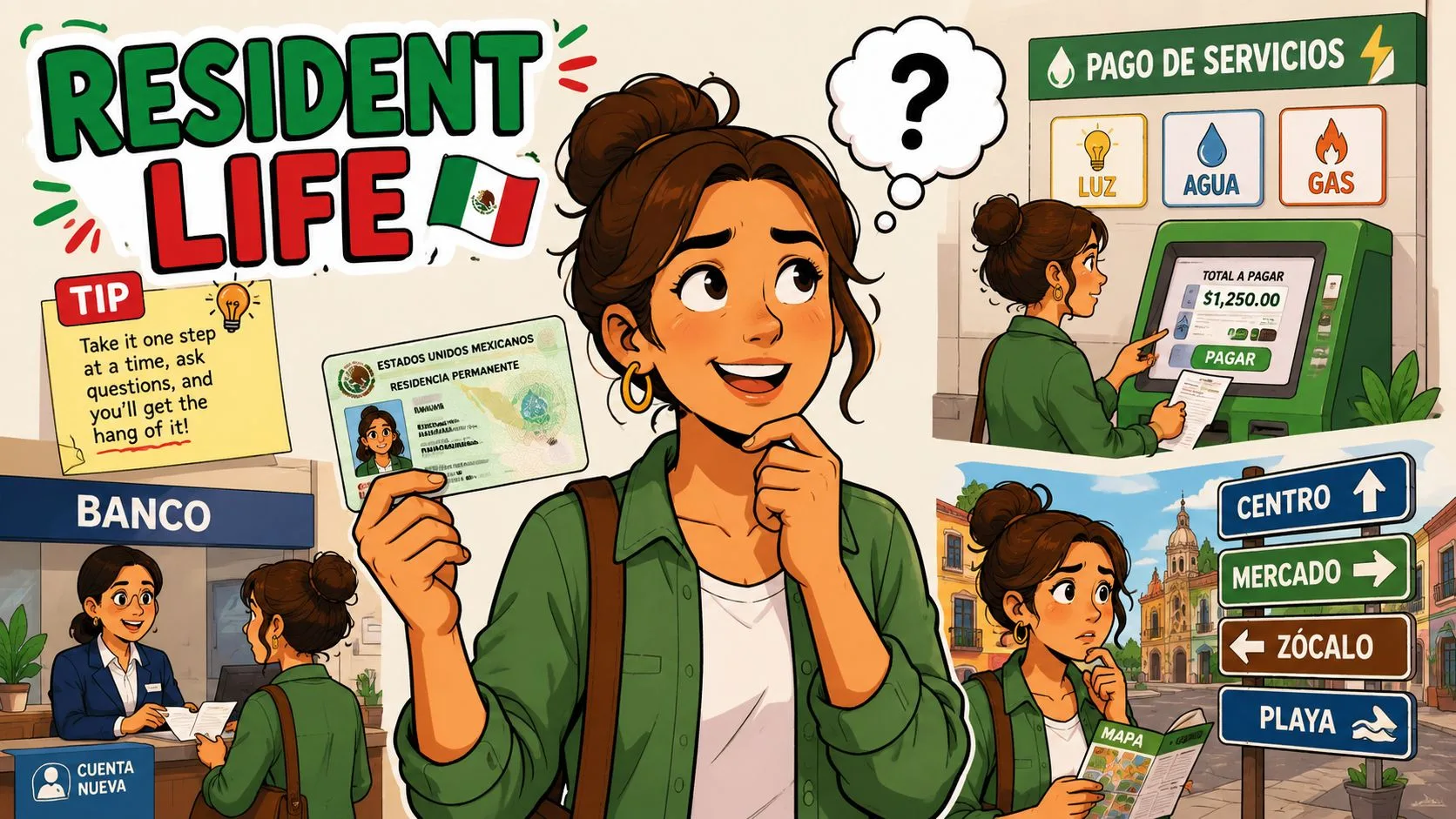
Official guidance says permanent residents should present their residency card when entering Mexico, and the card is indefinite rather than subject to periodic renewal, according to the Mexican consular guidance on permanent resident travel and use.
That's a major practical benefit. You're no longer living by renewal cycles the way temporary residents do.
Mistakes that still create trouble
- Entering casually without using the residency card properly: Your status only helps if you present it as a resident.
- Treating the card like a drawer item: If you travel, know where it is and keep it in usable condition.
- Assuming approval solves every admin issue: Banks, service providers, and local offices still want your documents to match.
- Ignoring old document inconsistencies: Name differences don't become harmless after approval.
Once you have the card, your main job is consistency. Travel consistently as a resident. Identify yourself consistently. Keep your records consistent.
Daily life is easier, but only if you stay organized
The card supports the ordinary parts of living here. Banking, billing, property administration, and longer-term planning all become more straightforward when your residency status is permanent and settled.
That's especially relevant if you're mapping out actual life costs instead of just dreaming about the move. A realistic look at San Miguel de Allende cost of living helps put that day-to-day planning in context.
Final reminders I'd give any client
- Use the right path from the start
- Build a file that answers questions before they're asked
- Take apostilles and translations seriously
- Don't underestimate family-bond evidence
- After approval, travel as a resident, not as a casual visitor
Permanent residency in Mexico works best for people who treat it as part of a full relocation system. Not a stamp. Not a side task. A system.
If you're planning a move, exploring luxury neighborhoods, or trying to align residency timing with a property purchase, Inside San Miguel offers on-the-ground guidance for buyers who want a smarter path into San Miguel de Allende.